Hi, what do you want to do?






Curated OER
Dishing the Dirt Part 1
Students create a soil center on their school grounds. They begin to write in their science journals. They participate in an experiment that helps the community begin their own gardens.

Curated OER
Paper
Students study the process of creating paper. They read and discuss a flier and visit centers in small groups to study Paper Fun, Historical Paper, What Paper Is Made Of, and Homemade Paper. After visiting each center, they share the...

Curated OER
History and Development of the Microscope
In this microscope worksheet, students review how microscopes work and how early scientists figured out how microscopes could help them with their discoveries. This worksheet has 3 fill in the blank and 7 short answer questions.

Curated OER
Hudson Canyon Expedition Let's Bet on Sediments!
Students investigate and analyze the patterns of sedimentation in the Hudson Canyon students observe how heavier particles sink faster than finer particles. They study that submarine landslides (trench slope failure) are

Curated OER
Inside A seed
Students examine the inside of a seed to see the beginnings of a plant. They identify the elements that plants need to grow and survive. They grow their seeds in the classroom.

Curated OER
Ellsworth Kelly
Students examine and discuss artwork by the artist Ellsworth Kelly. They create an abstract picture of two-dimensional geometric shapes using Kid Pix software based on a photograph taken by the student.

Curated OER
Ecosystems
Third graders identify and define an Ecosystem and the basic needs of all animals. They collect pond water in a pickle jar. They observe the organisms that are in the jar to keep an ongoing record of the creatures and their population.

Curated OER
How Does Water Cause Weathering?
Fourth graders explore the weathering process of water on rocks. They observe how water and friction from other rocks cause them to weather. Students discuss examine and discuss various rocks found on the playground, beach, etc. They...

Curated OER
You Are Where You Live
Students explore where insects live and how they have adapted to their environment.

Curated OER
You Are Where You Live
Third graders observe insects in a number of habitats. They recognize which insect characteristics are adaptations to their habitats.

Curated OER
Particulate Matter: The Lorax
Students collect air samples to test it for air pollution. They are read the story The Lorax and discuss the effects of air pollution. They share their observations with the class.

Curated OER
Particulate Matter: The Lorax
Students investigate how dirty air is outside. They read and discuss the book, The Lorax, by Dr. Seuss. They investigate using jars and lids to compare the dirt left each day as they remove the lids. They observe the lids and discuss if...

Curated OER
Show Me Economics
Students identify the penny as a copper coin worth 1 cent. They discover information found on the penny: President Lincoln's face, Lincoln Memorial, date, and location of minting.

Curated OER
Check Out Your Change!
Students examine a coin and write down details about the coin. They use appropriate tools and techniques to gather information. They employ logic to determine differences between the coins.

Curated OER
Missing Macroinvertebrates
Students investigate the concept of a macroinvertebrate. They observe the presence of increases or decreases in population in order to test for factors that contribute to the extinction of a species. Students predict the likelihood of...

Curated OER
Nanaotechnology: Small Science, BIG DEAL!
Students read an article that introduces them to the science and applications of nanotechnology. They discuss the the everyday examples of how nanotechnology is and can be used. In small groups, they observe and make inferences about...

Curated OER
Asexual Reproduction
Students identify the different types of asexual reproduction. In this biology lesson plan, students name organisms that reproduce asexually. They answer an interactive quiz and check their answers afterward.
Science Education Resource Center at Carleton College
Serc: Magnify It
For this lesson, students will view their finger from various viewing distances to discover that their visual field is limited and a magnifying glass is a tool that can help make something look bigger. Students will record what they see...
Science Buddies
Science Buddies: A Magnifying Discovery
Have you ever looked through a magnifying lens? Why do things look bigger when you look at them through the magnifying lens? Even though the object appears to get larger, it really stays the same size. Each lens has its own unique power...
Scholastic
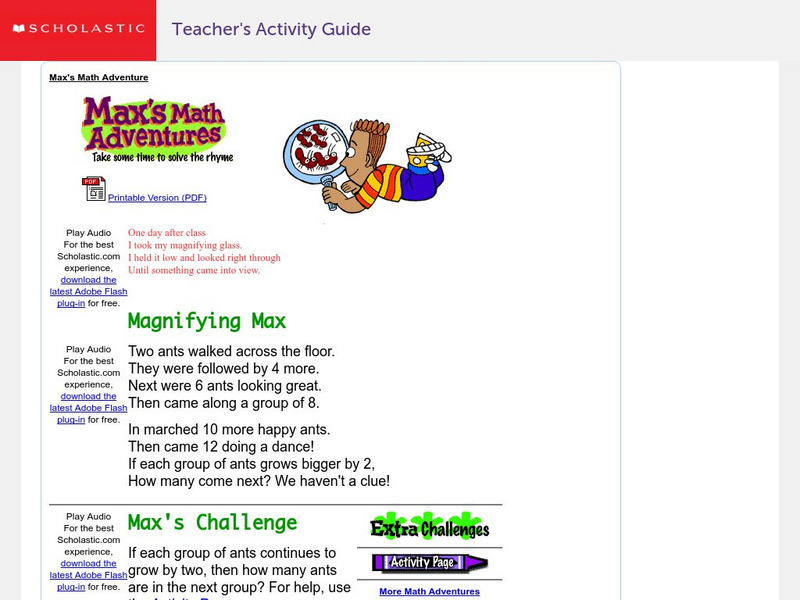
Scholastic: Max's Math Adventures: Magnifying Max
This site has the view through Max's magnifying glass. The ants seem to be walking past him in a pattern, can you help him predict how many ants are coming next? Teachers will like the teacher's guide, activity sheet, and extra challenges.
Tate
Tate Online: Case of the Mysterious Object
A clever and compelling interactive introduction to art appreciation and visual literacy. Parent and child or older child/younger child can pair up to solve an art gallery mystery. The object of this activity is to answer questions about...
TeachEngineering
Teach Engineering: Stations of Light
Student groups rotate through four stations to examine light energy behavior: refraction, magnification, prisms and polarization. They see how a beam of light is refracted (bent) through various transparent mediums. While learning how a...

Optical Society
Optical Society of America: Optics for Kids: Watch Tv Upside Down
An experiment to invert a television image using a magnifying lens. Accompanied by an explanation of what's happening.
Exploratorium
Exploratorium: Make Your Own Telescope
At this site students can make their own telescope and see how it works with this experiment. Out of a light, a pair of glasses, a magnifying glass and wax paper.