Hi, what do you want to do?






Curated OER
The Aurora
Students study the Aurora Borealis lights known commonly as the Northern and Southern lights. In this space science instructional activity, students study pictures of the Auroras for Jupiter and Saturn. Students visit the given website...

Curated OER
So Many Inventions!
Students listen to a teacher read aloud of two books about Chinese inventions. They examine some items that were invented by Chinese inventors such as dominoes, an abacus, a silk scarf, or kite. Next, they determine how a compass works...

Curated OER
The Electromagnetic Crane
Students explore electromagnetism, simple machines and the design process. They use the concepts of electromagnetism to design and build a device that uses an electromagnet, a pulley and a lever using the provided Engineering Design...

Curated OER
Shh, Do Not Wake the Baby!
Students explore the /sh/ digraph and how it is a blending of the /s/ and /h/ sounds. They use letterbox manipulatives to spell 'sh' words and identify /sh/ words as they read a story. They 'fish' for 'sh' words to practice writing at...

Curated OER
The Invention of the Telephone
Young scholars study the history of the telephone and its inventor. In this communications lesson plan students complete a tuning fork experiment to further demonstrate how sound is produced.

Curated OER
Visiting the Arctic Circle
Students familiarize themselves with the Arctic Circle by locating it on a globe and wall map. They discuss they climate in the North Pole and the reasons for its low temperatures. They compare and contrast the climates of the Arctic...

Curated OER
Fishy Fun
Students review the correspondent /ai/ = long a and break into groups of five. They use a fishing pole with a magnet attached to "fish" for words that contain the /ai/ sound in it. If they catch a word that does not contain the /ai/...

Curated OER
Using Magnetotactic Bacteria to Study Natural Selection
Pupils demonstrate that living organisms may possess incredible adaptations which enable them to survive. They observe bacteria that are able to orient themselves using the Earth's magnetic field and formulate a hypothesis as to how this...

Curated OER
Timing An X-ray Pulsar
Students use X-ray data to identify an object as a rotating neutron star, and determine its period of rotation. They use XTE observations of the Crab Pulsar to determine the period of the light intensity, interpret this period as the...

Curated OER
The Sundial
Learners explain the design, principle and orientation of a sundial, the type with a gnomon pointing towards the pole of the heavens. They construct a model sundial from paper.

Curated OER
Go Fish
Students recognize the short vowel a in written and spoken language. Through matching activities, they discriminate the short vowel /a/ from other vowel phonemes. Students associate the phoneme with its letter representation in a story...


Curated OER
Cracking Sticks
Students explore the letter /k/ in this lesson, and identify the /k/ sound in words. They read a tongue twister emphasizing the /k/ sound, and discuss that two letters make the /k/ sound - c and k. They then practice writing k's and...

Curated OER
Down by the Bay
Students listen to teacher read books about fish and participate in activities in order to explore how to identify bluefish. They count and graph the numbers of fish they find in simulated fishing activities.

Beacon Learning Center
Catching a Balanced Diet
First graders explore the importance of balanced meals. They play a fishing game to help them select foods to make up a balanced meal.

Curated OER
Compass Building Instructions
Students build their own compass following a given procedure. In this technology lesson, students explain how a compass is used in navigation. They trace the history of its development.

Curated OER
Galvanometers
Students construct their own galvanometer. For this physics lesson, students explain how it is used to detect electric current. They conduct an experiment to measure how much electricity flows through the circuit.

Curated OER
Using 4 main directions in a classroom
Students use the four directions of a compass rose to locate classroom features. In this directions lesson plan, students locate the features by identifying directions.

Curated OER
The Invention of Faraday Cage
Students demonstrate how Faraday's cage work by building their own electroscope. In this physics lesson, students explain how Faraday's cage work. They cite several applications of this principle in the real world.
Science Education Resource Center at Carleton College
Serc: Investigating Magnetism: What Are Magnets and Why Do They Attract or Repel
In this magnetism activity, students investigate why magnets attract certain objects and how the magnets can attract or repel each other by participating in a classroom activity. Students will observe, question, and investigate how the...
Science Education Resource Center at Carleton College
Serc: Mother Nature's Funnest Play Things: Magnets
In this experiment, learners will investigate magnets and how they work. They will understand that two like poles "repel" while opposite poles "attract." They will also observe how a natural force is created by two magnets and answer the...
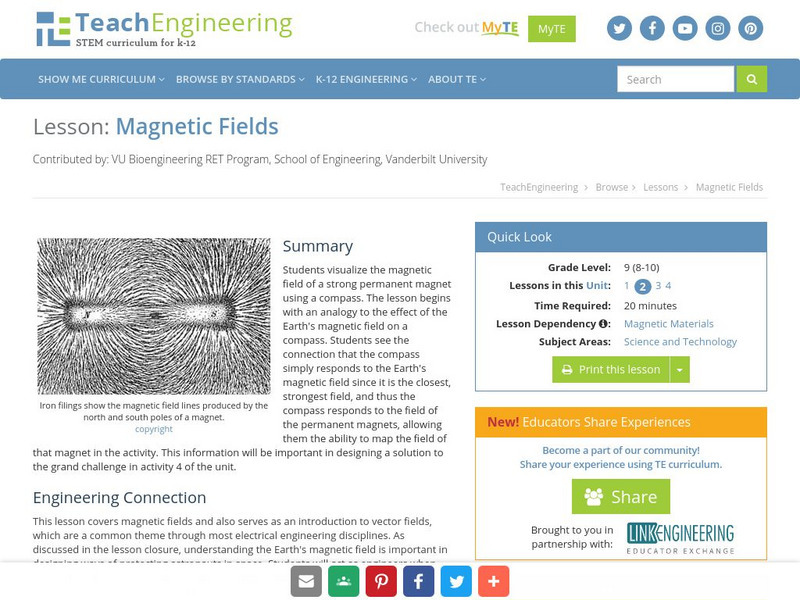
TeachEngineering
Teach Engineering: Magnetic Fields
Students visualize the magnetic field of a strong permanent magnet using a compass. The instructional activity begins with an analogy to the effect of the Earth's magnetic field on a compass. Students see the connection that the compass...

PBS
Pbs Learning Media: Magnets!
Learn about magnets, magnetic forces, and how magnets make things move.