Hi, what do you want to do?





Science Education Resource Center at Carleton College
Serc: Investigating Magnetism: What Are Magnets and Why Do They Attract or Repel
In this magnetism activity, young scholars investigate why magnets attract certain objects and how the magnets can attract or repel each other by participating in a classroom activity. Students will observe, question, and investigate how...

Georgia Department of Education
Ga Virtual Learning: Forces on Moving Charges in Magnetic Fields
In this interactive tutorial students will explore magnetic force. Students will observe interactions of magnets and study magnetic fields. The source of magnetic properties is believed to be moving charge. Since moving charge produces...
CK-12 Foundation
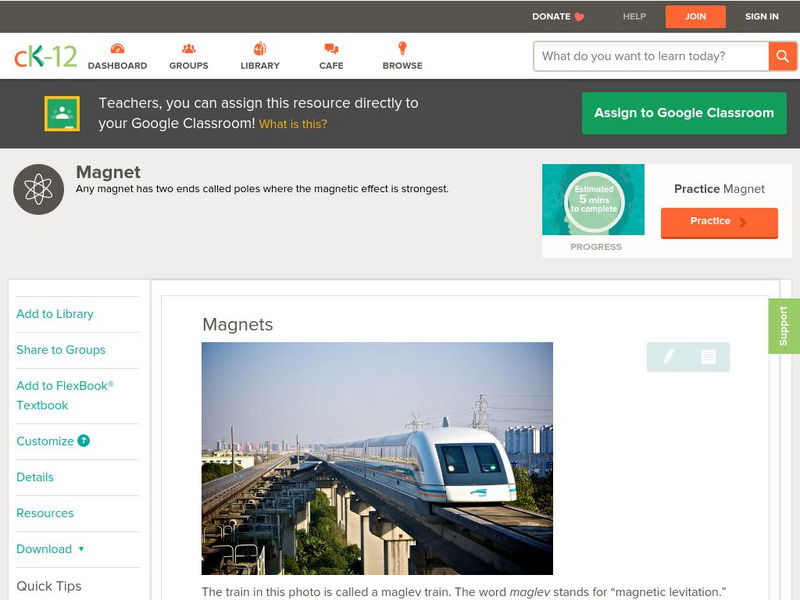
Ck 12: Physical Science: Magnets
A module that uses pictures, videos, reading passages, and review question to go over what a magnet and magnetic pole are, and how magnetic force is related to magnetic field. This site may require free registration to access all...
Other
Integrated Magnetics: Magnet Frequently Asked Questions
Answers to many Frequently Asked Questions on magnets and magnetism.
Science Education Resource Center at Carleton College
Serc: Mother Nature's Funnest Play Things: Magnets
In this experiment, students will investigate magnets and how they work. They will understand that two like poles "repel" while opposite poles "attract." They will also observe how a natural force is created by two magnets and answer the...
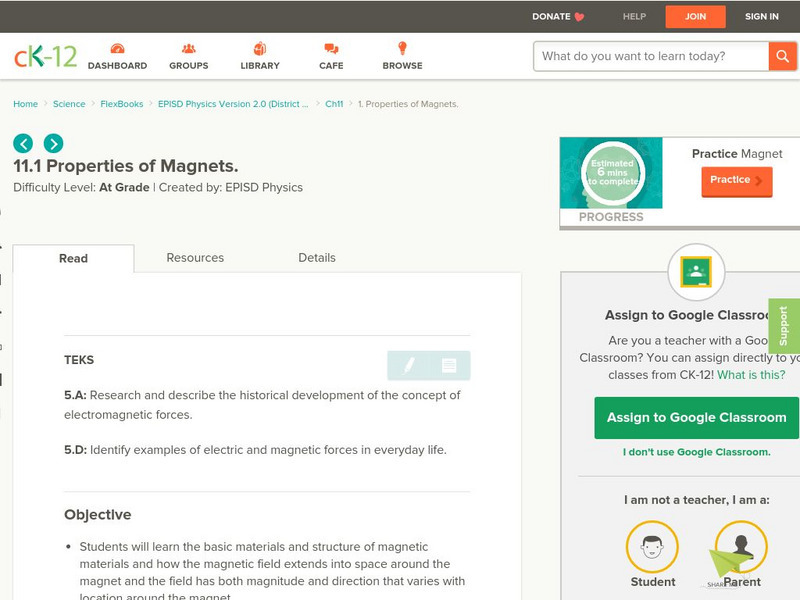
CK-12 Foundation
Ck 12: Properties of Magnets
[Free Registration/Login may be required to access all resource tools.] Looks at magnetic materials and the structure and breadth of a magnetic field. The concept of magnetic domains is explained, and how they behave in a magnetic field....
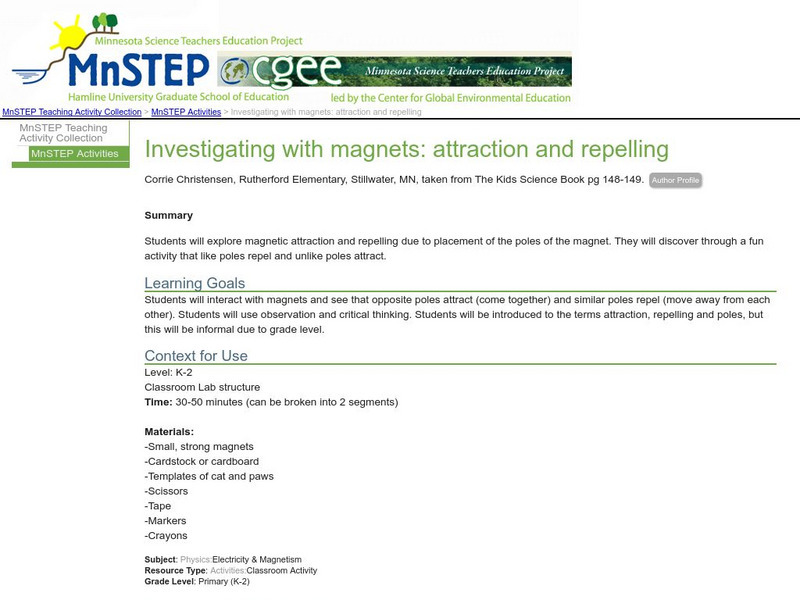
Science Education Resource Center at Carleton College
Serc: Investigating With Magnets: Attraction and Repelling
In this fun lab activity, students will learn about the attraction and repulsion of magnets. Students will discover that like poles repel while unlike poles attract.
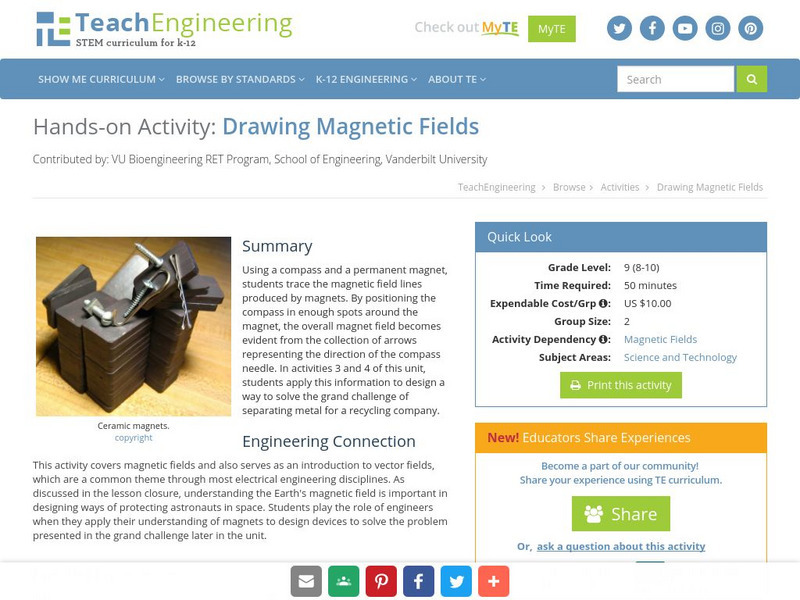
TeachEngineering
Teach Engineering: Drawing Magnetic Fields
Students use a compass and a permanent magnet to trace the magnetic field lines produced by the magnet. By positioning the compass in enough spots around the magnet, the overall magnet field will be evident from the collection of arrows...
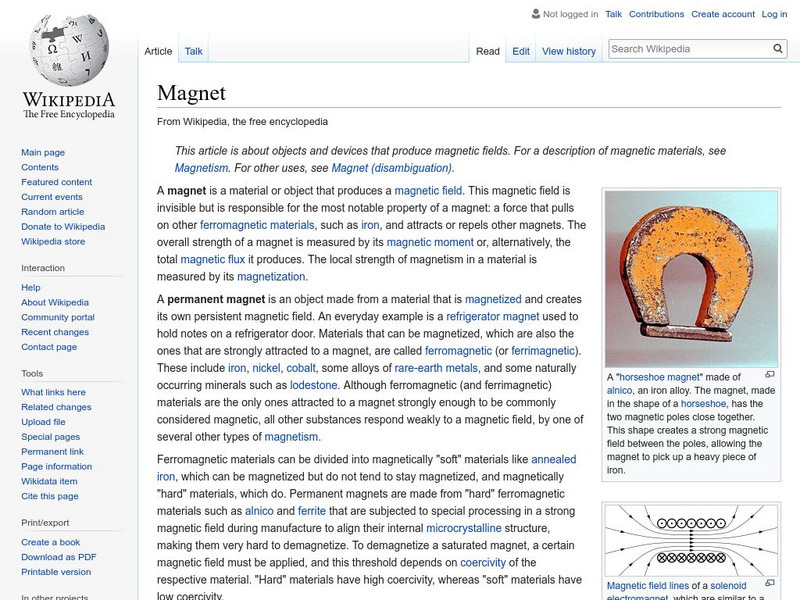
Wikimedia
Wikipedia: Magnet
Wikipedia.com provides an excellent introductory site on magnets. Including basic information describing different types of magnets and their characteristics.
Science Education Resource Center at Carleton College
Serc: Exploring Magnetism: Investigating the Forces of Magnets
Students describe and create an experiment to prove that like poles of magnets repel each other while opposite poles attract. Using the experiment, they use the data to support the claim that the repelling force is stronger than the...

Alabama Learning Exchange
Alex: The Magnetic Maglev Train
This is a hands-on, inquiry-based lesson that includes three magnetic stations in which students or small groups rotate in order to test and discover different magnetic properties and then use their knowledge to build a Maglev Train...
CK-12 Foundation
Ck 12: Plix: Compass Poles: Earth's Magnetic Field
[Free Registration/Login Required] A site containing an animation of a compass and a short quiz over the topic.
E-learning for Kids
E Learning for Kids: Science: Alexandrian Lighthouse: What Are Properties of Magnets?
Learn about the properties of magnets, what metals are attracted to them, what magnetic poles do, and about repulsion and attraction.

ClassFlow
Class Flow: Magnets
[Free Registration/Login Required] This flipchart helps students differentiate between and identify objects that are attracted by a magnet and those that are not attracted by a magnet.
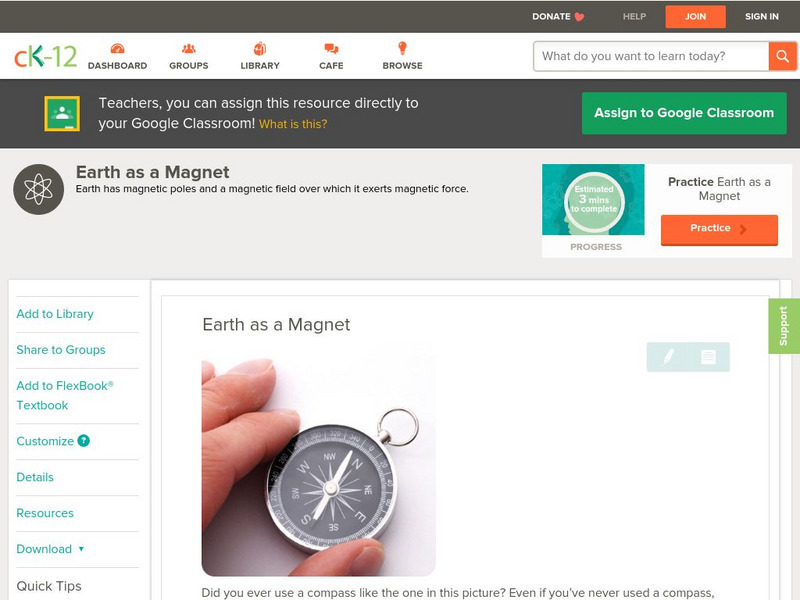
CK-12 Foundation
Ck 12: Physical Science: Earth as a Magnet
[Free Registration/Login may be required to access all resource tools.] Explains how Earth is a magnet, its geographic and magnetic poles, and its magnetic field.
Other
Stanford University: Probing What You Can't See
Students will investigate magnetic forces and poles using a refrigerator magnet.
University of New South Wales (Australia)
University of New South Wales: Einstein Light
Einstein Light highlights the Theory of Special Relativity and related topics. Learn how Galileo, Maxwell, and Einstein contributed to our knowledge of relativity, electricity, magnetism, and time by watching fun, interactive modules.
Read Works
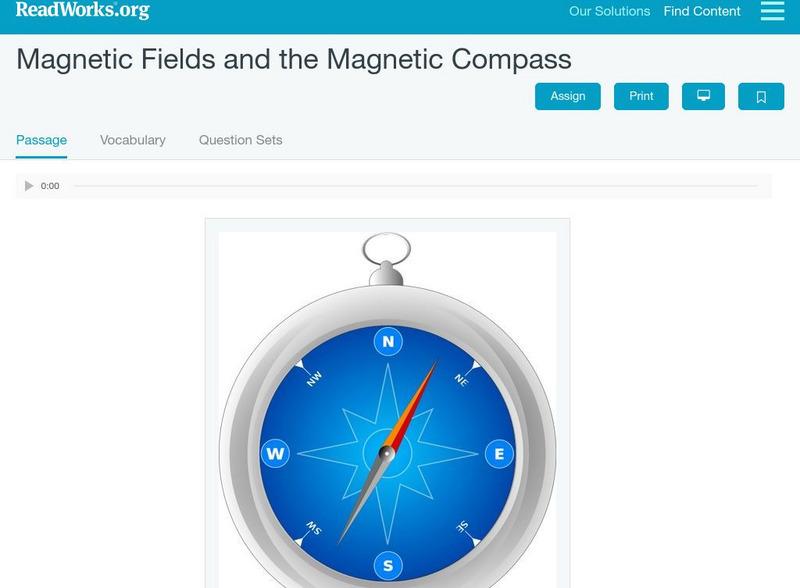
Read Works: Electric and Magnetic Forces and the Modern Day Compass
[Free Registration/Login Required] An informational text about how a compass works using electromagnetic force. A question sheet is available to help students build skills in reading comprehension.
Other
Space Weather Center: Our Protective Shield
The Earth's magnetosphere helps shield us from cosmic and solar radiation. This segment offers a great explanation of this abstract concept along with numerous images and diagrams. An interactive game is provided as well.
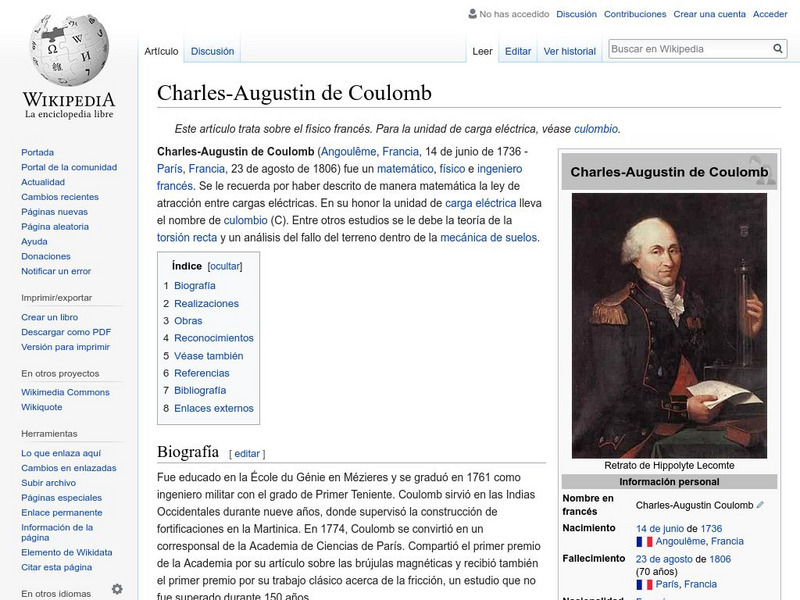
Wikimedia
Wikipedia: Charles Augustin De Coulomb
Spanish-language site lets students discover the life and work of this physicist and engineer, who is known for his studies of electric charges.
Other
Family Education Network: Heavy Metal
An engaging site that provides interesting facts about magnets. Solve a problem and discover how to create a compass.
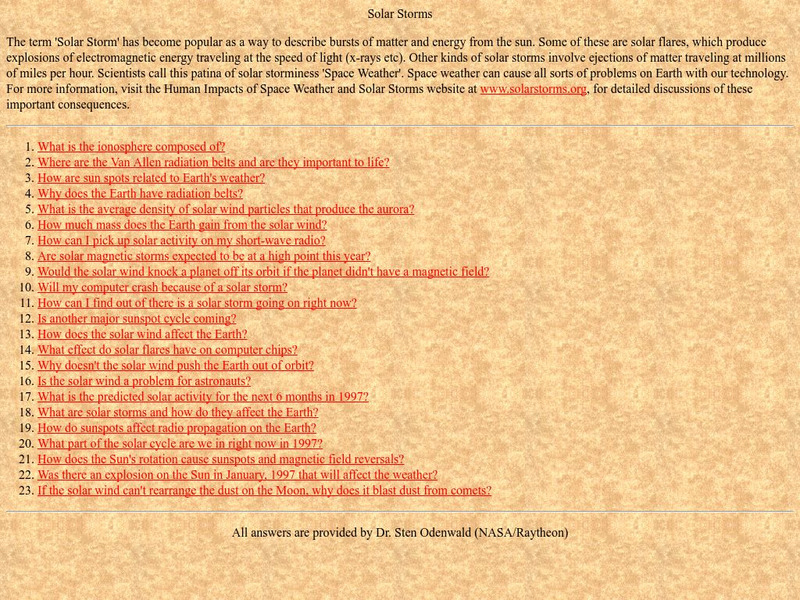
NASA
Nasa: Image Science Center: Ask the Space Scientist Earth
Site from NASA contains a collection of 91 questions pertaining to the Earth's atmosphere, magnetic field, ionosphere, rotation and origin of life.
Curated OER
Science Kids: Science Images: Aurora Borealis, Northern Lights
The aurora borealis (also known as the northern lights) is a spectacular light display that can be seen at night in regions near the North Pole (auroras can also be seen near the South Pole). Auroras occur because of charged particles...