Hi, what do you want to do?






NASA
Build a Light Detector Inspired by Space Communications
Data can travel on light waves ... who knew!?! Pupils explore the idea of using light waves to transmit data through space. They then build their own boards that detect a specific wavelength of light.

Exploratorium
Bridge Light
An illuminating activity demonstrates how interference of light waves creates a pattern. Using Plexiglas™ and construction paper, participants see rainbows appear as they twist or press against the plastic plates. After the activity, you...

Exploratorium
Diffraction
Kindle knowledge of how light travels by using this activity in your physical science curriculum. By setting up a candle flame or flashlight bulb and viewing it through a slit, observers of light see evidence of its wave characteristic....

Exploratorium
Corner Reflector
If you set up a triad of mirrors into a corner figuration, they act as a kaleidoscope, bouncing light waves back and forth indefinitely, changing the light that your eyes perceive. Although the materials required are very specific and...

IOP Institute of Physics
Physics in Concert
What do physicists and musicians have in common? A lot more than you might think. After first viewing a slide show presentation and completing a series of skills practice worksheets on the physics of light, sound, and...

International Technology Education Association
Singin' the Black and Blues
How does the color of the sky change from blue to reds and oranges to black? An illuminating lesson explains how light travels through different mediums using the sun's light as an example. By examining diagrams and illustrations, pupils...

Teach Engineering
Catching the Perfect SAR Waves!
Zero in on an interesting resource involving radar technology. Groups construct a radar sensing unit and learn to calibrate the system. Using the radar system and the Pythagorean Theorem, they calculate distances between objects.

Exploratorium
Cylindrical Mirror
Using flexible mirror-like paper, physical scientists experiment with images produced by curving it and looking into its reflective surface. They find that concave mirrors cause reflected light waves to cross and actually flip the image...

International Technology Education Association
Make a Pinhole Camera
With a little light and a lot of time, you can create some amazing images. This NASA-related task instructs pupils to build a pinhole camera. The lesson provides suggestions for different pictures to try with the pinhole camera...

Teach Engineering
Beating the Motion Sensor
I bet I can cross the room without having the lights come on. Class members set up an experiment in which they try to determine what materials will mask motion detected by a sensor. Groups predict how materials will interact with...

Teach Engineering
Quantum Dots and Colors
Introduce teams to quantum dot solutions with an activity that has them expose solutions to a blacklight, observe the colors, and take measurements. Groups graph the data and analyze the dependence between particle size and...

NASA
Speaking in Phases
Hear from deep space. Pupils learn how satellites transfer information back to Earth. They learn about three different ways to modulate radio waves and how a satellite sends information with only 0s and 1s. Using sound, class members...

Exploratorium
Bone Stress
Lighten up a bit with this activity! Use an old-fashioned overhead projector to shine light through a pair of polarizing filters. Place a stressed plastic object in between and display the colors of light waves revealed! Rotate the...

Exploratorium
Moire Patterns
By overlapping combs and window screening and by looking at a printed set of consecutively larger circles, learners observe Moire patterns, which provide a visual of what happens during wave interference.

Exploratorium
Polarized Sunglasses
Reflected waves of light move within a plane, and because of this, polarizing materials can reduce the glare our eyes see. This resource explains how to set up a demonstration of this effect. Consider it for use in your physical science...

Exploratorium
Vocal Visualizer
Make sound visible with an activity that provides directions for how to build a vocal visualizer meant to create light patterns. Making noise into the visualizer causes a mirror to vibrate, reflecting a laser beam, and creating...

Exploratorium
Hot Spot
Not only does a concave mirror focus light waves, it can also concentrate infrared radiation into a hot spot. If you have a small electric heater and such a mirror, demonstrate this for your physical science class.

Exploratorium
A Splash of Color - Is Pure Water Colorless?
What makes the ocean blue but a glass of ocean water nearly colorless? Investigators prepare tubes of water to examine the color of water. Scholars discover the relationship between light absorption, color variations, and water depth as...

Curated OER
Bronx Cheer Bulb
If you chew or make a "raspberry" while viewing an LED light source, the light will appear to wiggle or flicker. It is not because of the light itself, but because of the vibration of your skull! Have your physics class give this a try...

Exploratorium
Bubble Tray
Create jumbo bubbles and use them to teach about surface tension or interference, perfect for a physical science lesson on light or molecular attraction.

National Nanotechnology Infrastructure Network
Powers of Ten with the Blue Morpho Butterfly
Explore the powers of ten while examining a Blue Morpho butterfly wing. Learners discover there is a lot more than meets the eye when one looks close enough.

It's About Time
AC and DC Currents
An informative physics lesson includes two teacher demonstrations, one on AC currents and the other on DC currents, allowing pupils to take notes while watching. The resource includes questions to assign as homework or...

University of Waikato
Māui and the Sun
Using a Maori legend, How Maui Tamed the Sun, youngsters are introduced to the importance of sunlight to civilization. Teach them about nuclear fusion that occurs to produce the solar energy we later receive on Earth as...
Exploratorium
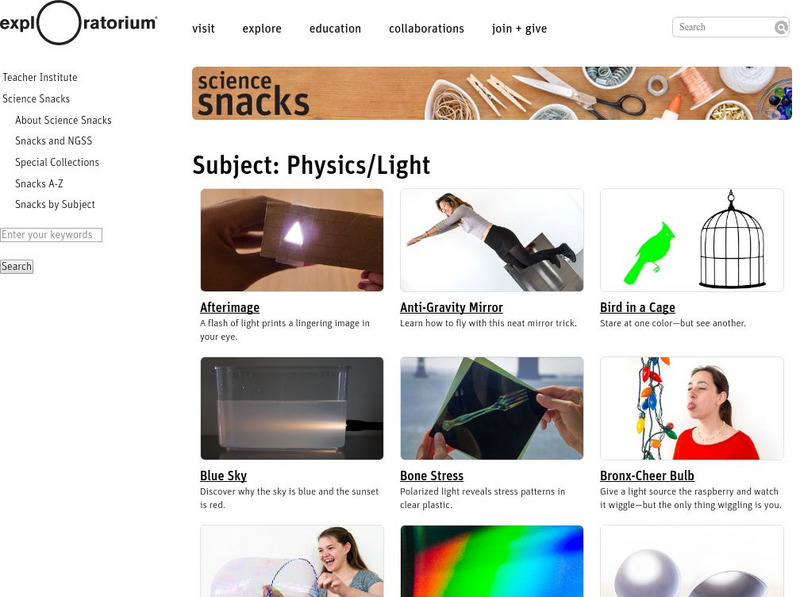
Exploratorium: Science Snacks: Physics/light
Here is a large collection of simple science class activities for understanding the physics of light.