Hi, what do you want to do?






NASA
Taking Apart the Light
Break down light into spectra. Scholars learn how atoms emit and absorb photons and come to understand how this process allows scientists to identify different atoms based on either absorption lines or emission lines. Learners then...

IOP Institute of Physics
Physics in Concert
What do physicists and musicians have in common? A lot more than you might think. After first viewing a slide show presentation and completing a series of skills practice worksheets on the physics of light, sound, and...

Leicestershire County Council
Developing Handwriting Skills for Individuals with Autistic Spectrum Disorder
Here is a resource packed with strategies to help individuals with ASD improve their handwriting skills. Intended for the teacher or specialist, the resource provides background information on reasons learners with ASD have difficulty...

Howard Hughes Medical Institute
Niche Partitioning Activity
Dinnertime on the African savanna is a highly choreographed event! Introduce young ecologists to the concept of niche partitioning through a hands-on activity. Pupils research animal behaviors and use data to develop an understanding of...

Exploratorium
A Splash of Color - Is Pure Water Colorless?
What makes the ocean blue but a glass of ocean water nearly colorless? Investigators prepare tubes of water to examine the color of water. Scholars discover the relationship between light absorption, color variations, and water depth as...

University of Waikato
Māui and the Sun
Using a Maori legend, How Maui Tamed the Sun, youngsters are introduced to the importance of sunlight to civilization. Teach them about nuclear fusion that occurs to produce the solar energy we later receive on Earth as...

Teach Engineering
Thirsty for Gold
In the last portion of the six-part unit, teams perform an experiment with gold nanoparticles to determine which sport drink has the most electrolytes. The nanoparticles are used as chemical sensors and fluoresce in different wavelengths...

It's About Time
Identifying Matter
High schoolers test wood splints that have been soaked in mystery solutions to identify the different colors it produces when lit. The lesson concludes with a reading passage and analysis questions.

Cornell University
Building Spectroscope
Given specific materials, scholars follow a set of instructions to build and calibrate their very own spectroscopes. After construction, they test the scope for accuracy and make modifications where necessary.
Exploratorium
Exploratorium: Science Snacks: Physics/light
Here is a large collection of simple science class activities for understanding the physics of light.
TeachEngineering
Teach Engineering: Exploring Light: Absorb, Reflect, Transmit or Refract?
In a hands-on way, students explore light's properties of absorption, reflection, transmission and refraction through various experimental stations within the classroom. To understand absorption, reflection and transmission, they shine...

TeachEngineering
Teach Engineering: The Visual Spectrum
In this activity, students make simple spectroscopes (prisms) to look at different light sources. The spectroscopes allow students to see differing spectral distributions of different light sources.
Utah Education Network
Uen: I'll Build You a Rainbow
In these three activities, students explore the colors of the spectrum in white light.
TeachEngineering
Teach Engineering: Designing a Spectroscopy Mission
Students find and calculate the angle that light is transmitted through a holographic diffraction grating using trigonometry. After finding this angle, student teams design and build their own spectrographs, researching and designing a...
TeachEngineering
Teach Engineering: Engineering Your Own Spectrograph
Students use simple materials to design an open spectrograph so they can calculate the angle light is bent when it passes through a holographic diffraction grating. A holographic diffraction grating acts like a prism, showing the visual...

Optical Society
Optical Society of America: Optics for Kids: Release the Rainbow
A simple activity to demonstrate how light separates into colors when it passes through water acting as a prism.
TeachEngineering
Teach Engineering: Building a Fancy Spectrograph
Students create and decorate their own spectrographs using simple materials and holographic diffraction gratings. A holographic diffraction grating acts like a prism, showing the visual components of light. After building the...
TeachEngineering
Teach Engineering: Rgb to Hex Conversion
Students practice converting between RGB and hexadecimal (hex) formats. They learn about mixing primary colors in order to get the full spectrum of colors and how to average pixel values.
TeachEngineering
Teach Engineering: Thirsty for Gold
Student teams conduct an experiment that uses gold nanoparticles as sensors of chemical agents to determine which of four sports drinks has the most electrolytes. In this way, students are introduced to gold nanoparticles and their...

Science Made Simple
Science Made Simple: Why Is the Sky Blue?
This website has three different projects from which to choose on the topic of why the sky is blue. Also, you can scroll up to learn more about why the sky is blue.
TeachEngineering
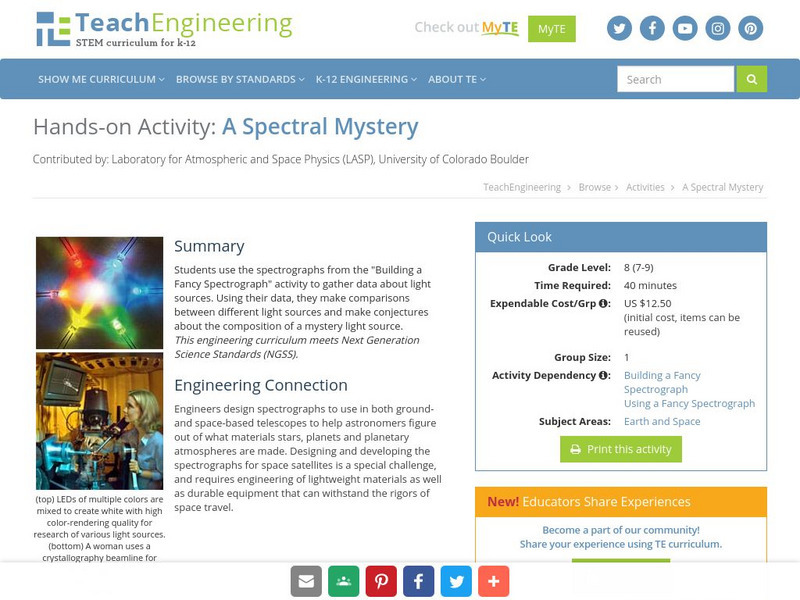
Teach Engineering: A Spectral Mystery
Students use the spectrograph from the "Building a Fancy Spectrograph" activity to gather data about light sources. Using their data, they make comparisons between different light sources and make conjectures about the composition of a...
TeachEngineering
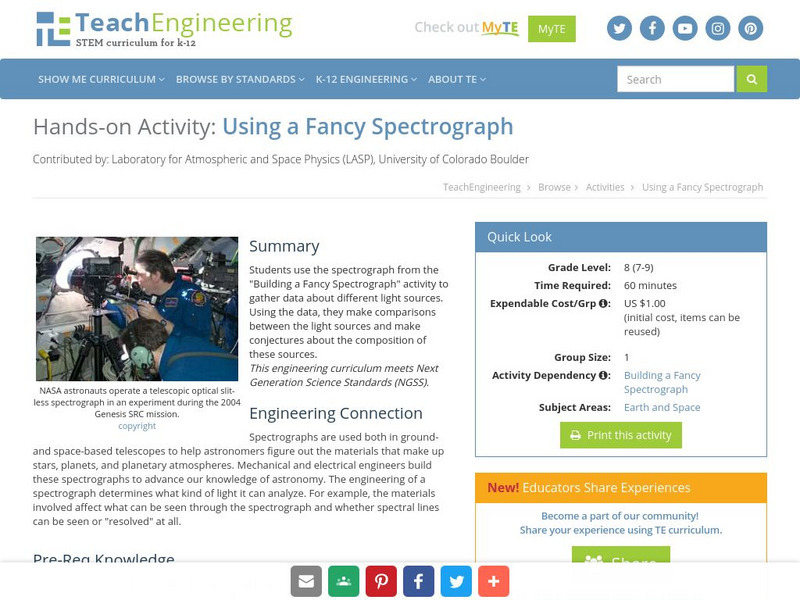
Teach Engineering: Using a Fancy Spectrograph
Students use the spectrograph from the "Building a Fancy Spectrograph" activity to gather data about different light sources. Using the data, they make comparisons between the light sources and make conjectures about the composition of...

Exploratorium
Exploratorium: Science Snacks: Cd Spectroscope
Analyze light by creating a CD spectroscope in this activity. See the whole spectrum of light with the spectroscope.
Exploratorium
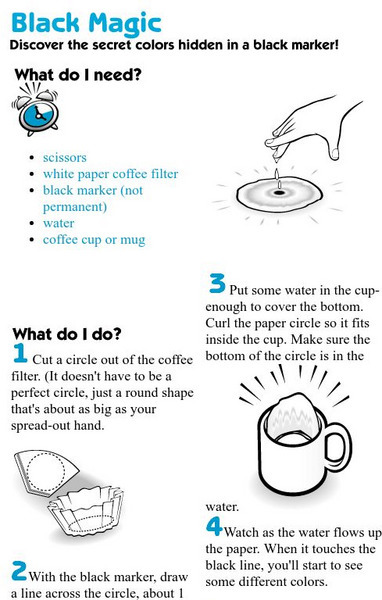
Exploratorium: Black Magic
A great and easy-to-do activity where students separate the colors in a black marker and develop an understanding that black is a composite of other colors.