Hi, what do you want to do?






CK-12 Foundation
Ck 12: Life Science: 2.20 Cell Cycle
Understand the life cycle of a eukaryotic cell.
CK-12 Foundation
Ck 12: Life Science: 9.18 Importance of Insects
Understand the ecological importance of insects, and why they are important to humans.
CK-12 Foundation
Ck 12: Life Science: 3.6 Rna
Learn about the structure and function of RNA in the body.
CK-12 Foundation
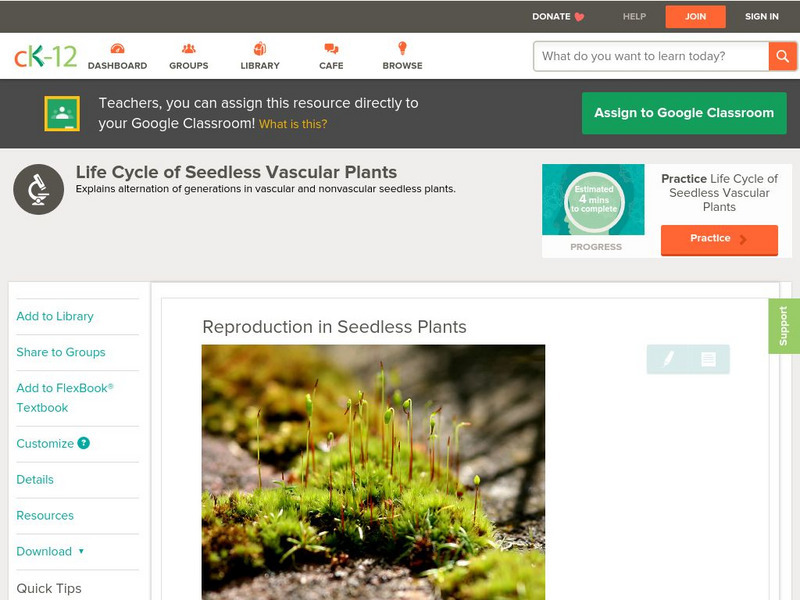
Ck 12: Life Science: Reproduction in Seedless Plants
[Free Registration/Login may be required to access all resource tools.] Seedless plants can reproduce asexually or sexually. Some seedless plants, like hornworts and liverworts, can reproduce asexually through fragmentation. When a small...

University of Michigan
Michigan Sea Grant: Teaching Great Lakes Science: Fish Identification
In this lesson, students examine the physical characteristics of fish that live in the Great Lakes and identify common features that help species to survive in that environment. Downloadable resources include a fish poster, fish family...
PBS
Pbs Learning Media: Newton's Triple Play: Baseball Science
In this lesson, students watch a video and animations that relate Isaac Newton's three laws of motion to baseball and apply what they've learned about these laws to another sport or other real-life situation.
Exploratorium
Exploratorium: Microscope Imaging Station: Classroom Explorations
These microscope activities provide students with lots to explore. Activities include the characteristics of living things, math in science, cell biology, genetics, physiology, and mitosis.

TED Talks
Ted: Ted Ed: Could Comets Be the Source of Life on Earth?
While comets were historically thought to be ill omens of war and famine, recent science has revealed that these celestial wonders actually contain amino acids, the building blocks of life on Earth. Justin Dowd explores the implications...
Indiana University
Ensi: The Great Fossil Find Lesson Plan
Students hear a story as they "find" bones that you have put in an envelope for them. Their job is to begin assembling the bones as best they can. The students will invariably come up with different configurations--just like scientists...
Better Lesson
Better Lesson: Counting Clams a Tidal Flat Adventure
Mathematics has an important role in the real world outside of school. For this lesson, students will learn how scientists use multiplication to estimate animal populations. Included in the lesson are a detailed plan, background...
BioEd Online
Bio Ed Online: Biology Teacher Resources
This in-depth site provides middle and high school science teachers with a wide array of free instructional resources, such as slide sets, streaming video presentations, and laboratory activities. Information is provided that is...
PBS
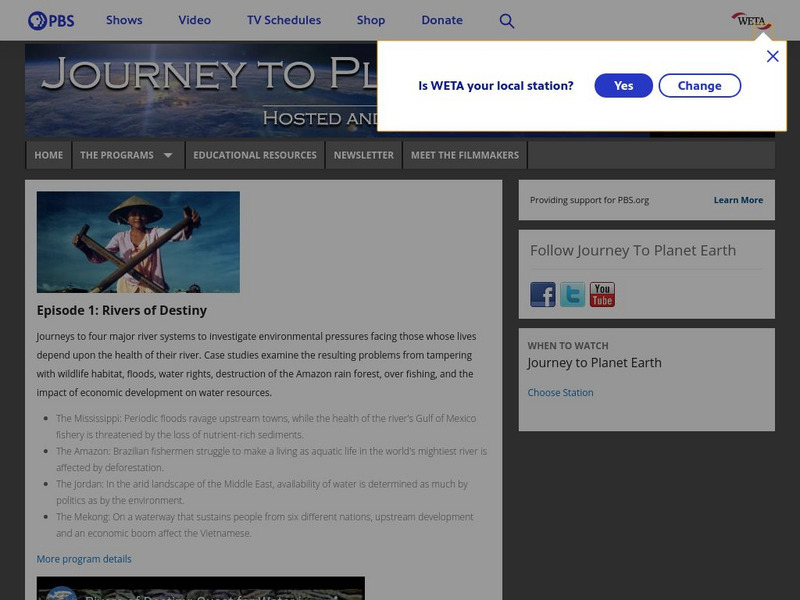
Pbs Teachers: Rivers of Destiny
This site explains the importance of rivers in the natural balance of life on Earth, and describes what happens when people begin to tamper with rivers. This will also help students identify options for dealing with the outcomes of human...
NASA
Nasa: Planets in a Bottle
In this simple lesson, students grow yeast to learn how the climates on each of the nine planets would affect life.

Alabama Learning Exchange
Alex: Angiosperms Plants With Flowers
By using a hands-on activity,the learners will learn about the Life Cycle of the Angiosperms. Students will learn about the female and male parts of a flower. This would be a great activity to follow a unit on reproduction in flowering...

Alabama Learning Exchange
Alex: Biodiversity: Local Ecosystem & Food Web
This is a hands on lesson in which learners will explore their local community to identify living things. It can be used as part of a unit on biodiversity and energy transfer within a biology, zoology, or environmental science course, or...

Alabama Learning Exchange
Alex: The Mean, Median, and Mode Chain Gang
Cooperative learning groups and chain links are used to find the mean, median, and mode. A Science NetLinks instructional activity is linked for further real-life application in the world of baseball (optional). This lesson plan was...