Hi, what do you want to do?






Committee for Children
Second Step: Grade K: Lesson 16: Managing Danger
This parent resource accompanies Second Step: GRADE K: Lesson 16: Managing Danger. Parents should reinforce to their children that feeling angry is natural but that hurtful, mean behaviors are not okay.
PBS
Pbs Learning Media: Zombie Autopsies: Spooky Psychiatric Medicine to Save World
After looking at zombies to learn about brain disease that alters behavior, students now must develop a cure for zombies. They use Skittles, where each color represents a different neurotransmitter. They then present their cure to the...
PBS
Pbs Learning Media: Wild Kratts: All About Lizards Lesson Plan
Students explore the diversity of lizards in terms of characteristics, behavior, and habitat. Activities feature five species of lizards and their special body structures needed for survival.
Common Sense Media
Common Sense Media: Education: Chart It: Grades 6 8
Young scholars will learn to assess people's intentions and the impact of their words and actions, both positive and negative, in online environments. Requires free membership.
Common Sense Media
Common Sense Media: Education: Rings of Responsibility: Grades 3 5
Students explore what it means to take on responsibilities in both their offline and online communities as a way to learn how to be good digital citizens. Students sit in circles, which depict the "Rings of Responsibility," in order to...
TeachEngineering
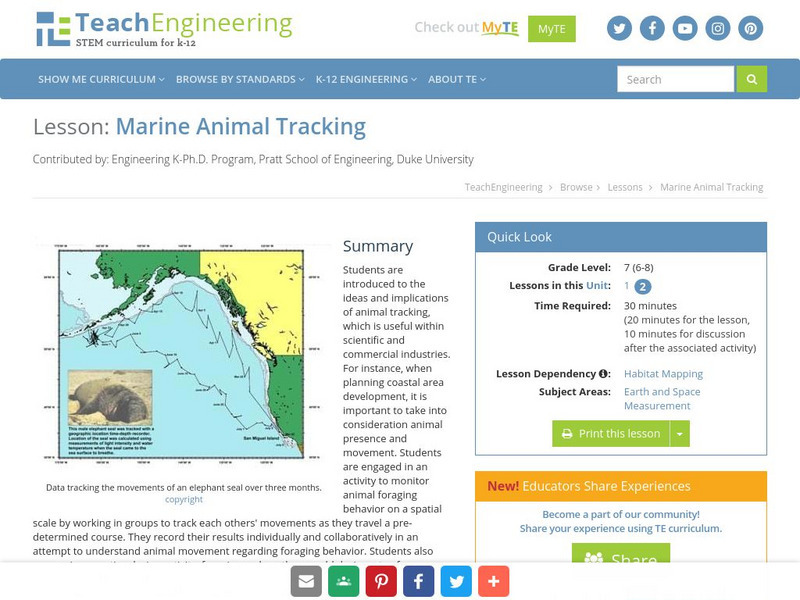
Teach Engineering: Marine Animal Tracking
This lesson plan engages students in an activity to monitor animal foraging behavior on a spatial scale. The students will break into groups and track each other's movements as they move through a pre-determined course. The results will...
TeachEngineering
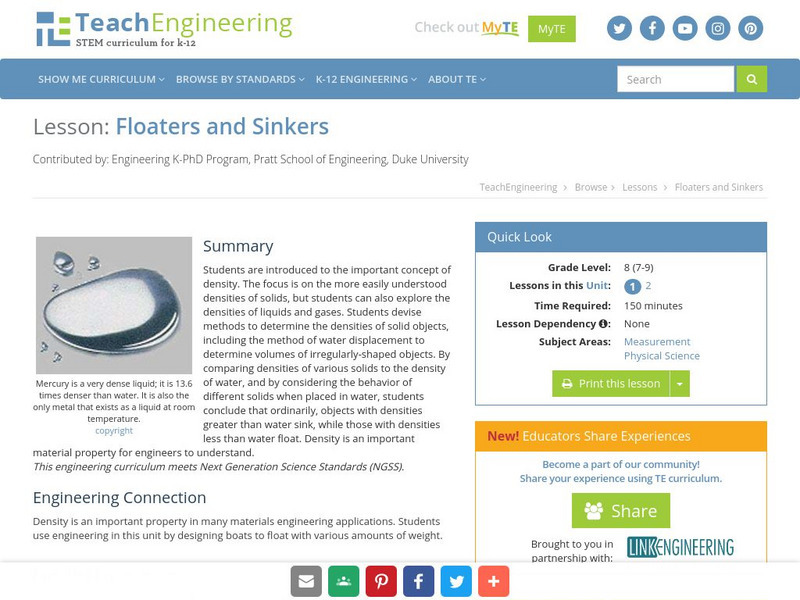
Teach Engineering: Floaters and Sinkers
This instructional activity introduces students to the important concept of density. The focus is on the more easily understood densities of solids, but students can also explore the densities of liquids and gases. Students devise...

Alabama Learning Exchange
Alex: Importance of Fur for Animals
This is a lesson to teach students how to read a thermometer and gain an understanding of why fur is important for some animals' survival.
Other
The Science House: The Cat's Meow Lesson Plan
Experiment provides this activity used to create interest in a common substance: milk. Students are asked to form a hypothesis about the behavior of milk as household detergents act upon it. The most important aspects of this activity...
ReadWriteThink
Read Write Think: Creating Class Rules a Beginning to Creating Community
Contains plans for two lessons that teach about proper classroom behavior and creating community by discussing why they are in school and what they need in order to accomplish their goals while there. In addition to objectives and...
Common Sense Media
Common Sense Media: Education: Privacy Rules: Grades 3 5
Students learn that children's websites must protect their private information. They learn to identify these secure sites by looking for their privacy policies and privacy seals of approval. They discuss a scenario in which their private...
Center For Civic Education
Center for Civic Education: Becoming a Voter
In this lesson, students apply their state's requirements for registering to vote. Students learn when and how to register, how to complete a voter registration form, and when and how to reregister.
Council for Economic Education
Econ Ed Link: Classroom Cash Incentive Plan
Learn more about the economy through this informative lesson. "In this lesson, you will learn how the incentive program affects the personal choices you make in class. You will also analyze how economic incentives can affect behavior."
Community Learning Network
Cln: Instructional Materials in Media Literacy Studies
CLN "Theme Pages," focus on specific topics within Media Literacy/Studies. CLN's theme pages are collections of useful Internet educational resources within a narrow curricular topic and contain links to two types of information....

Alabama Learning Exchange
Alex: Thinking Hobbit
This is an introductory instructional activity designed to stimulate student interest in reading The Hobbit by J.R.R. Tolkien. The instructional activity familiarizes learners with the physical traits and social codes used to guide...

BioEd Online
Bio Ed Online: Our Sense of Taste
What are the basic tastes? Where is information about taste detected in the body? In this lesson students taste four mystery substances and learn that the tongue is covered with taste buds, which contain taste receptors that communicate...
BioEd Online
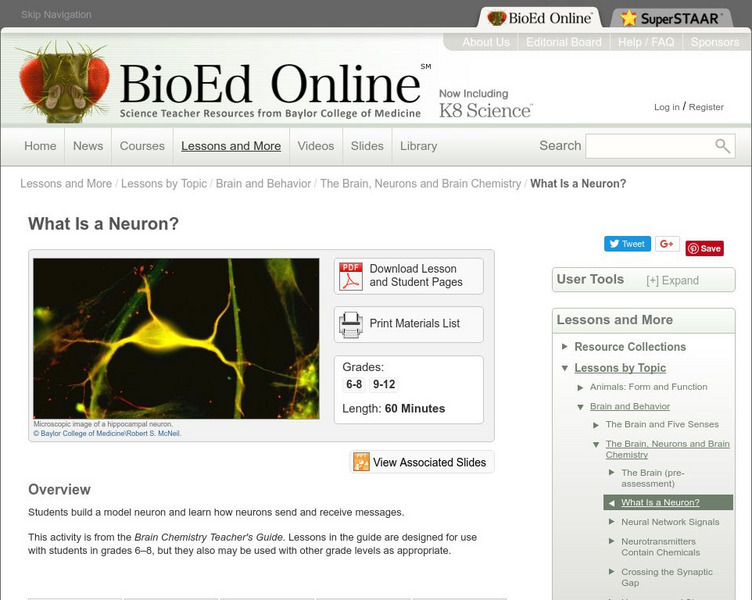
Bio Ed Online: What Is a Neuron?
Messages within the brain and the rest of the nervous system are sent very rapidly. These messages are conducted by cells called neurons. Neurons are specialized to receive and transmit message and neurons are connected in networks. In...
BioEd Online
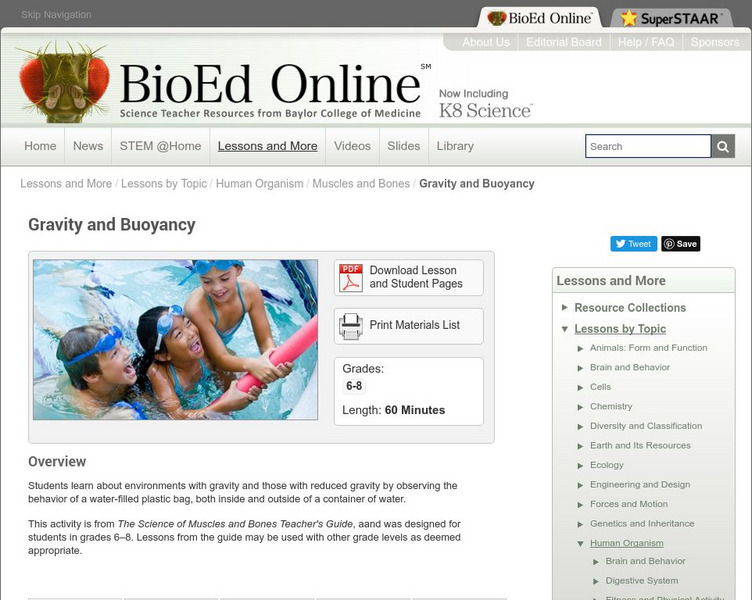
Bio Ed Online: Gravity and Buoyancy
In the following lesson plan for grades 6-8, students learn about environments with gravity and those with reduced gravity by observing the behavior of a water-filled plastic bag, both inside and outside of a container of water.
Sophia Learning
Sophia: Nature vs. Nurture
This lesson will identify nature and nurture as debated causes for behavior and personality.
Council for Economic Education
Econ Ed Link:the Collapse of Corporate Giants: The New Dr. Evils?
In this lesson, learn the difference between unethical actions and criminal behavior.