Hi, what do you want to do?






CK-12 Foundation
Telegraph
Most pupils don't know what a telegraph is, much less how one works. A secret simulation has scholars pick the size of the primary and secondary loops, the battery voltage, and which letters in the Morse Code they want to transmit. They...

Curated OER
The Invention of the Telegraph
Students study the history of telegraph invention. In this technology lesson plan, students build their own Morse Telegraph System. They discuss how this invention benefits the society.

Curated OER
The Invention of the Telephone
Students study the history of the telephone and its inventor. In this communications lesson students complete a tuning fork experiment to further demonstrate how sound is produced.

Curated OER
Morse Code and the Titanic
Learners review the story of the Titanic. In this science inventions lesson plan, students use what they learn about the Titanic to study electromagnets and the invention of the telegraph. Learners make electromagnets with batteries,...

Curated OER
A Survey of Thomas Edison's Inventions
Learners complete a web survey for Thomas Edison's inventions. In this Thomas Edison lesson, students visit the websites to learn about the inventions of Thomas Edison.

Curated OER
History of the Battery
Young scholars study the development of batteries. In this electrochemistry instructional activity, students compare the different types of batteries. They explore its applications especially in the medical field.

National First Ladies' Library
Eli Whitney: A Top Ten Inventor?
Learners conduct research and present their findings in a persuasive manner. Then they work in groups to enhance the development of cooperative work skills. Students also present their findings through persuasive skills in writing and/or...

Curated OER
Creating a Simple Telegraph Machine
Students experiment and discuss circuits and how they work. In this science lesson, students construct a telegraph machine using cardboard, wires, battery, electric tape and masking tape. They investigate what happens as the circuits...

Curated OER
The Founder of Electromagnetism
Students identify and study the founder of electromagnetism. In this magnetism activity students complete several experiments including building a galvanometer.

Curated OER
Life of Thomas Edison
Students research the life of Thomas Edison. In this Thomas Edison lesson, students explore major life events of Thomas Edison. Students investigate the inventions of Thomas Edison. Students discover how various fields of study...

Curated OER
Applied Science - Built Environment Pre Lab (Morse Code)
Students study communication. For this telegraph lesson, students examine Morse code and the composition of an elementary telegraph circuit. They listen to a presentation and try to create Morse Code messages on a worksheet. This lesson...
University of Virginia
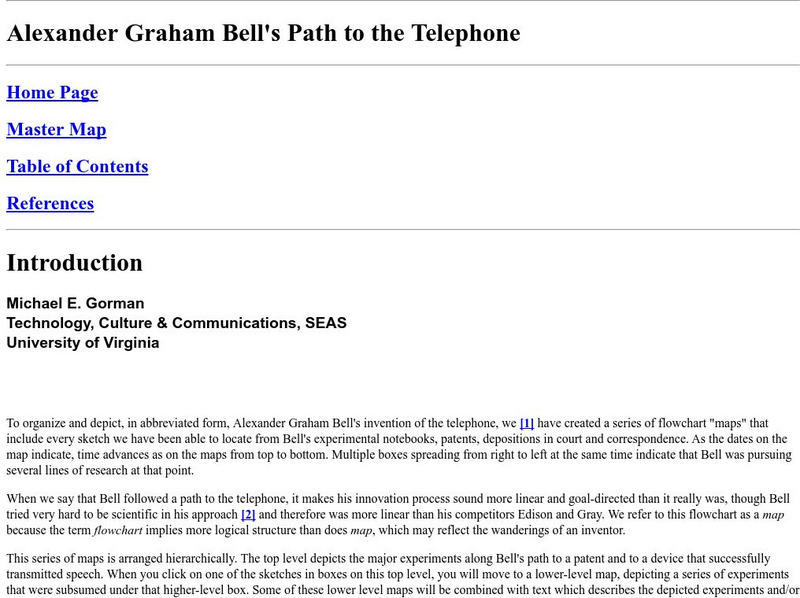
University of Virginia: Alexander Graham Bell's Path to the Telephone
A detailed survey of the invention and evolution of the telephone. This scholarly article includes a Master Map that shows Bell's thought processes as he developed the telephone, with each step linked to more in-depth information. The...

Smithsonian Institution
Lemelson Center: Invention Stories
Six categories of inventions highlight the inventors in those categories and describe their sometimes world-changing inventions. Other inventions are not so critical, but nonetheless fascinating.

PBS
Pbs: American Experience: Joseph Henry Lays Groundwork for the Telephone
This is the man who most encouraged Bell to invent the telephone. Bell said, "But for Henry, I never would have gone ahead with the telephone." This is a fascinating account both of Bell's invention and of Henry's life. Half a biography,...
A&E Television
History.com: 6 Key Inventions by Thomas Edison
Edison's genius was improving on others' technologies and making them more practical for the general public. Thomas Edison applied for his first patent in 1868, when he was just 21 years old. The famous inventor's first brainchild was...

National High Magnetic Field Laboratory
Magnet Academy: Timeline of Electricity and Magnetism: 1850 1869
The Industrial Revolution is in full force, Gramme invents his dynamo and James Clerk Maxwell formulates his series of equations on electrodynamics.

National High Magnetic Field Laboratory
Magnet Academy: Timeline of Electricity and Magnetism: 1830 1839
The first telegraphs are constructed and Michael Faraday produces much of his brilliant and enduring research into electricity and magnetism, inventing the first primitive transformer and generator.

National High Magnetic Field Laboratory
Magnet Academy: William Thomson, Lord Kelvin
William Thomson, known as Lord Kelvin, was one of the most eminent scientists of the nineteenth century and is best known today for inventing the international system of absolute temperature that bears his name. He made contributions to...
Wikimedia
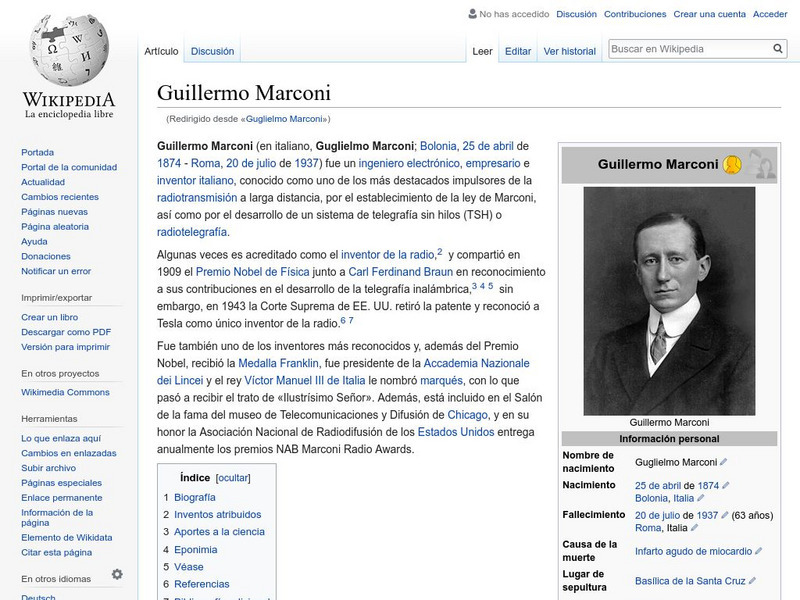
Wikipedia: Guillermo Marconi
This site chronicles the father of wireless communication. Examines his life and how his accomplishments affected both society and warfare.

National High Magnetic Field Laboratory
Magnet Academy: Carl Friedrich Gauss
Although he is best known as one of the greatest mathematicians of all time, Carl Friedrich Gauss was also a pioneer in the study of magnetism and electricity. To facilitate an extensive survey of terrestrial magnetism, he invented an...

PBS
Pbs: American Experience: Rescue at Sea
Companion website to the PBS documentary on the collision of two ships in 1909 and the reliance on the newly invented telegraph for rescue.