Hi, what do you want to do?






Curated OER
Quantum Mechanics and Atomic Physics
Students will discuss the de Brogile Hypothesis and state the circumstances under which the wave nature of matter is observed. They will also calculate the wavelengths of matter waves.

Florida State University
Florida State University: Light and Color: Reflection of Light
An in-depth discussion on reflection of light can be found here. Among the topics discussed include are the difference between specular and diffuse reflection, concave and convex mirrors, facets, total internal reflection, and much more....

Vision Learning
Visionlearning: Physics: Light I: Particle or Wave
Instructional module focusing on light. Discussion includes historical development of particle versus wave theories and the scientific studies leading to the understanding of light waves today. Site also includes an interactive practice...
Georgia Department of Education
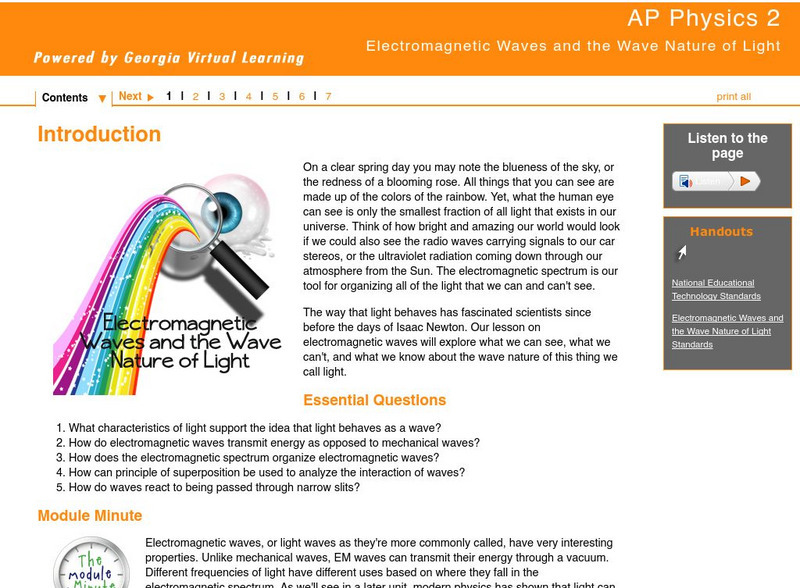
Ga Virtual Learning: Electromagnetic Waves and the Wave Nature of Light
In this interactive lesson about electromagnetic waves students will explore what they can see, what they can't, and what they know about the wave nature of this thing called "light."

University of Colorado
University of Colorado: Physics 2000: Quantum Atom
Several pages with an interesting discussion of the visible light spectrum and atomic absorption and emission line spectrum. Features excellent graphics, thorough and understandable discussion, and many interactive Java applets.
University of Colorado
University of Colorado: Physics 2000: Cat Scans: Projecting Shadows
This page and the three pages which follow discuss how X-ray technology can be used to produce an image of the human body. Discussion is understandable and highly intriguing. Several interactive animations allow the visitor to explore...
Georgia Department of Education
Ga Virtual Learning: Electromagnetic Waves
Through informational text, interactive activities, practice problems, and virtual simulations, students explore the properties of electromagnetic waves.
TeachEngineering
Teach Engineering: Waves: The Three Color Mystery
Students are presented with a challenge question concerning color blindness and asked to use engineering principles to design devices to help people who are color blind. Using the legacy cycle as a model, this unit is comprised of five...
CK-12 Foundation
Ck 12: Physical Science: Visible Light and Matter
[Free Registration/Login may be required to access all resource tools.] How visible light interacts with matter and classifying matter in terms of light.
PBS
Pbs Learning Media: Bringing the Universe to America's Classrooms: Waves: Light Collection
Observe the appearance of objects under different conditions to find that objects are only visible when illuminated by light, explore how light interacts with different materials, and develop a code that uses light to communicate across...
Utah State Office of Education
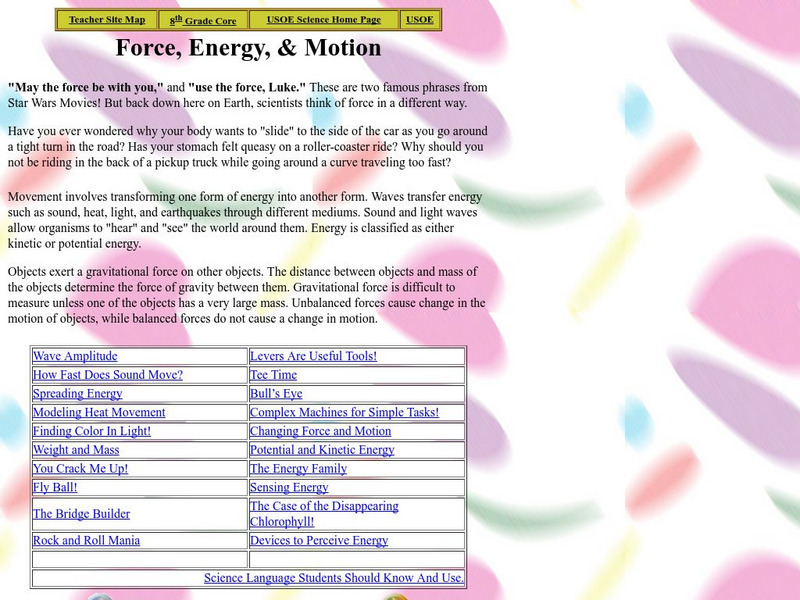
Utah State Office of Education: Force, Energy, & Motion
A unit on energy, force, and motion presented with interactive and classroom activities. Students gain an understanding of weight, mass, potential and kinetic energy, sound, and heat with this engaging resource.
Vision Learning
Visionlearning: Physics: Light Ii: Electromagnetism
Instructional module focusing on light and electromagnetism. Discussion includes historical discoveries that led to the understanding of the electromagnetic spectrum. Site also includes an interactive practice quiz and links relating to...
CK-12 Foundation
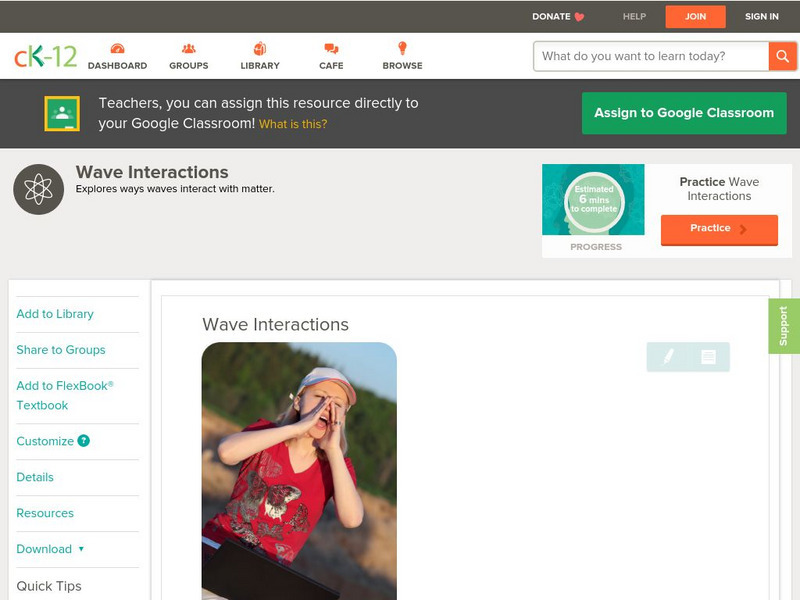
Ck 12: Physical Science: Wave Interactions
[Free Registration/Login may be required to access all resource tools.] Ways that waves can interact with matter and examples.
California Institute of Technology
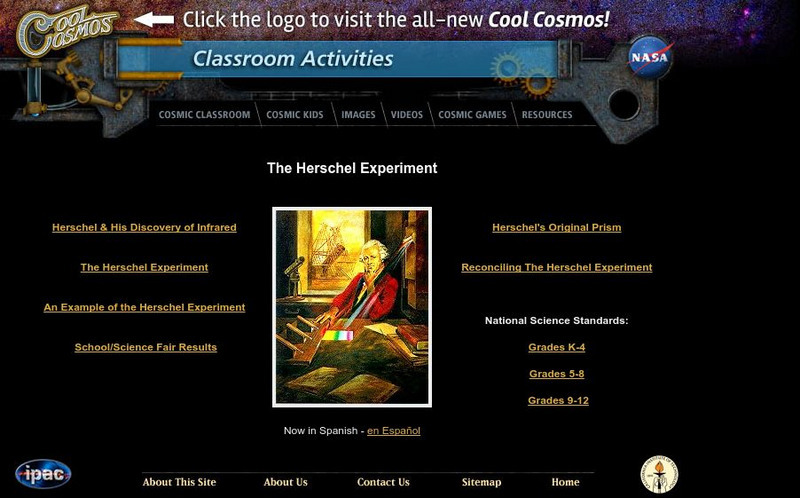
Cool Cosmos: The Herschel Experiment
This website provides a background on the discoverer of infared light--Sir Frederick William Herschel. A version of the experiment Herschel conducted in the 1800s is provided as well.
E-learning for Kids
E Learning for Kids: Science: Winery: Why Can We See Through Some Objects but Not Others?
Learn about the properties of materials in their interactions with light, including whether they are opaque, transparent, or translucent, and which of these produce shadows.