Hi, what do you want to do?





OpenStax
Open Stax: Industrialization 1870 1900: From Invention to Industrial Growth
This section of the textbook describes how new inventions spurred industrial growth in the 19th century and discusses the business methods and models of Andrew Carnegie, John Rockefeller, and J. P. Morgan.
Other
Sir Wilfrid Laurier Sb: Computer Integration Activities
This list of activities designed by teachers aim to integrate information and communication technologies into the curriculum. There are also links to descriptions of various methods and practices that teachers can use to integrate...

BiologyWise
Biology Wise: Fluid Mosaic Model
The fluid mosaic model provides an explanation of the structure of biological membranes. It explains why a membrane can perform all of its functions, e.g., permeability and adhesion. This resource describes the main components of a cell...
TeachEngineering
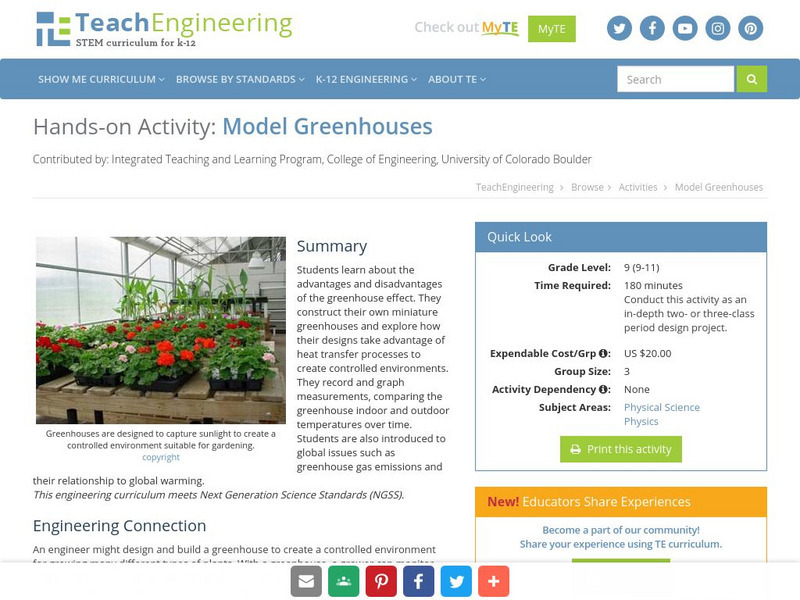
Teach Engineering: Model Greenhouses
Students learn about the advantages and disadvantages of the greenhouse effect. They construct their own miniature greenhouses and explore how their designs take advantage of heat transfer processes to create controlled environments....
TeachEngineering
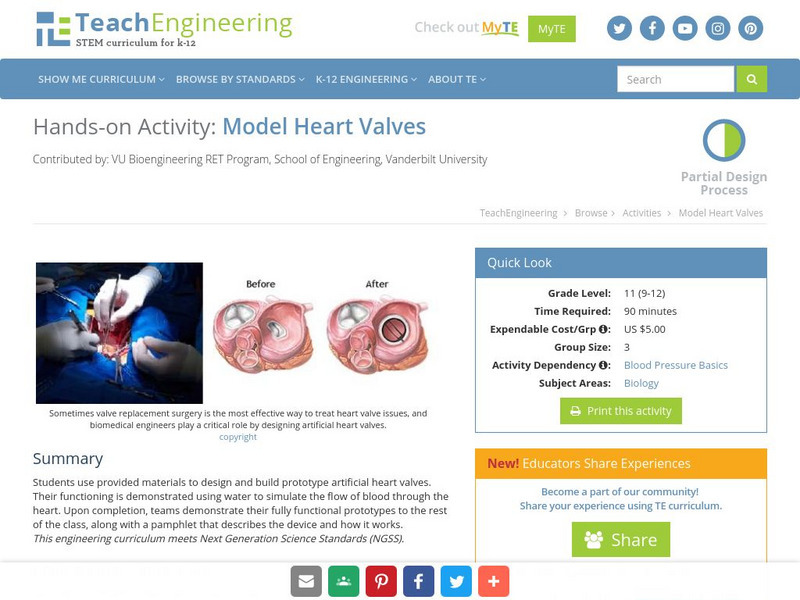
Teach Engineering: Model Heart Valves
Students use provided materials to design and build prototype artificial heart valves. Their functioning is demonstrated using water to simulate the flow of blood through the heart. Upon completion, teams demonstrate their fully...
ReadWriteThink
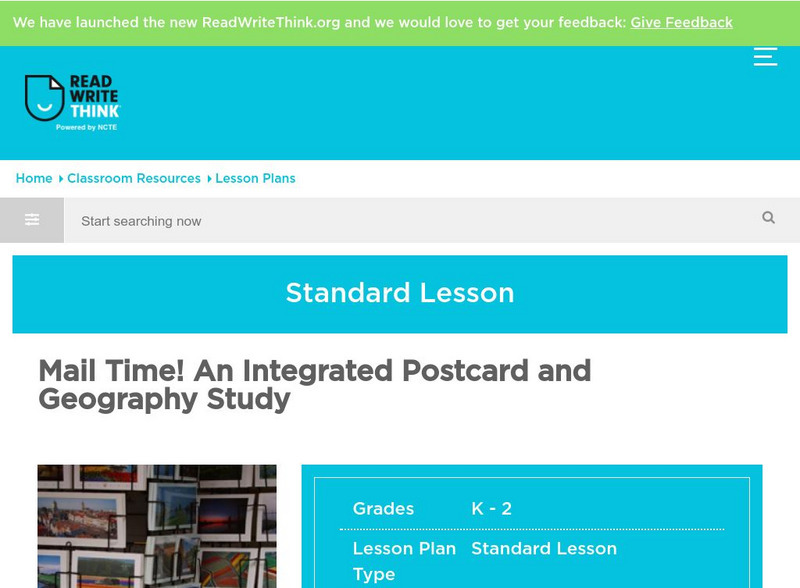
Read Write Think: Mail Time! An Integrated Postcard and Geography Study
Contains plans for five cross-curricular lessons that teach about geography, reading, and writing by having students send postcards to relatives and asking them to send postcards back. In addition to objectives and standards, this...
CK-12 Foundation
Ck 12: Evolution of the Atomic Model
[Free Registration/Login may be required to access all resource tools.] Students take a closer look at how our understanding of the atom has evolved over time.
Virginia Tech
Virginia Tech: Digital Library & Archives: Models of Curriculum Integration
This e-journal, from Virginia Tech, provides and comprehensive background and a visual reference to interdisciplinary curriculum.
Other
Kathy Schrock's Guide to Everything: Samr and Bloom's
An explanation of what the Substitution Augmentation Modification Redefinition Model (SAMR) Model is, and how it can be integrated with Bloom's taxonomy, as well as technology. Includes an extensive collection of slideshows, videos, and...
TeachEngineering
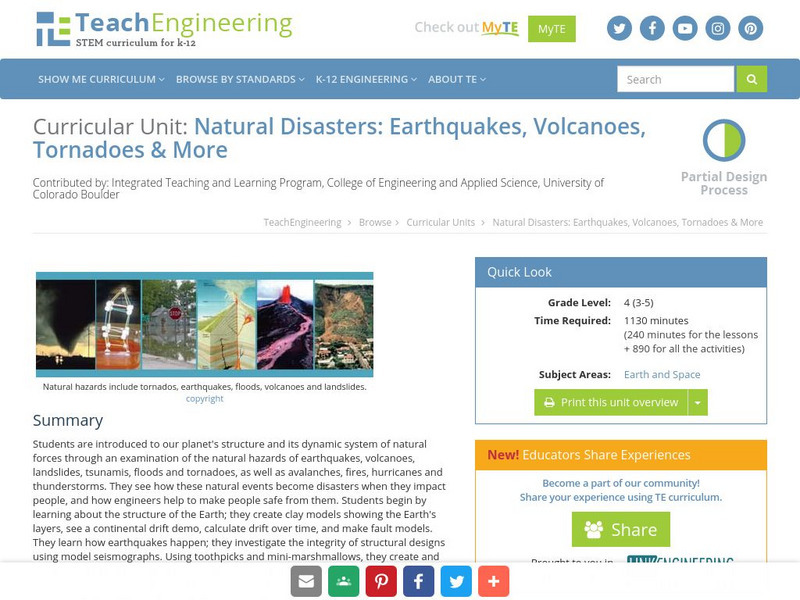
Teach Engineering: Natural Disasters
Students are introduced to our planet's structure and its dynamic system of natural forces through an examination of the natural hazards of earthquakes, volcanoes, landslides, tsunamis, floods and tornados, as well as avalanches, fires,...

TeachEngineering
Teach Engineering: Environment
Through 10 lessons and more than 20 hands-on activities, students are introduced to the concept of an environment and the many interactions within it. As they learn about natural and human-made environments, as well as renewable and...
TeachEngineering
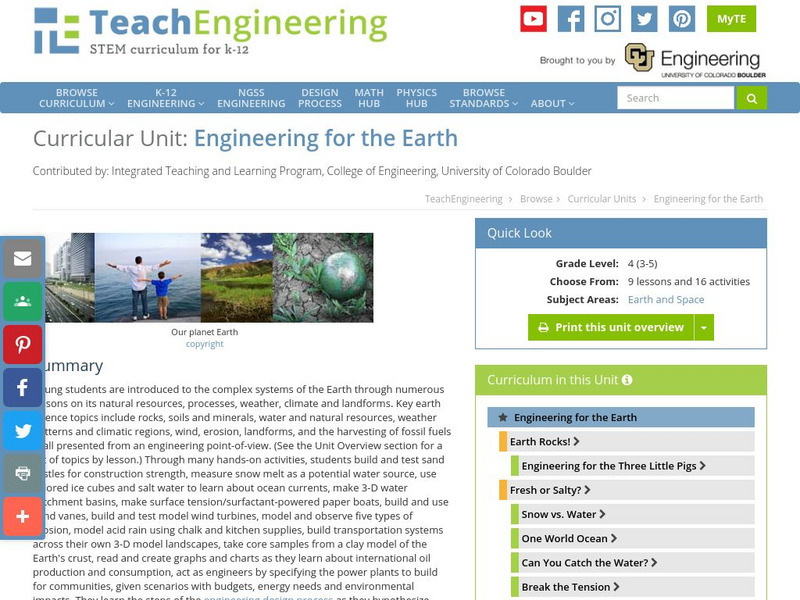
Teach Engineering: Engineering for the Earth
Young students are introduced to the complex systems of the Earth through numerous lessons on its natural resources, processes, weather, climate and landforms. Key earth science topics include rocks, soils and minerals, water and natural...
TeachEngineering
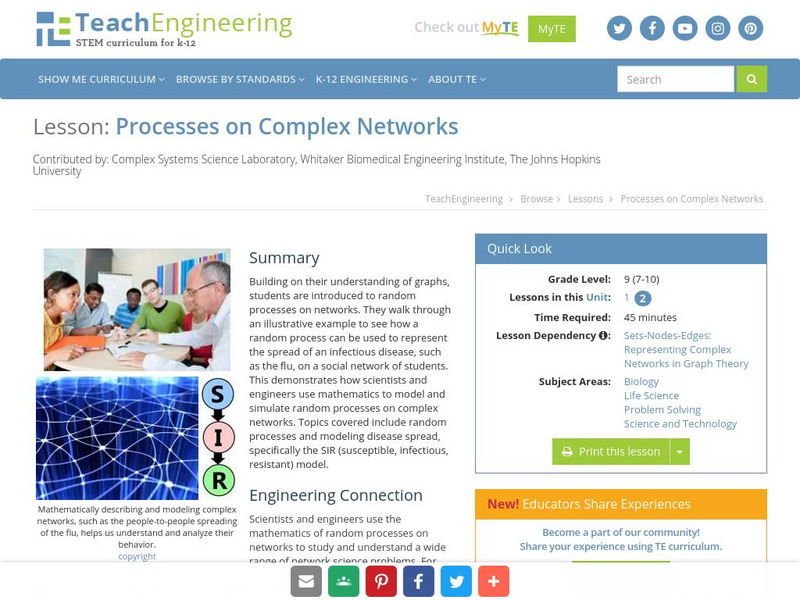
Teach Engineering: Processes on Complex Networks
Building on their understanding of graphs, students are introduced to random processes on networks. They walk through an illustrative example to see how a random process can be used to represent the spread of an infectious disease, such...

TeachEngineering
Teach Engineering: Let the Blood Flow
Students work as biomedical engineers to find liquid solutions that can clear away polyvinyl acetate polymer "blood clots" in model arteries (made of clear, flexible tubing). Teams create samples of the "blood clot" polymer with...
TeachEngineering
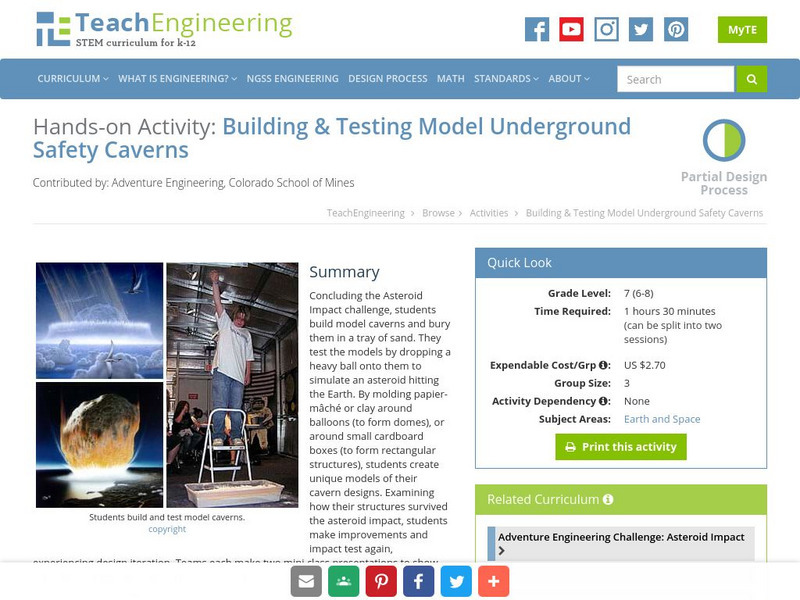
Teach Engineering: Testing the Caverns
Students build model caverns and bury them in a tray of sand. They test the models by dropping balls onto them to simulate an asteroid hitting the Earth. By molding papier-mache or clay around balloons (to form domes), or around small...
TeachEngineering
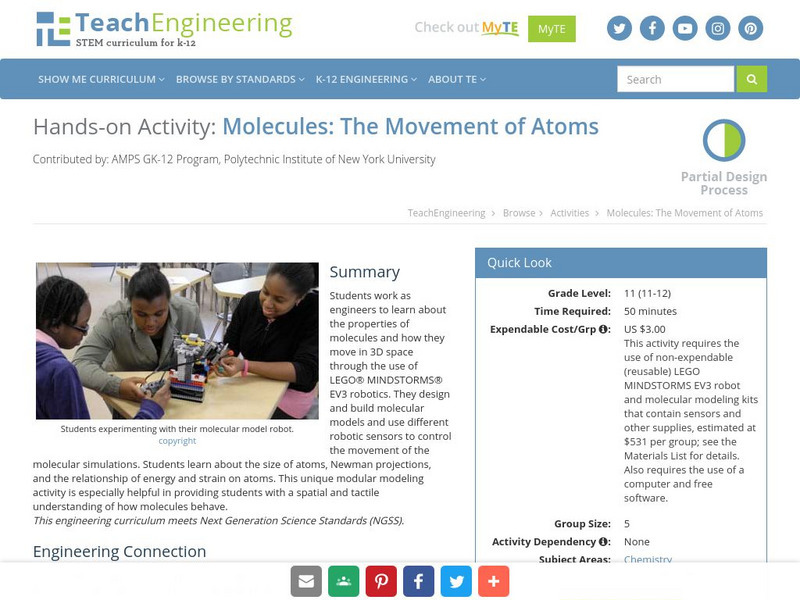
Teach Engineering: Molecules: The Movement of Atoms
Students work as engineers to learn about the properties of molecules and how they move in 3D space through the use of LEGO MINDSTORMS NXT robotics. They design and build molecular models and use different robotic sensors to control the...
TeachEngineering
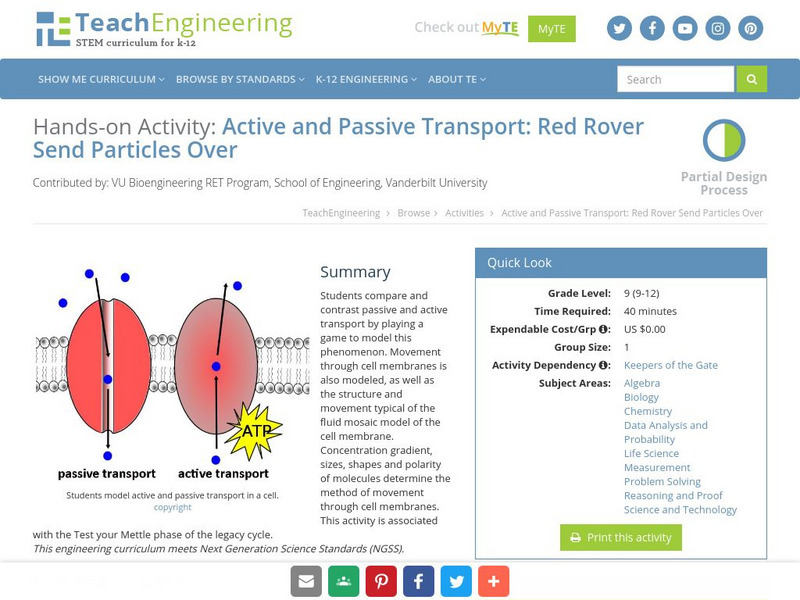
Teach Engineering: Active and Passive Transport: Red Rover Send Particles Over
Students compare and contrast passive and active transport by playing a game to model this phenomenon. Movement through cell membranes is also modeled, as well as the structure and movement typical of the fluid mosaic model of the cell...
TeachEngineering
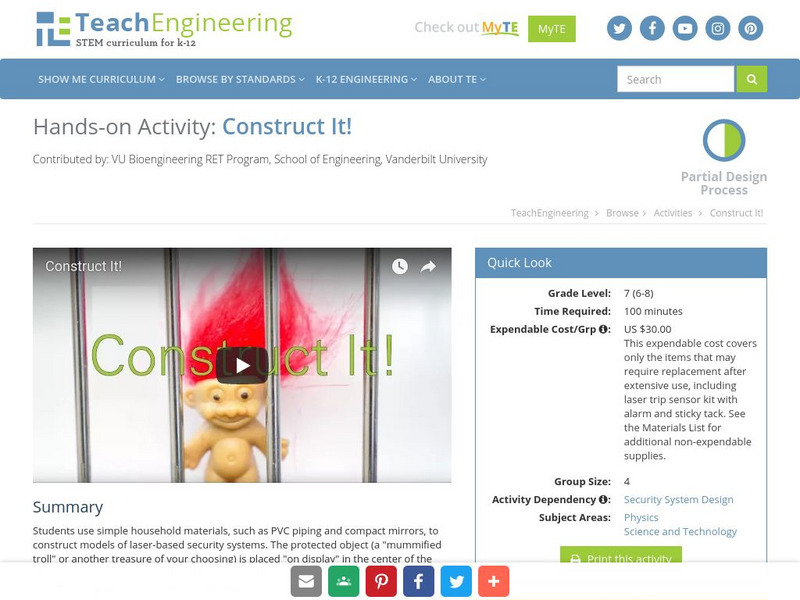
Teach Engineering: Construct It!
Students use simple household materials, such as PVC piping and compact mirrors, to construct models of laser-based security systems. The protected object (a "mummified troll" or another treasure of your choosing) is placed "on display"...
TeachEngineering
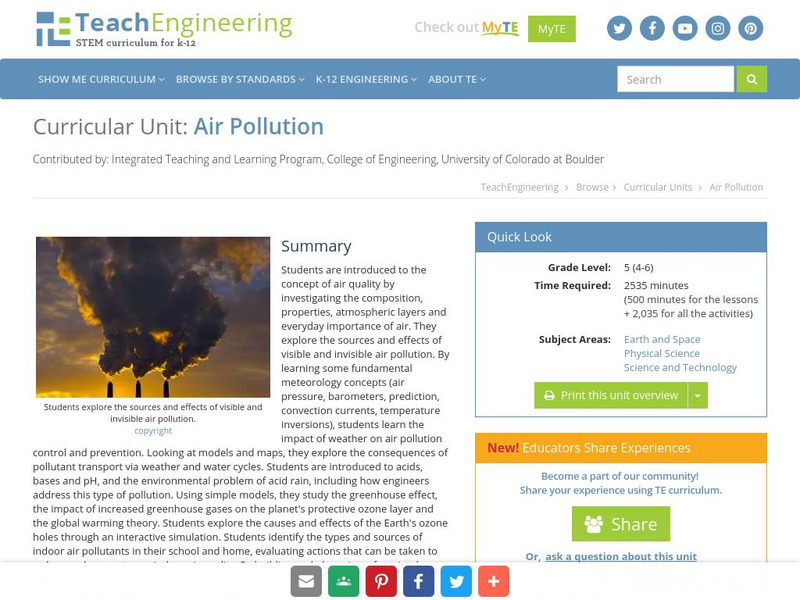
Teach Engineering: Air Pollution
Students are introduced to the concept of air quality by investigating the composition, properties, atmospheric layers and everyday importance of air. They explore the sources and effects of visible and invisible air pollution. By...
TeachEngineering
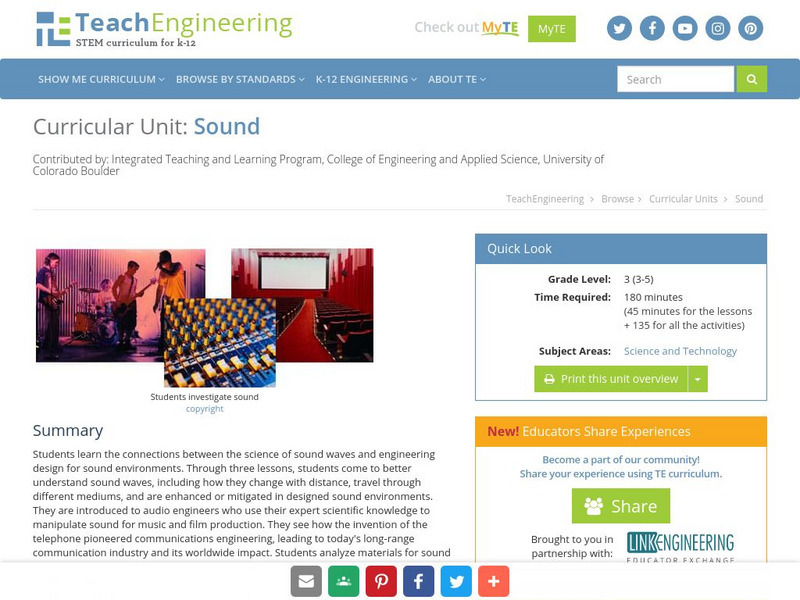
Teach Engineering: Sound
Students learn the connections between the science of sound waves and engineering design for sound environments. Through three lessons, students come to better understand sound waves, including how they change with distance, travel...
TeachEngineering
Teach Engineering: Design a Solar City
Students design and build a model city powered by the sun! They learn about the benefits of solar power, and how architectural and building engineers integrate photovoltaic panels into the design of buildings.
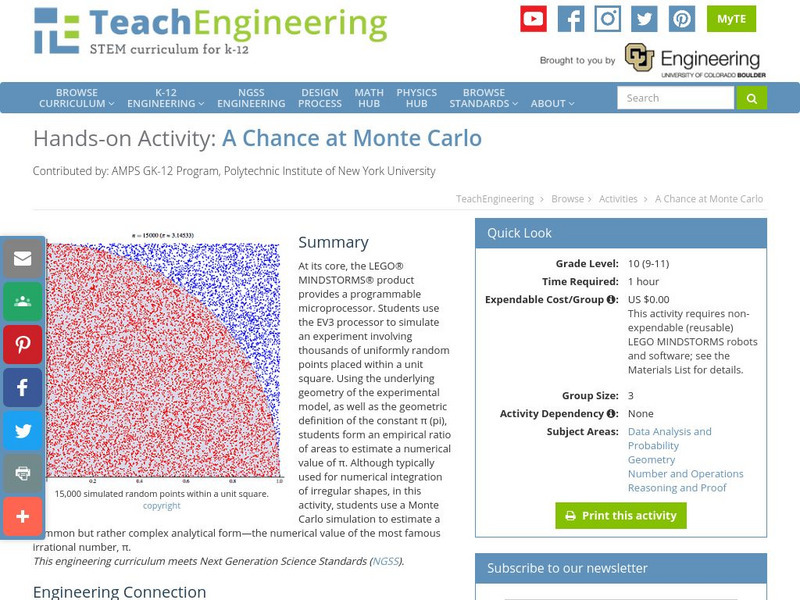
TeachEngineering
Teach Engineering: A Chance at Monte Carlo
At its core, the LEGO MINDSTORMS product provides a programmable microprocessor. Students use the EV3 processor to simulate an experiment involving thousands of uniformly random points placed within a unit square. Using the underlying...
TeachEngineering
Teach Engineering: Energy of Motion
By taking a look at the energy of motion all around us, students learn about the types of energy and their characteristics. They first learn about the two simplest forms of mechanical energy: kinetic and potential energy, as illustrated...
Other
Multimedia Schools: Moving Every Child Ahead the Big6
This article looks at applying the Big6 process to issues raised by No Child Left Behind legislation. The goal of the Big6 process is to improve performance by improving thinking through application of information technology skills. This...