Hi, what do you want to do?





Other
Lehigh University: Land Use Change
An inquiry-based science unit for middle school students centered on how human activities affect environmental changes related to land use. The lessons integrate technology and lab activities while teaching about today's land use and how...
TeachEngineering
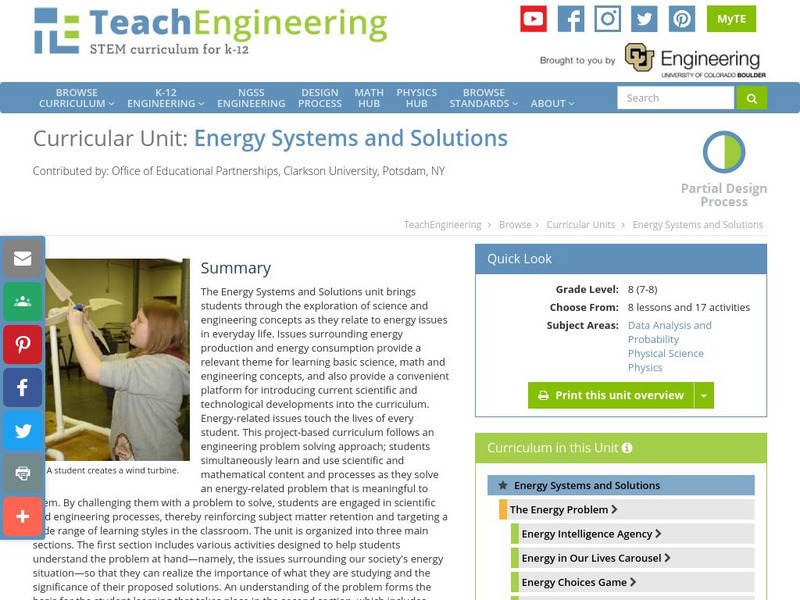
Teach Engineering: Energy Systems and Solutions
The Energy Systems and Solutions unit brings students through the exploration of science and engineering concepts as they relate to energy issues in everyday life. Issues surrounding energy production and energy consumption provide a...
TeachEngineering
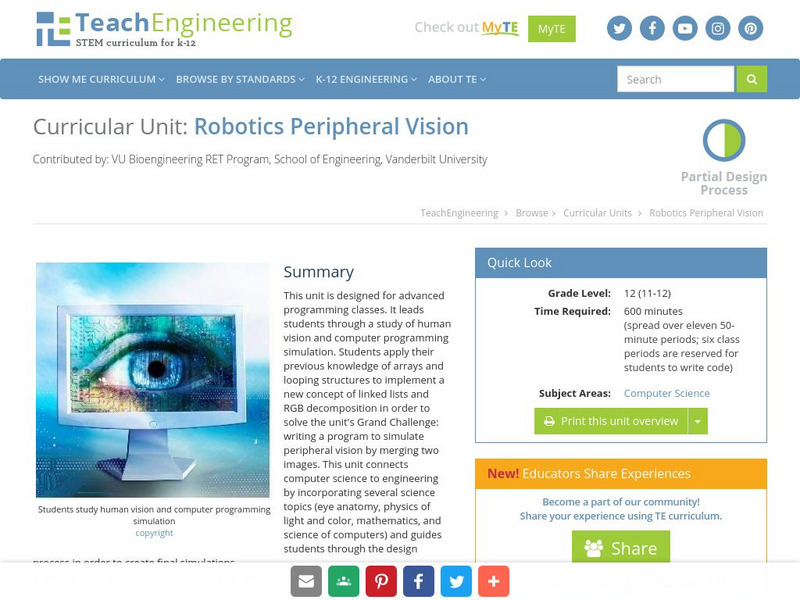
Teach Engineering: Robotics Peripheral Vision
This unit is designed for advanced programming classes. It leads students through a study of human vision and computer programming simulation. Students apply their previous knowledge of arrays and looping structures to implement a new...
![Laura Candler: Green Court Claims: Are Green Companies Really Green? [Pdf] Lesson Plan](https://static.lp.lexp.cloud/images/attachment_defaults/resource/large/FPO-knovation.png "Laura Candler: Green Court Claims: Are Green Companies Really Green? [Pdf] Lesson Plan")
Other
Laura Candler: Green Court Claims: Are Green Companies Really Green? [Pdf]
In this lesson, students investigate claims that companies make about their products and business practices they use to imply that they are environmentally friendly. Students work in groups to research the claim they chose and then...
TeachEngineering
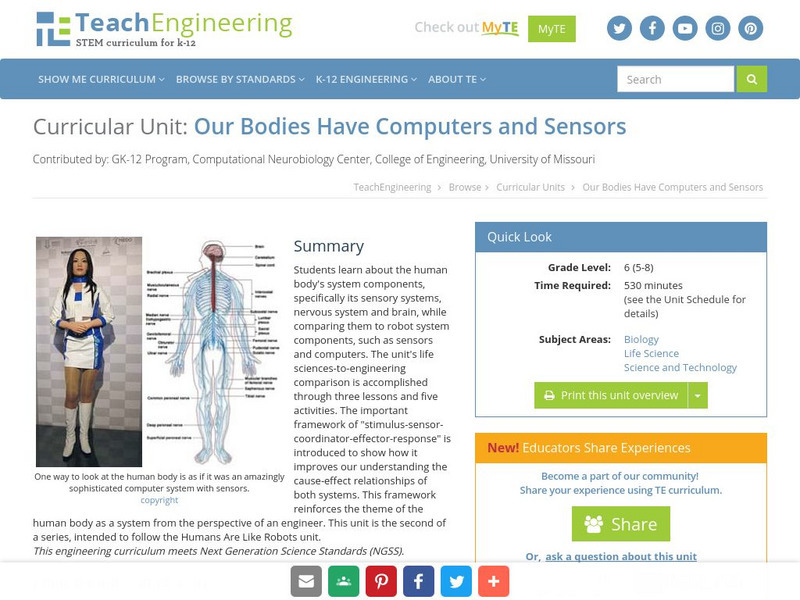
Teach Engineering: Our Bodies Have Computers and Sensors
Students learn about the human body's system components, specifically its sensory systems, nervous system and brain, while comparing them to robot system components, such as sensors and computers. The unit's life sciences-to-engineering...
TeachEngineering
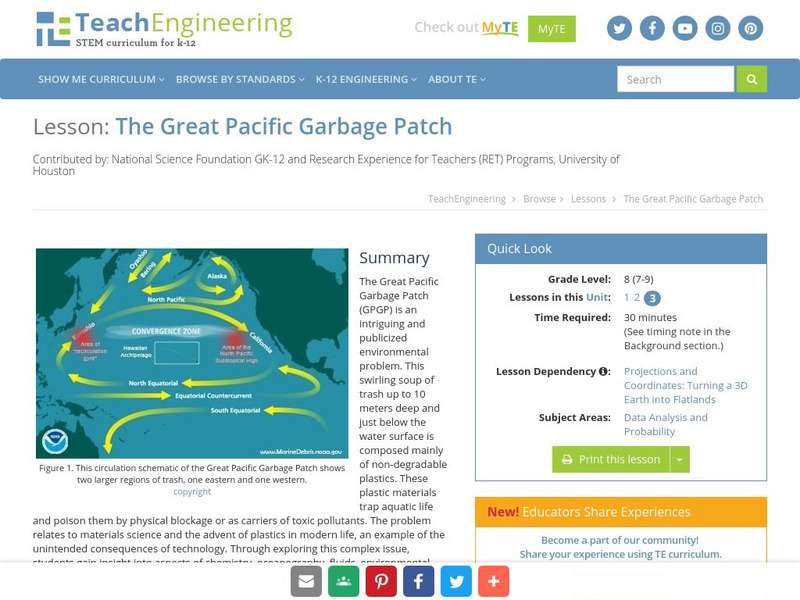
Teach Engineering: The Great Pacific Garbage Patch
The Great Pacific Garbage Patch (GPGP) is an interesting and somewhat publicized environmental problem. A swirling soup of trash up to 10 meters deep and just below the water surface is composed mainly of non-degradable plastics. These...
TeachEngineering
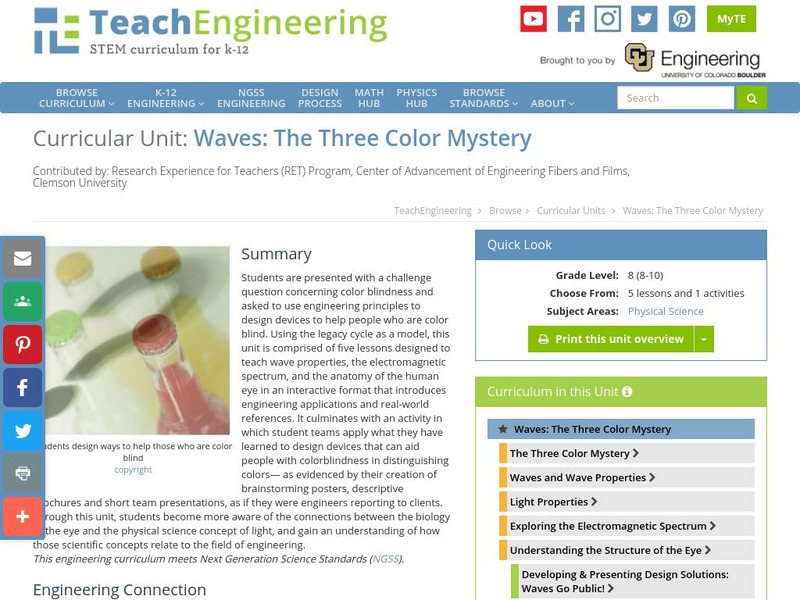
Teach Engineering: Waves: The Three Color Mystery
Students are presented with a challenge question concerning color blindness and asked to use engineering principles to design devices to help people who are color blind. Using the legacy cycle as a model, this unit is comprised of five...
TeachEngineering
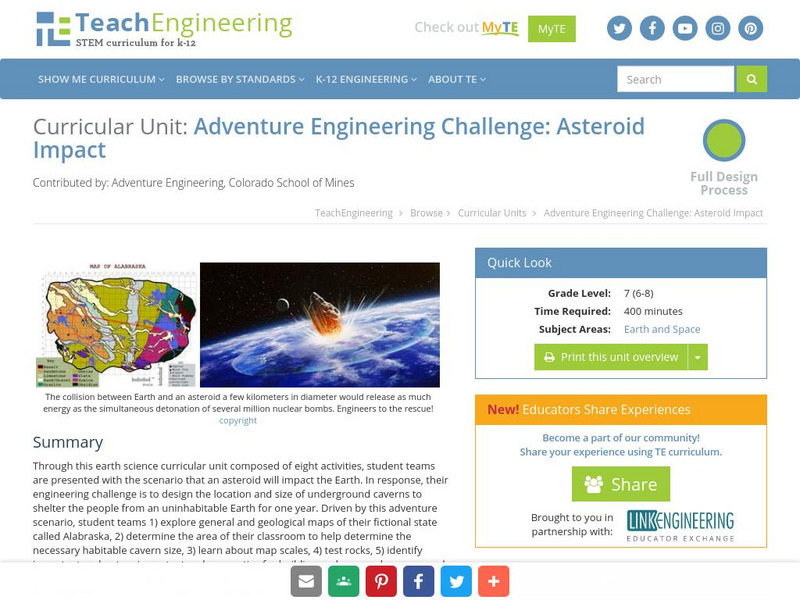
Teach Engineering: Asteroid Impact
Asteroid Impact is an 8-10 class long (350-450 min) earth science curricular unit where student teams are posed with the scenario that an asteroid will impact earth. They must design the location and size of underground caverns to save...
TeachEngineering
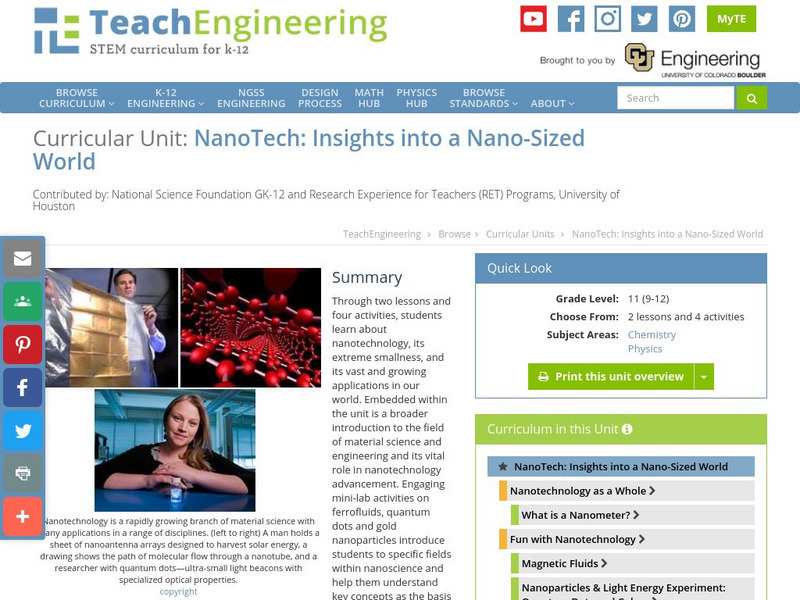
Teach Engineering: Nano Tech: Insights Into a Nano Sized World
Through two lessons and four activities, students learn about nanotechnology, its extreme smallness, and its vast and growing applications in our world. Embedded within the unit is a broader introduction to the field of material science...
ArtsNow
Arts Now Learning: Grade 3: Rock N Art
In this arts integrated unit, 3rd graders will explore Rocks and Soil. These projects focus on bringing multiple art forms to the Earth Sciences for third graders. Students will focus on comparing and contrasting the 3 types of rocks, as...
TeachEngineering
Teach Engineering: Riding the Gravity Wave
Students write a biographical sketch of an artist or athlete who lives on the edge, riding the gravity wave, to better understand how these artists and athletes work with gravity and manage risk. Note: The literacy activities for the...
TeachEngineering
Teach Engineering: Environmental Challenges in China
Students learn about the wonderful and fascinating country of China, and its environmental challenges that require engineering solutions, many in the form of increased energy efficiency, the incorporation of renewable energy, and new...
TeachEngineering
Teach Engineering: Engineering for the Earth
Young students are introduced to the complex systems of the Earth through numerous lessons on its natural resources, processes, weather, climate and landforms. Key earth science topics include rocks, soils and minerals, water and natural...
TeachEngineering
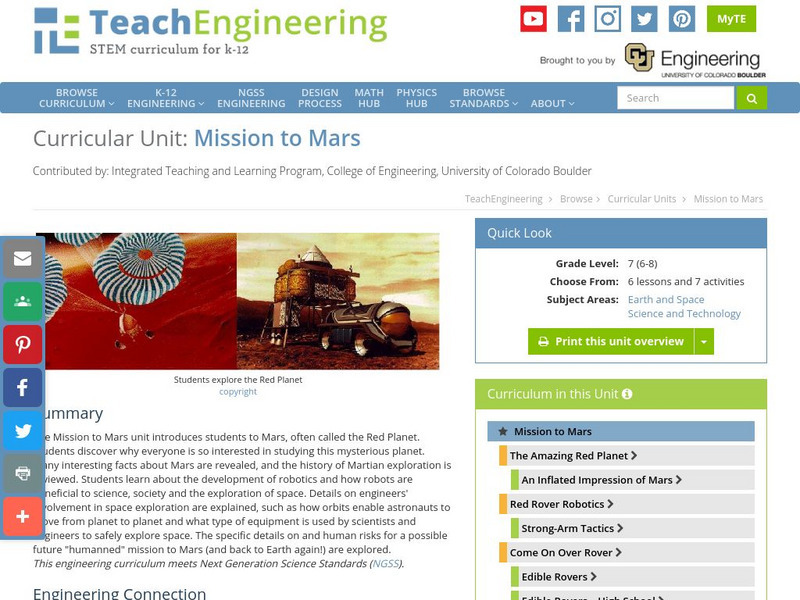
Teach Engineering: Mission to Mars
The Mission to Mars curricular unit introduces students to Mars-the Red Planet. Students discover why scientists are so interested in studying this mysterious planet. Many interesting facts about Mars are revealed, and the history of...

TeachEngineering
Teach Engineering: Nanotechnology as a Whole
Students are given a general overview of nanotechnology principles and applications, as well as nanomaterials engineering. Beginning with an introductory presentation, they learn about the nano-scale concept and a framework for the...

TeachEngineering
Teach Engineering: Survive That Tsunami!
Students use a table-top-sized tsunami generator to observe the formation and devastation of a tsunami. They see how a tsunami moves across the ocean and what happens when it reaches the continental shelf. Students make villages of model...
TeachEngineering
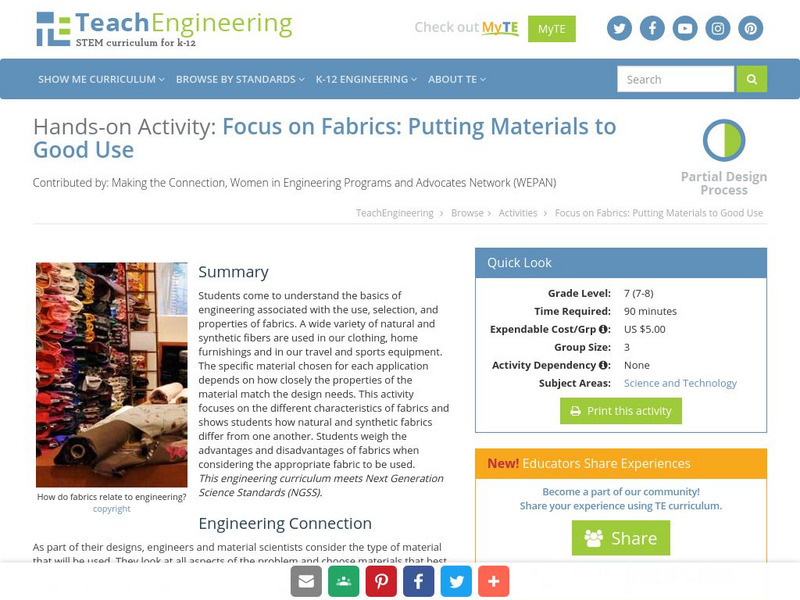
Teach Engineering: Focus on Fabrics: Putting Materials to Good Use
The goal is for students to understand the basics of engineering associated with the use, selection, and properties of fabrics. A wide variety of natural and synthetic fibers are used in our clothing, home furnishings and in our travel...

Alabama Learning Exchange
Alex: Pass It Down
This lesson, Pass It Down, integrates science and math into two consecutive hands-on genetics activities that should be embedded within an existing genetics unit suitable for biology students. The results of each activity will be...
Science Education Resource Center at Carleton College
Serc: American Field Guide: Teacher Resources
American Field Guide is a tremendous resource for you and your students. Embedded within this site you will find lesson plans that weave segments of video together into units of inquiry around specific topics. The lessons in the units of...
Other
Whale Net: Start Up Educational Activities
Site provides resources for teachers seeking to construct an interdisciplinary unit on whales. Includes links to "Whale Watch Data," News Archives, and much more. Provides various activities teachers can integrate into their classrooms...
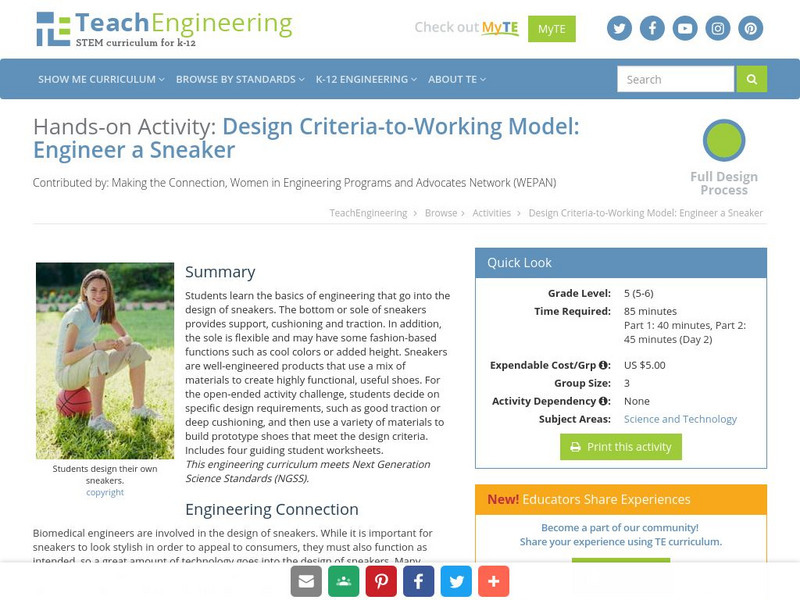
TeachEngineering
Teach Engineering: Engineer a Sneaker
The goal is for students to understand the basics of engineering that go into the design of a sneaker. The bottom or sole of a sneaker provides support, cushioning, and traction. In addition the sole is flexible and can have some fashion...
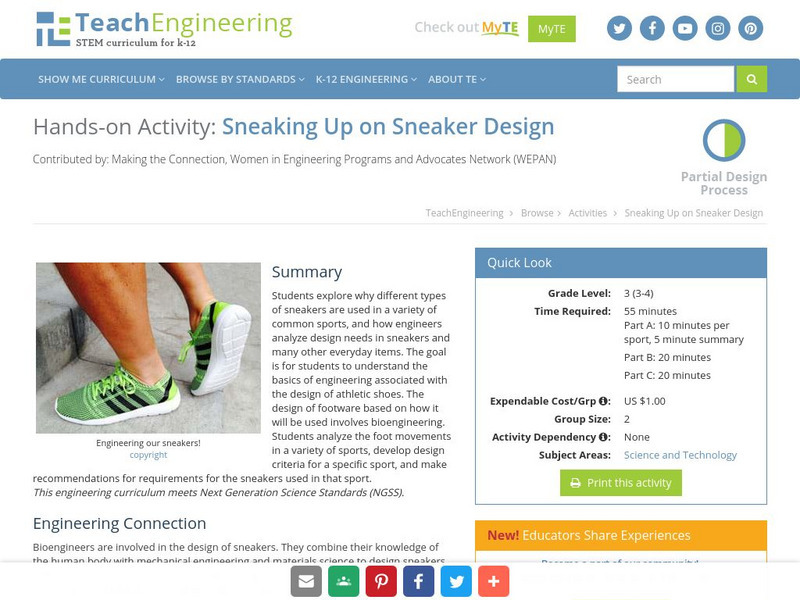
TeachEngineering
Teach Engineering: Sneaking Up on Sneakers
This activity explores why different types of sneakers are used in a variety of common sports. It connects how engineers analyze design needs in sneakers and everyday items. The goal is for students to understand the basics of...
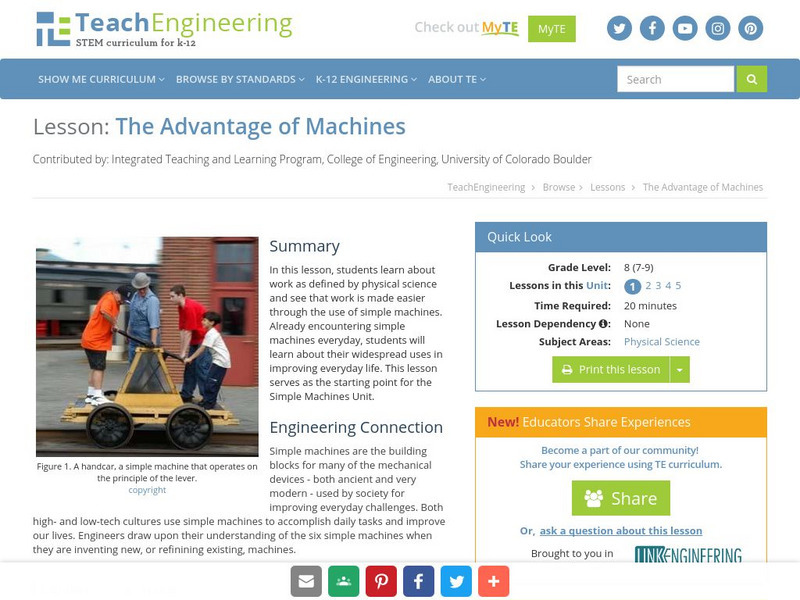
TeachEngineering
Teach Engineering: The Advantage of Machines
In this lesson, learners learn about work as defined by physical science and see that work is made easier through the use of simple machines. Already encountering simple machines everyday, students will be alerted to their widespread...
Montgomery CountyPublic Schools
Mcps: City Weather Project and Technology Routines
A Grade 8 Science teacher describes how she set up her classroom routines to facilitate group interaction and efficient use of technology tools during a UDL unit. As part of their unit on meteorology, students created a presentation on...