Hi, what do you want to do?





TeachEngineering
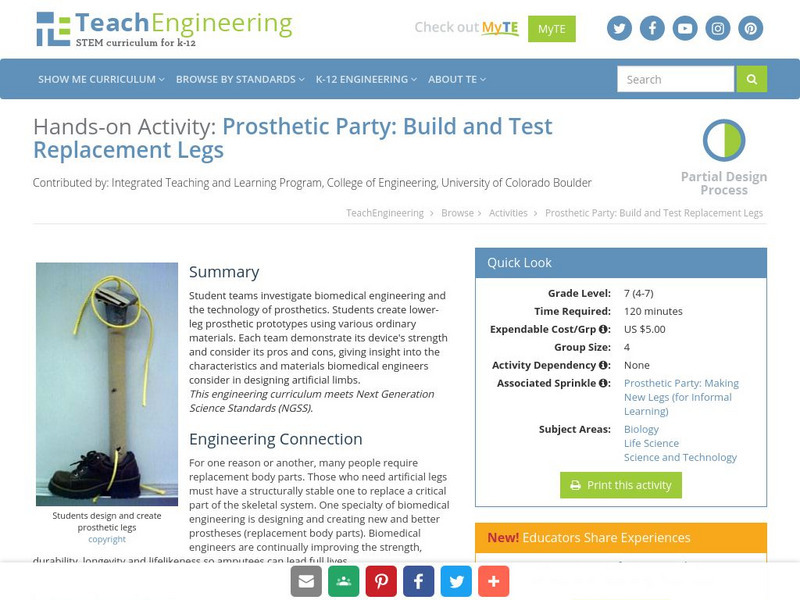
Teach Engineering: Prosthetic Party
Student teams investigate biomedical engineering and the technology of prosthetics. Students create a model prosthetic lower leg using various materials. Each team demonstrate its prosthesis' strength and consider its pros and cons,...
TeachEngineering
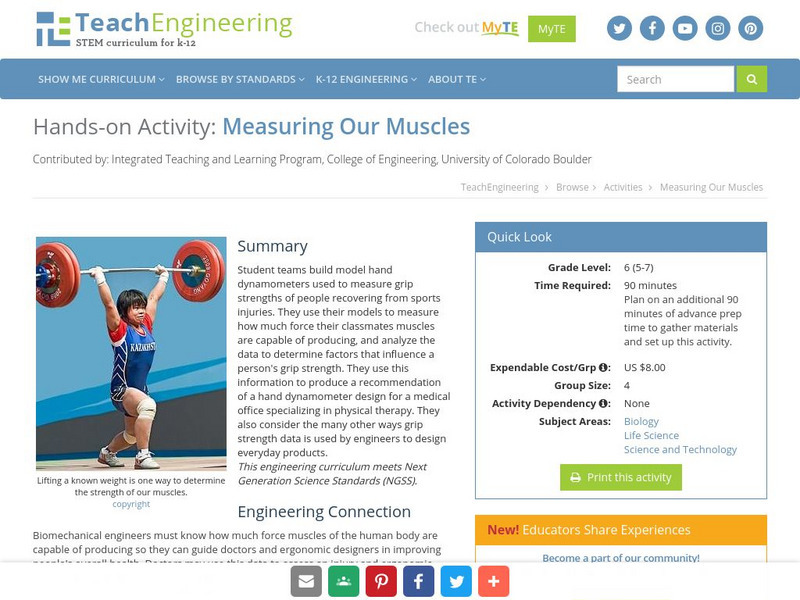
Teach Engineering: Measuring Our Muscles
Student teams build model hand dynamometers used to measure grip strengths of people recovering from sports injuries. They use their models to measure how much force their classmates muscles are capable of producing, and analyze the data...
TeachEngineering
Teach Engineering: You're the Expert
Student teams learn about and devise technical presentations on four reproductive technology topics pregnancy ultrasound, amniocentesis, in-vitro fertilization or labor anesthetics. Each team acts as a panel of engineers asked to make a...
TeachEngineering
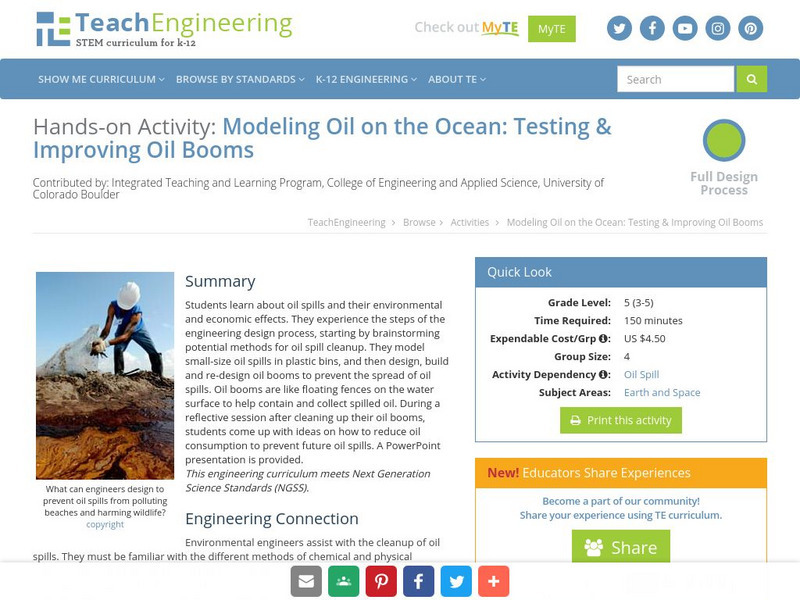
Teach Engineering: Oil on the Ocean
Students learn about oil spills and their environmental and economic effects. They experience the steps of the engineering design process as they brainstorm potential methods for oil spill clean-up, and then design, build, and re-design...
TeachEngineering
Teach Engineering: The Dirty Water Project
In this activity, students investigate different methods (aeration and filtering) for removing pollutants from water. They will design and build their own water filters.
TeachEngineering
Teach Engineering: Growing and Graphing
Students visit a 2nd and a 4th grade class to measure the heights of older students using large building blocks as a non-standard unit of measure. They can also measure adults in the school community. Results are displayed in...
TeachEngineering
Teach Engineering: Tissue Mechanics
Students reflect on their experiences making silly putty (the previous hands-on activity in the unit), especially why changing the borax concentration alters the mechanical properties of silly putty and how this pertains to tissue...
TeachEngineering
Teach Engineering: Microfluidic Devices and Flow Rate
Students obtain a basic understanding of microfluidic devices, how they are developed and their uses in the medical field. After conducting the associated activity, they watch a video clip and learn about flow rate and how this relates...

TED Talks
Ted: Ted Ed: Why the Metric System Matters
For the majority of recorded human history, units like the weight of a grain or the length of a hand weren't exact and varied from place to place. Now, consistent measurements are such an integral part of our daily lives that it's hard...
Annenberg Foundation
Annenberg Learner: China Through Mapping
In this lesson, Mimi Norton integrates world geography with the study of Chinese culture and history by engaging her young students in a variety of activities to locate natural and human-made landmarks on maps of China. To build...

Alabama Learning Exchange
Alex: Endangered Species
Young scholars research and create a brochure project on an endangered species of their choice integrating aspects of math, science, social studies, art, reading and writing. This project allows the students to make connections across...

Alabama Learning Exchange
Alex: Defending Personal Freedoms
This lesson is an introduction to the Civil Rights Movement in American history. The social and political impact of the current events and key people who played an integral role during this era provide a wealth of insight into the...
ibiblio
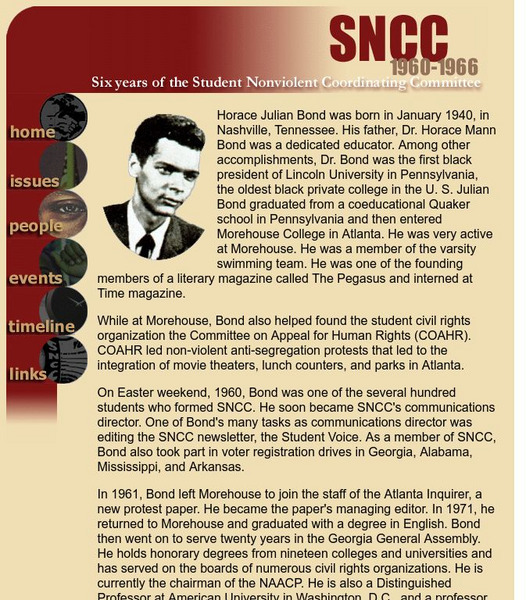
Ibiblio: Julian Bond
Informative biography of one of the founding leaders of the Student Nonviolent Coordinating Committee, a leading civil rights group of the 1960s.
National Endowment for the Humanities
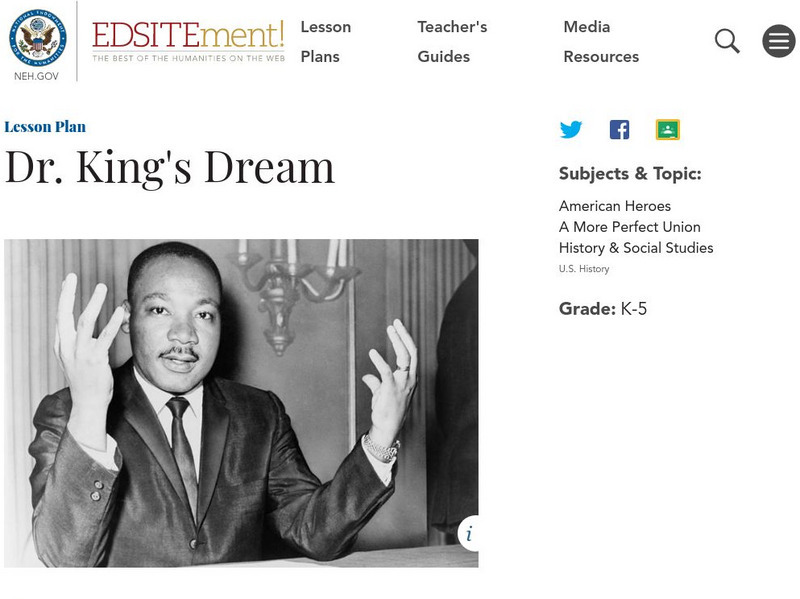
Neh: Edsit Ement: Dr. King's Dream
There are 4 "Guiding Questions" which reveal the content of the lesson plan provided in "Dr. King's Dream:" "What do we mean by the term 'civil rights'?" "Who was Martin Luther King, Jr., and how did he fight for civil rights?" "What can...
TeachEngineering
Teach Engineering: What Happened to the Water? Designing Ways to Get and Clean
In this scenario-based activity, students design ways to either clean a water source or find a new water source, depending on given hypothetical family scenarios. They act as engineers to draw and write about what they could do to...
TeachEngineering
Teach Engineering: Pea Soup Ponds
In this activity, students will learn how water can be polluted by algal blooms. They will grow algae with different concentrations of fertilizer or nutrients and analyze their results as environmental engineers working to protect a...
TeachEngineering
Teach Engineering: Product Development and the Environment
In this activity, students investigate the life cycle of an engineered product and how the product impacts the environment. They analyze a product using a simple life cycle assessment that assigns fictional numerical values for different...
TeachEngineering
Teach Engineering: How Clean Is That Water?
This lesson plan helps students understand the factors that affect water quality and the conditions that allow for different animals and plants to survive. Students will look at the effects of water quality on various water-related...
TeachEngineering
Teach Engineering: Splish, Splash, I Was Takin' a Bath!
In this lesson, students will explore the causes of water pollution and its effects on the environment through the use of models and scientific investigation. In the accompanying activities, they will investigate filtration and aeration...
TeachEngineering
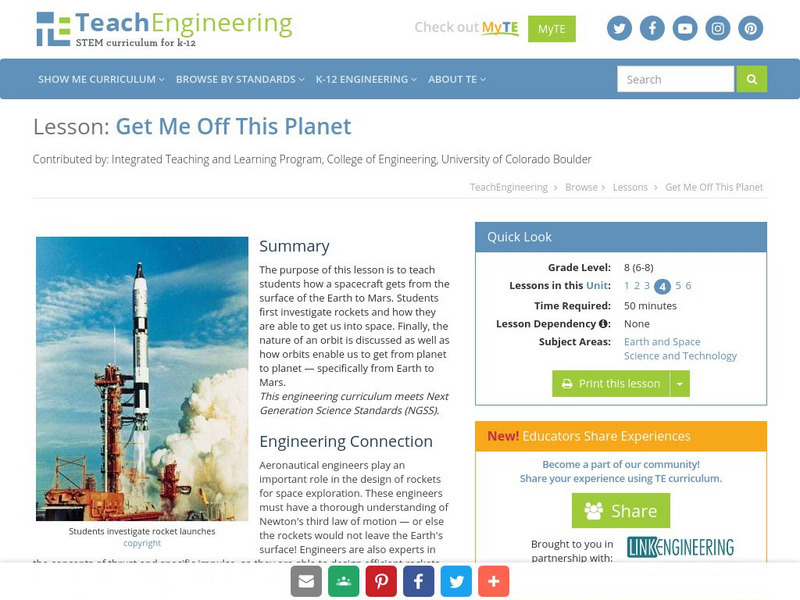
Teach Engineering: Get Me Off This Planet
The purpose of this lesson is to teach learners about how a spacecraft gets from the surface of the Earth to Mars. The lesson first investigates rockets and how they are able to get us into space. Finally, the nature of an orbit is...
TeachEngineering
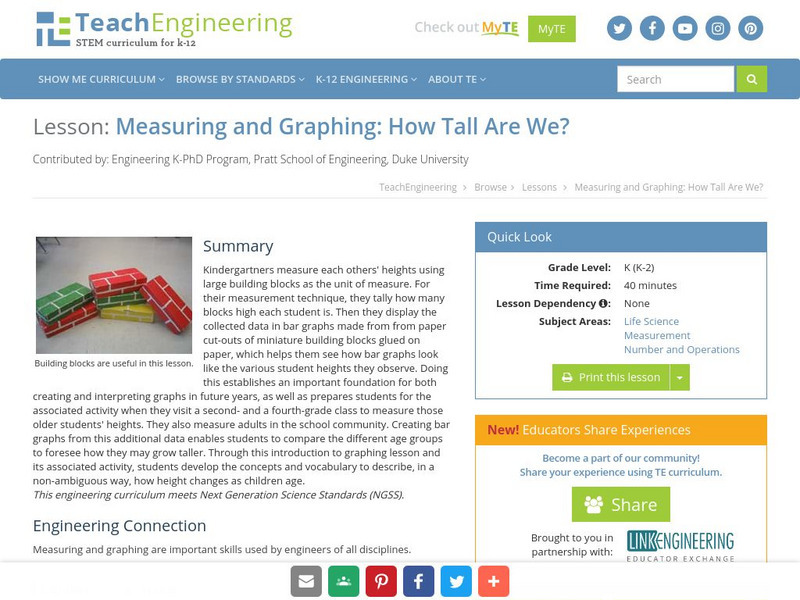
Teach Engineering: How Tall Are We?
Kindergartners measure each other's height using large building blocks, then visit a 2nd and a 4th grade class to measure those learners. They can also measure adults in the school community. Results are displayed in age-appropriate bar...