Hi, what do you want to do?






Houston Area Calculus Teachers
Area and Volume
An AP calculus lesson begins with an activity to determine the volume of a solid using a cross-section. Next, learners review the ways to find the area between two curves , as well how to find the volume of a solid created...
TeachEngineering
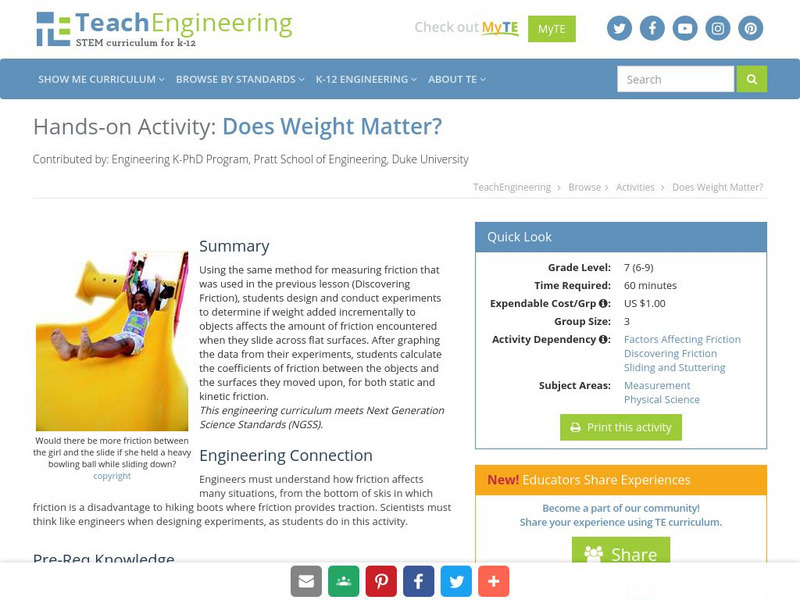
Teach Engineering: Does Weight Matter?
Using the same method for measuring friction that was used in the previous lesson (Discovering Friction), students design and conduct an experiment to determine if weight added incrementally to an object affects the amount of friction...
TeachEngineering
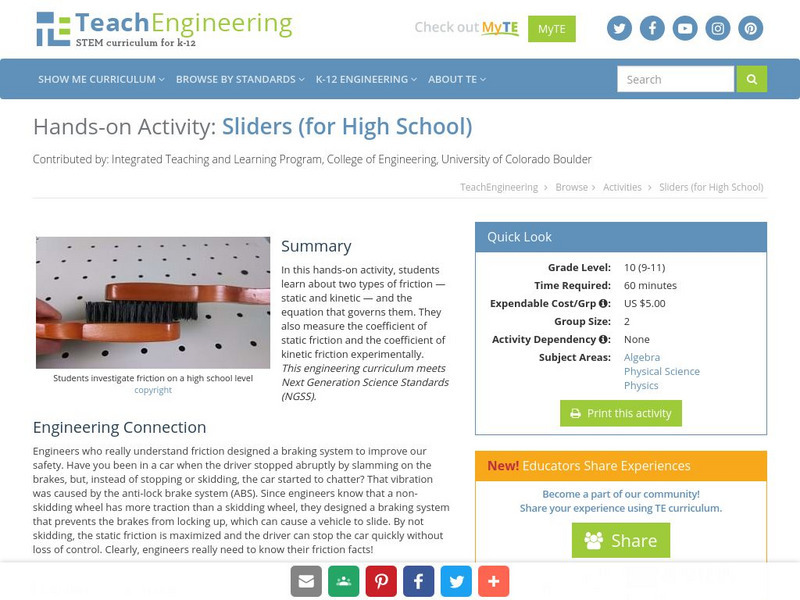
Teach Engineering: Sliders (For High School)
In this hands-on activity, students learn about two types of friction - static and kinetic - and the equation that governs them. They also measure the coefficient of static friction and the coefficient of kinetic friction experimentally.
Texas Instruments
Texas Instruments: An Introduction to Derive
In this activity, students use the Derive software to algebraically solve expressions, find factors, study binomial coefficients, and investigate derivatives and integrals.
TeachEngineering
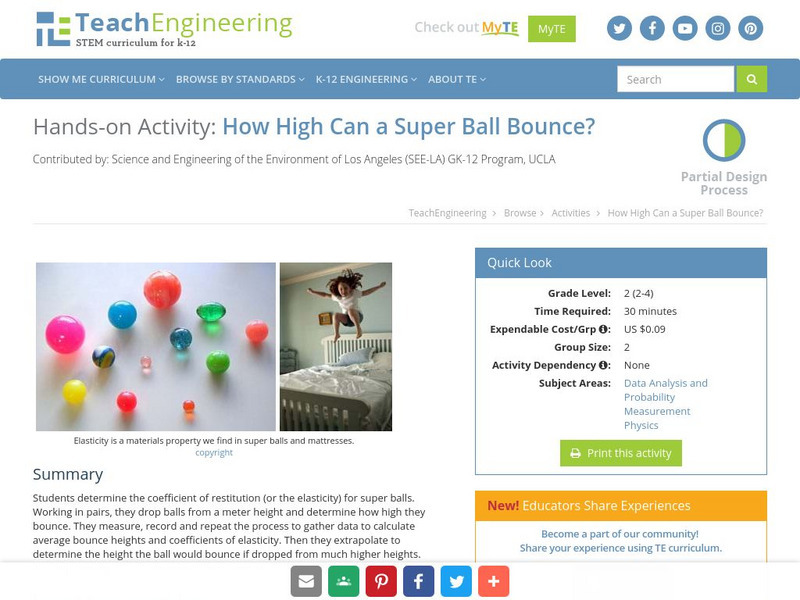
Teach Engineering: How High Can a Super Ball Bounce?
Students determine the coefficient of restitution (or the elasticity) for super balls. Working in pairs, they drop balls from a meter height and determine how high they bounce. They measure, record and repeat the process to gather data...
TeachEngineering
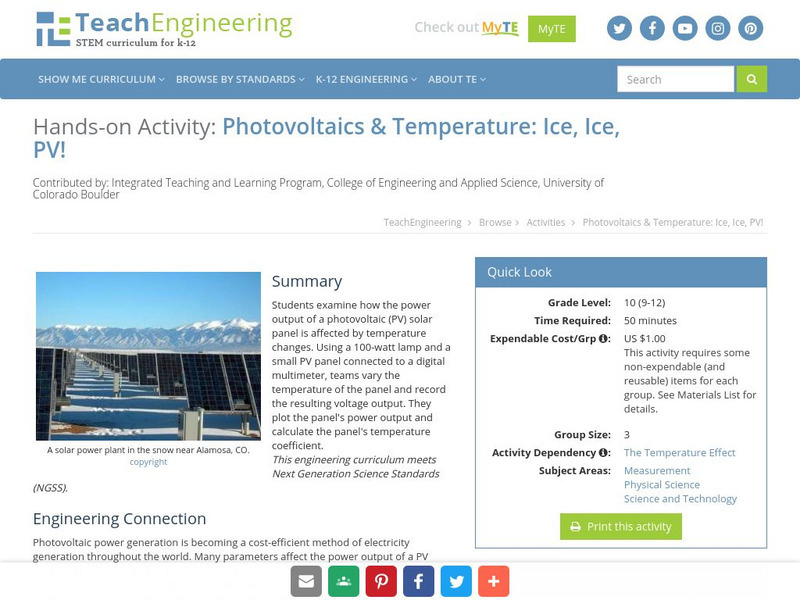
Teach Engineering: Ice, Ice, Pv!
Students examine how the power output of a photovoltaic (PV) solar panel is affected by temperature changes. Using a 100-watt lamp and a small PV panel connected to a digital multimeter, teams vary the temperature of the panel and record...
TeachEngineering
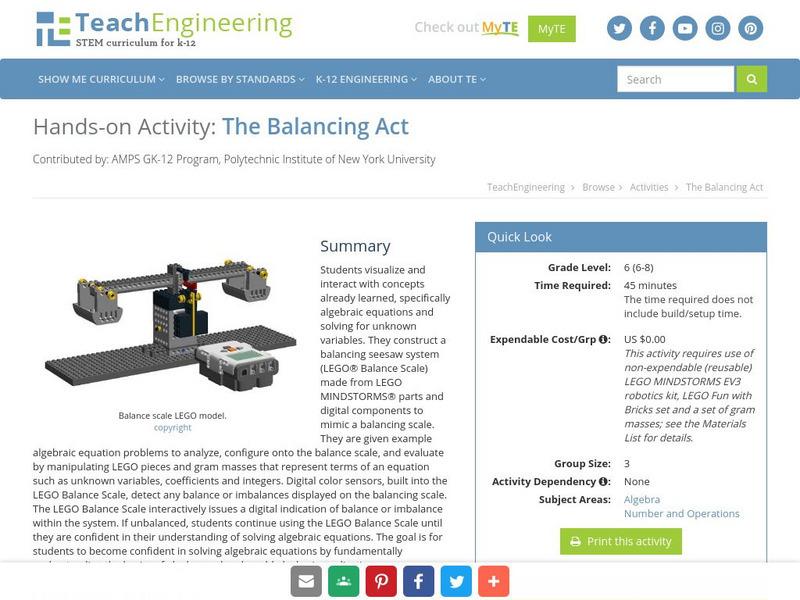
Teach Engineering: The Balancing Act
Students are given the opportunity to visualize and interact with concepts they have already learned, specifically algebraic equations and solving for unknown variables. Students construct a balancing seesaw system (LEGO Balance Scale)...
TeachEngineering
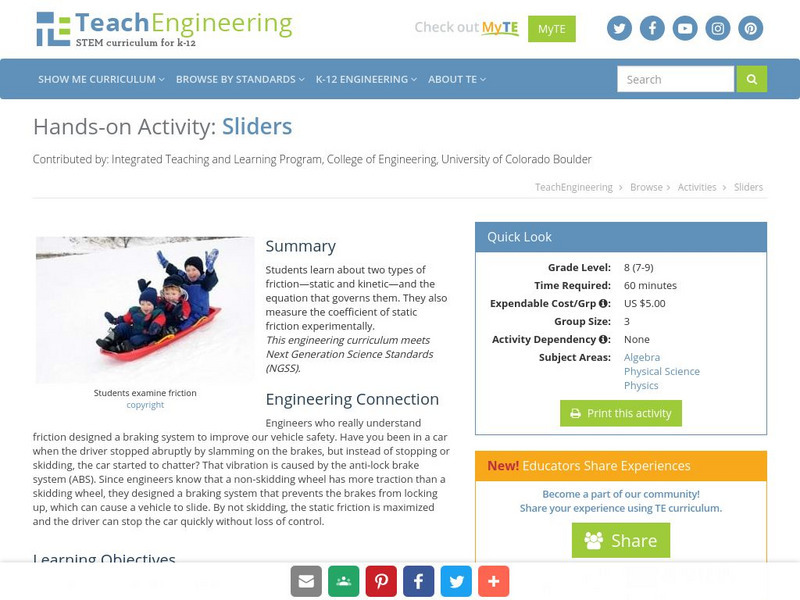
Teach Engineering: Sliders
In this hands-on activity, students learn about two types of friction - static and kinetic - and the equation that governs them. They also measure the coefficient of static friction experimentally.

TeachEngineering
Teach Engineering: Ramp and Review (For High School)
In this hands-on activity - rolling a ball down an incline and having it collide into a cup - the concepts of mechanical energy, work and power, momentum, and friction are all demonstrated. During the activity, students take measurements...
TeachEngineering
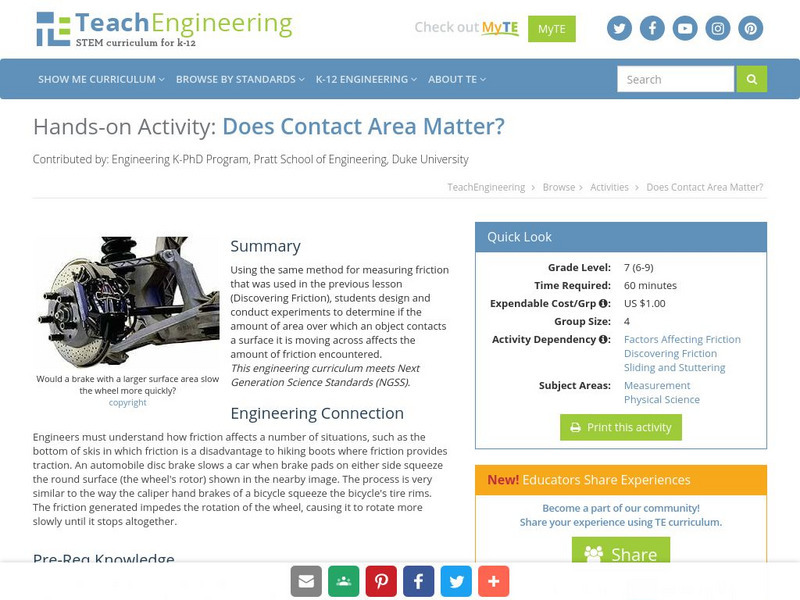
Teach Engineering: Does Contact Area Matter?
Using the same method for measuring friction that was used in the previous lesson (Discovering Friction), students design and conduct an experiment to determine if the amount of area over which an object contacts a surface it is moving...