Hi, what do you want to do?






Curated OER
DNA Extraction from Yeast Cells
Students explore DNA. They work in groups and mix prepared detergent/ salt solution, meat tenderizer solution, Fleischman's yeast and water to extract DNA from yeast. Observations are recorded.

Virginia Department of Education
DNA Structure, Nucleic Acids, and Proteins
What is in that double helix? Explain intricate concepts with a variety of creative activities in a lesson that incorporates multiple steps to cover DNA structure, nucleic acids, and proteins. Pupils explore the history of DNA structure,...

Curated OER
Marshmallow Babies
Eighth graders interpret the genotypes and phenotypes, then pair up chromosomes.

Curated OER
Where Are the Dinosaurs?
Students explore the concept of extinction by studying dinosaurs. In this dinosaur lesson, students distinguish between extinct creatures and those that still exist.

Curated OER
Mendelian and Non-Mendelian Heredity
Tenth graders discuss their physical features, and why they look the way they do. They listen as the teacher discusses DNA, alleles, and dominant or recessive genes. Students perform an experiment with different colored markers...

Curated OER
Where are the Dinosaurs?
Students construct their own diorama based on the life of a dinosaur. In this dinosaur instructional activity, students create models of dinosaurs and dinosaurs' eggs to explore the life cycle of this extinct species.

Curated OER
The Empirical Challenges of Racial Classification
This instructional activity will help students examine their preconceptions and assumptions about racial categories and understand the impossibility of constructing a consistent system of human racial classification.

Curated OER
Heredity
In this science worksheet, middle schoolers find the answers to various types of heredity problems. They use the sheet to set goals for completing the unit.

Curated OER
The Nash Case -- Identifying, Choosing and Using Genes
Students complete a variety of exercises as they examine the case of the Nash family who conceived one child in order to provide cells that may be used in a cell transplant for a dying sibling.

Curated OER
Blending Butterflies
Students create camouflage butterflies. In this camouflage lesson plan, students read about the different types of camouflage. Each student in the class chooses a spot in the classroom and creates a camouflaged butterfly. They hang up...

Curated OER
Lesson 16: DNA Technology
Students research different areas of biotechnology. In this biology lesson, students create a presentation about their research. They debate the topic presented and share their views on the subject.

Curated OER
Born of Blood
Eighth graders use a large Punnett Square and infer how genes determine blood types. In this blood type lesson students predict blood types and demonstrate how Punnett Squares are related to genes and chromosomes.

Curated OER
Square Dancing
Fourth graders investigate the concept of using punnett squares in the determination of the offspring.They collect drawings and pictures and create a collection for student science journals.

Curated OER
Candy Dish Selection
Students explore natural selection. They explore the concepts of adaptations, and the way which random factors affect the survival of individuals and populations.

Curated OER
Drosophila Melanogaster
Students cross wild type flies and mutants, both purchased from a biological supply house (Carolina Biological Supply or Wards, for example) in groups from lesson one.
![Genome Sciences Education Outreach: State Your Traits [Pdf] Lesson Plan](https://static.lp.lexp.cloud/images/attachment_defaults/resource/large/FPO-knovation.png "Genome Sciences Education Outreach: State Your Traits [Pdf] Lesson Plan")
University of Washington
Genome Sciences Education Outreach: State Your Traits [Pdf]
Multi-activity lesson in which learners engage in learning about the inheritance of genetic traits.
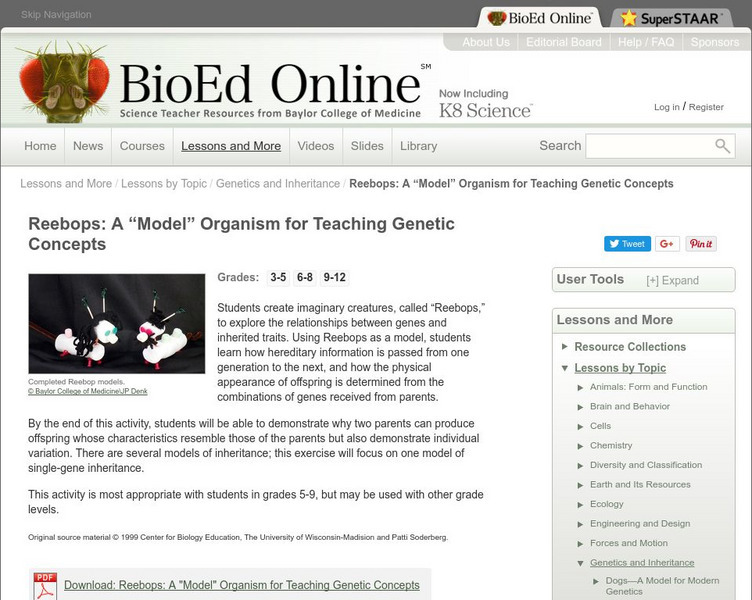
BioEd Online
Bio Ed Online: Reebops: A "Model" Organism for Teaching Genetic Concepts
For this lesson students create imaginary creatures, called "Reebops," to explore the relationships between genes and inherited traits. Using Reebops as a model, students learn how hereditary information is passed from one generation to...
University of Washington
Genome Sciences Education Outreach: State Your Traits (High School Level) [Pdf]
Multi-activity lesson focuses on genetics and the basic principles of inheritance.
Science Buddies
Science Buddies: Pedigree Analysis: A Family Tree of Traits
Some characteristics, like the shape of your hairline, whether your earlobes are attached or detached, and whether or not you have freckles are inherited from your parents. In this science project you will learn about Mendelian traits,...
TeachEngineering
Teach Engineering: Don't Be a Square
After watching video clips from the Harry Potter and the Goblet of Fire movie, students explore the use of Punnett squares to predict genetic trait inheritance. The objective of this lesson is to articulate concepts related to genetics...
PBS
Pbs: Our Genes/our Choices: The Probabilities of Problems: A Look at Inheritance
Learn how the genes inherited from two parents can be recombined in their offspring in this simulation activity. In addition, investigate the probabilities of passing on inherited genetic disorders.
Utah STEM Foundation
Utah Stem Action Center: Inherited Traits
Ever wondered why you might look like your parents? Or an animal cub my look like its mom? Learn about inherited traits with this quick and easy lesson.
Alabama Learning Exchange
Alex: Cats, Dogs,and Dragons. Oh My!
This is a technology-based, hands-on Biology lesson on Heredity and Traits. Students learn about the basics of Heredity through a virtual tour and then work to create their own dragon based on the inheritance of traits.(Adapted from ASIM).
Michigan Reach Out
Michigan Reach Out: Genetics: You Are Unique
In this lesson plan, students learn basic genetics by identifying their inherited traits.