Hi, what do you want to do?





Sophia Learning
Sophia: Informal Language
This lesson discusses informal language and when it should be used. SL.9-10.6 Adapt to task/formal

ReadWriteThink
Read Write Think: Lesson Plan: Audience, Purpose, Language in Electronic Messages
Lesson plan considers changes in writing style since the inception of e-mail and text messaging.
![University of Michigan: How to Give an Academic Talk [Pdf] Article](https://content.lessonplanet.com/knovation/original/32627-6d6b5738d829f3ae323a2287b87a2e0b.jpg?1661500277 "University of Michigan: How to Give an Academic Talk [Pdf] Article")
University of Michigan
University of Michigan: How to Give an Academic Talk [Pdf]
The Awful Academic Talk and the Principles of Effective Talks are discussed and outlined with suggestions for a more interesting speech delivery. This was originally directed to those making academic presentations at a university or...
BBC
Bbc Bitesize: Speaking and Listening: Standard English
Explains what standard English is and when it is used, the difference between formal and informal language, and non-standard forms of English such as those found in dialects.
BBC
Bbc Bitesize Revision: Formal Tone in a Discursive Essay
This page provides several tips for using formal tone in an essay. The tips are arranged into 'Do' and 'Do not use' categories.
Department of Defense
Do Dea: Conventions
Sharpen your use of the formal conventions of English with this self-guided learning module. The module focuses on formal and informal language, making pronouns agree with their antecedents, and common spelling and grammar errors. At the...

Grammarly
Grammarly Handbook: Cliches
This page focuse on cliches and explains why they should not be used in formal writing; it provides examples of other words to get the point across more clearly.
Grammarly
Grammarly Blog: Anytime vs. Any Time
This page focuses on changes in language usage pertaining to "anytime" and "any time." In informal writing "anytime" can be used, but in formal writing "any time" is perferable. Examples are provided.

Grammarly
Grammarly Blog: Anyway, Anyways, or Any Way
This page focuses on formal and informal use of "anyway," anyways," and "any way." Anyways is very infomal and should not be used; "anyway" is correct to mean "in case of" and "any way" should be used for all other situations. Examples...
Grammarly
Grammarly Blog: Anymore vs. Any More
This page explains the use of "anymore" in informal writing, but in formal writing and anywhere else, "any more" is preferable. Examples are provided.
Sophia Learning
Sophia: Correcting Double Negatives
This slideshow lesson focuses on double negatives. It includes defining the term, explaining why they aren't used, providing a list of "no" words, offering ways to correct them with examples, and listing steps to eliminate them in writing.
Sophia Learning
Sophia: Correcting Double Negatives
This slideshow lesson focuses on fixing double negatives. It starts by showing what a double negative really says and how to make it say what they mean. It discusses why they are not used, when they can be used in writing, a list of...
Sophia Learning
Sophia: One vs. You
This slideshow lesson focuses on the use of "one" and "you." It defines each, explains the differences, tells when to use each, and provides examples.
Randall Davis
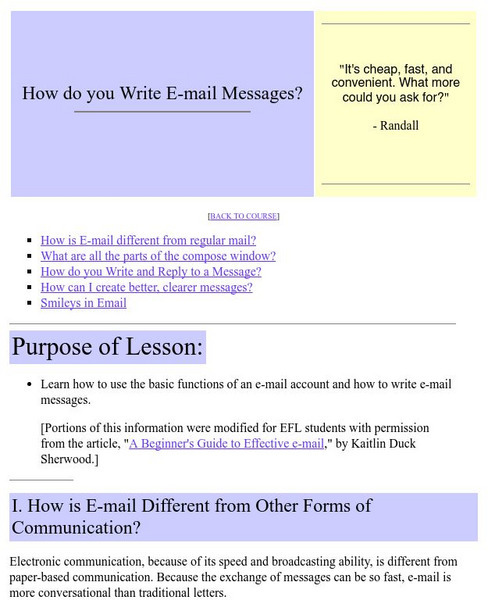
Esl Net world.com: How Do You Write E Mail Messages?
This tutorial explains writing email messages in formal and informal style using Hotmail. It explains the steps taken in composing, replying to, and sending messages.