Hi, what do you want to do?






Curated OER
Glided Age
Eleventh graders will participate to brainstorm on the overhead, characteristics of an "irresponsible" adult and 5 of a "responsible" one? How do these differ if we apply these to businesses? Working in partners--Create a Code of Ethics...

Curated OER
The Great Migration: Two American Tales
Students compare and contrast experiences of European immigrants and African American migrants in U.S. cities. After examining the topic, they write essays evaluating the differences and similarities of the groups' experiences.

Curated OER
Miners of the Prairie: The Days of Shaft Mining in Northern Illinois
Learners explore the life and times of a coal miner in Illinois through the analysis of primary source documents and images.

Curated OER
The AME Church in U.S. History
Ninth graders explore the history of the African Methodist Church in the United States. In this African American history lesson plan, 9th graders discover why the church was founded and research its history and noteworthy members....

Curated OER
Return South Migration Lesson Plan
Students study the reasons so many immigrants returned to the South following the Civil Rights Movement. They examine how the former slaves influenced the cultural life in the Northern cities.

Curated OER
What is an American?
Students create a collage in groups that illustrates what it means to be an American. In this being American lesson plan, students compare different kinds of families and present their collage and describe what it means to be an American.

Curated OER
Live from Channel 22
Students explore 1920s America. In this American history lesson, students research primary and secondary sources in order to examine the events and noteworthy people of the time period. Students use their...

Curated OER
Brucemore Mansion
Students take a closer look at Brucemore Mansion. In this Iowa history lesson, students research what life was like at the mansion during the Gilded Age and through history. Students also research the responsibilities of servants as well...

Curated OER
Bias vs. Perspective: An Inevitable Aspect of Journalism?
Students explore the types of media that U.S. teens prefer the ways in which viewers identify and account for journalistic bias. They explore the ways in which media shapes one's opinion or affects their judgment.

Curated OER
On the Line
Students view a television program that traces the use of the assembly line in mass production and the subsequent conflict between workers' rights and management. They analyze and discuss the portrayal of the American worker over time...

Curated OER
Working Conditions in America: 1880s versus 2000s
Students conduct research into the life of Americans and how working conditions have changed over time from the 1880's to modern times. They use primary and secondary resources in order to compile research in order to report the findings...

Curated OER
USH Test One
Eleventh graders write about one reason immigrants came to the United States in the late 1800's. They take a test that focuses upon past concepts and then an introduction is given by the teacher for the concepts of Imperialism and The...

Curated OER
A Twist On American Symbolism
Students discover how and why flag and national anthem of the United States were created, and in what ways they represent the foundation of our national identity.

Curated OER
We The People
High schoolers engage in this introductory unit of history which is ideal for the first few weeks of instruction. The unit is meant to prepare students for the nation wide contest associated with History Day.

Curated OER
Country Research
Sixth graders research a given country using teacher selected websites. They gather notes about their country in an organized manner. They then create a PowerPoint including a reference page displaying the information they gathered.

Curated OER
Reconstruction Word Search Puzzle
In this social studies worksheet, students look for the words in the puzzle that are related to the theme of the word search. Spelling skills are worked on.

Curated OER
City Bound
Fifth graders identify the reasons for people migrating to cities after the Civil War. Using population data, they discover why populations in cities rose while rural populations fell during 1860 to 1900. They discuss the impact a...
Stanford University
Sheg: Document Based History: Reading Like a Historian: Jacob Riis
[Free Registration/Login Required] Students solve a problem surrounding a historical question by reading primary source documents. This historical inquiry lesson allows students to investigate the photographs of 19th-century progressive...
History Teacher
Historyteacher.net: Immigration & Urban Society: Late 19c: Quiz (2)
10-question multiple choice quiz is immediately scored and evaluates your comprehension of immigration the late 19th century.
Other
On the Lower East Side: Observations of Life in Lower Manhattan
Links to contemporary essays about life on the Lower East Side of New York City in the late 19th and early 20th centuries. These essays cover a range of topics and are well worth exploring to find out what problems writers were exposing...
Independence Hall Association
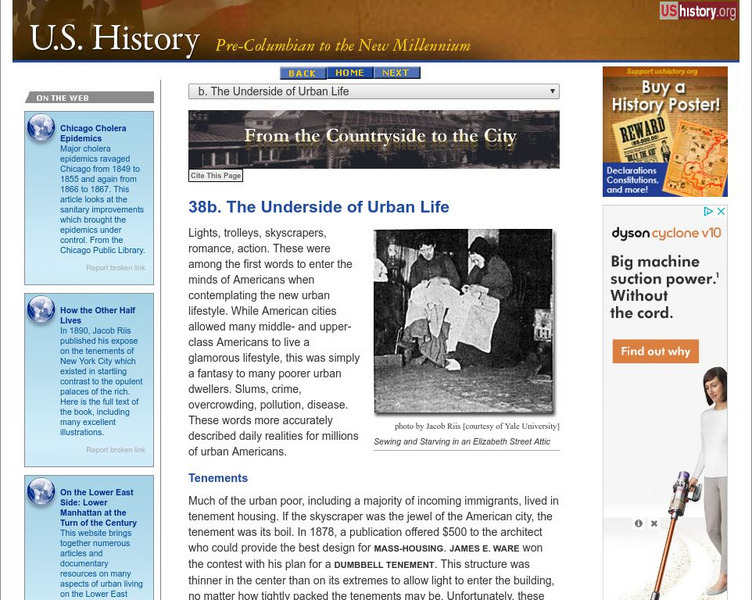
U.s. History: The Underside of Urban Life
Read about the plight of the urban poor in the rapidly growing cities. In addition to the modern skyscrapers, the cities also had tenement housing where the poor lived. Find a description of that housing and the problems this housing bred.

National Humanities Center
National Humanities Center: Toolbox Library: The West, the Gilded and the Gritty: America, 1870 1912
Four nineteenth-century landscape paintings that suggest the meaning of the West in American life.
University of Minnesota
U Mn: Immigrants & Cities: Mapping Ethnic Enclaves in Early 20th Century Us
This resource couples a visual and descriptive map of urban ethnic enclaves with an oral interview by an immigrant growing up in New York City. Its goal is to provide different ways of "mapping" or understanding life for immigrants...

Khan Academy
Khan Academy: Us History: 1865 1898: America Moves to the City
The industrial boom of the late nineteenth century led Americans and immigrants from the world over to leave farming life and head to the city.