Hi, what do you want to do?






US Surgeon General
Get the Facts on E-Cigarettes
Imagine these flavors: chocolate, candy, menthol. What age group do you imagine is the target audience of an advertising campaign that features a product with these flavors? Find out the facts about vaping with a resource that provides...

Ashbrook Center at Ashland University
The Constitutional Convention
Imagine sitting down with representatives of your school to write a new student handbook. What arguments would ensue? How would compromises be made to finish the project? Scholars research the Constitutional Convention using a directory...

American Museum of Natural History
Being An Anthropologist: Laurel Kendall
Imagine studying Korean culture, especially the role of women, as well as marriage and religious rituals from home! Anthropologist Laurel Kendall shares what she has learned from her many trips to this fascinating country half a world away.

University of North Carolina
Audience
Challenging pupils' perspectives by having them walk in the shoes of the reader. An informative resource discusses how to identify an audience and anticipate their needs before writing an upcoming argumentative essay.

American Museum of Natural History
Train of Thought
Hop aboard the train of thought. A remote learning resource has learners consider thought experiments to consider scientific theories. It provides two examples, one on orbiting bodies and the other on the speed of light, for them to work...

American Museum of Natural History
Light, Matter and Energy
Let Einstein's work shine the way. Pupils read about Einstein's iconic equation, E=mc^2, using a remote learning resource and see how ideas from other scientists such as Kepner, Curie, Galilei, and Newton led to its discovery. They...

American Museum of Natural History
Space and Time
Carve out some time to learn about space-time. Young scientists use a remote learning resource to read up on the relationship between space and time. They consider the idea of relativity, see how objects with a large mass can bend space...

American Museum of Natural History
Ask a Scientist About Dinosaurs
Who doesn't want to know more about the mysterious dinosaurs? Learners read about dinosaurs and the process scientists use to continue learning more about the animals in an interview-type format. A paleontologist responds to submitted...

American Museum of Natural History
Talk to a Titanosaur
Learn all about the Titanosaur with an engaging website that delves deep into the large reptile's physical traits, family history, discovery, and fossil reconstruction.

American Museum of Natural History
Nobody's Perfect
Even Einstein made mistakes, you know. A remote learning resource explains how scientists are sometimes unsuccessful. Pupils learn about Einstein's failed quest to find a unified field theory that explained the entire universe.

University of North Carolina
Conditionals: Verb Tense in “If” Clauses
"If you give a mouse a cookie, then he's going to ask for a glass of milk." These iconic words from Laura Numeroff's classic tale offer a great example of conditionals, a topic covered in the handout as part of a larger writing series...

Library of Congress
Loc: American Treasures of Library of Congress: Imagination
This site is on an unusual exhibit at the Library of Congress that focuses on the American imagination in the realm of the arts. Here you can find original documents and drawings in architecture, music, literature and more.

Other
The Imagine Nation
Homepage for the imagine nation, a coalition with the aim of putting innovation and imagination back into schools through art. Links include resources and highlights of initiatives.

NASA
Nasa: Imagine the Universe: Imagine the Universe!
This helpful site provides everything you want to know about studying the universe. Take a look at the tools and methods scientists use to study the universe, discover some of the objects that make up our universe, learn how scientists...
NASA
Nasa: Imagine the Universe: Fa Qs on Quasars
A list of answers to many questions related to quasars and active galaxies.
NASA
Nasa: Imagine the Universe: Supernovae (Basic)
A detailed description of a supernova developing from a single massive star. There is a quiz, related links, animation, lesson plans, and an FAQ sheet available also.
NASA
Nasa: Imagine the Universe: Active Galaxies and Quasars
Describes quasars as being classified within the category of an active galaxy. A description of the emergence of high-energy. Definitions of key words are provided.gamma-ray quasars as an important component of the gamma-ray sky.
NASA
Nasa: Imagine the Universe: Supernovae Remnants
A brief description of supernova remnants with many embedded links to help define terms used in the description. The specific topics are age and the importance of remnants to us and the types. Definitions of key words are provided.
NASA
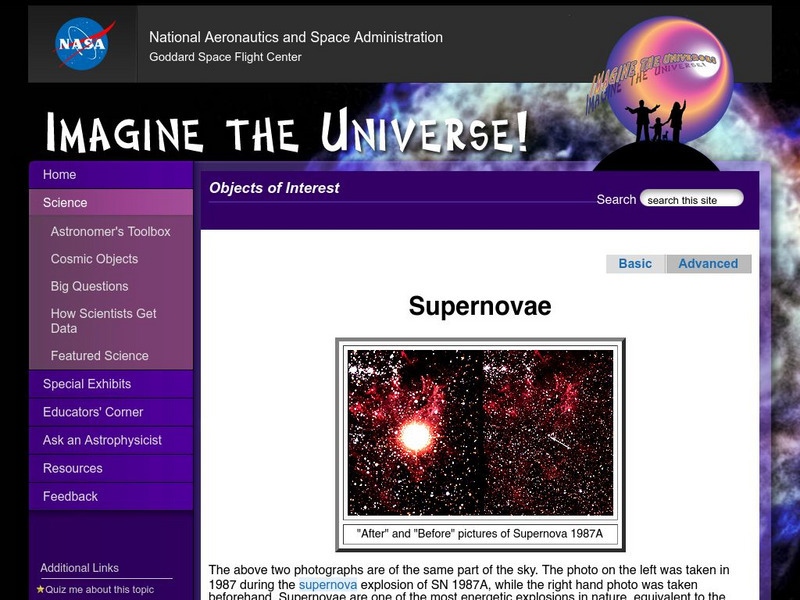
Nasa: Imagine the Universe: Supernovae (Advanced)
Supernovae are divided into two basic physical types, including a description of supernova types and how they are classified based on the existence of hydrogen spectral lines. Definitions of key terms are provided.

NASA
Nasa: Imagine the Universe: Welcome to the World of Multiwavelength Astronomy!
This Imagine the Universe site provides an introduction into the multiwavelength universe and astronomy. Site provides graphics, links to a quiz, facts on this topic as well as teacher resources.
National Endowment for the Arts
National Endowment for the Arts: Imagine! Introducing Your Child to the Arts
Creative play with a purpose! Information, from the National Endowment for the Arts, to encourage and guide your children in understanding and appreciating the arts. Learn how to engage them in arts of all sorts: writing, dance, music,...
NASA
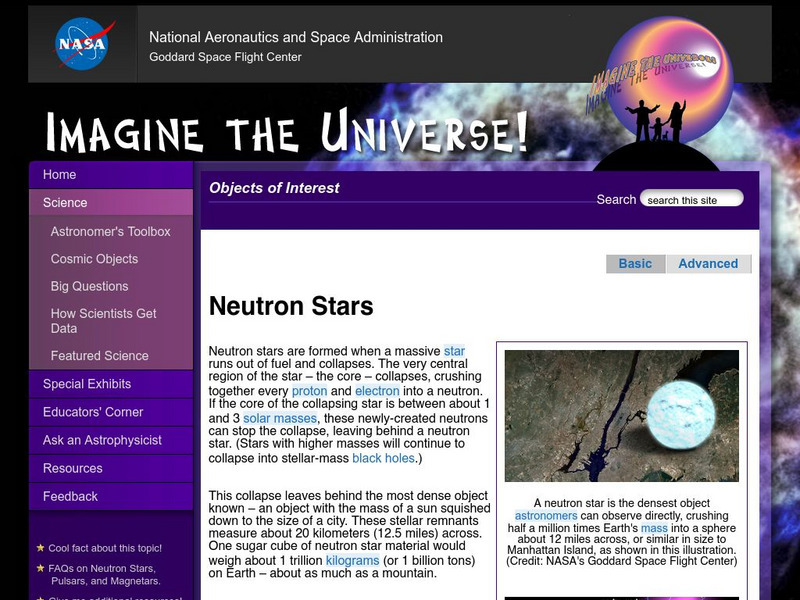
Nasa: Imagine the Universe: Neutron Stars and Pulsars
Discover what neutron stars and pulsars are and view pictures of them. Includes links to additional resources and lesson plans.
NASA
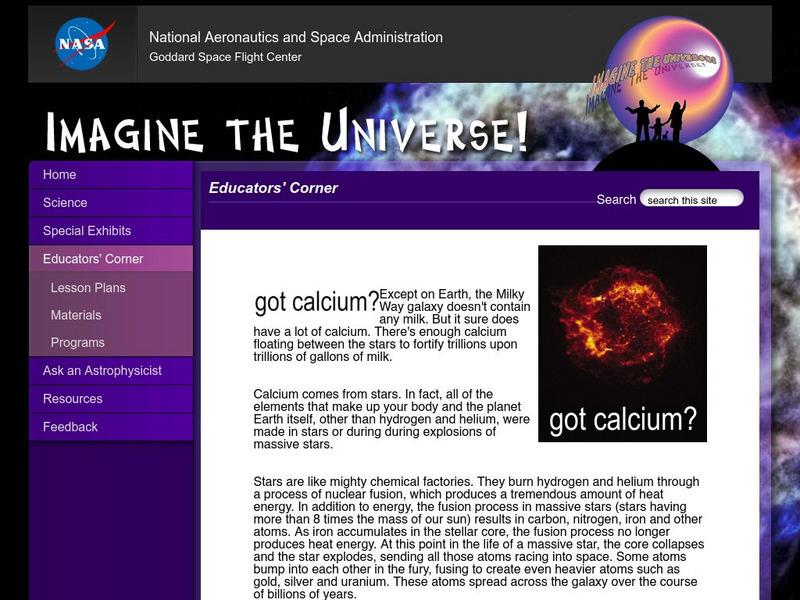
Nasa: Imagine the Universe: Got Calcium?
This site has an article on, "The Milky Way galaxy doesn't contain any milk, but it sure does have a lot of calcium. There's enough calcium floating between the stars to fortify trillions about trillions of stars."
NASA
Nasa: Imagine the Universe: "Burst Behind the Sun"
Site provides the article, "Burst Behind the Sun Reveals Magnetic Charm of Distant Explosion," that details on a gamma-ray burst that occurred on December 6, 2002. Provides graphics and links to learn more about gamma-ray bursts.
Other popular searches
- Creativity and Imagination
- Sociological Imagination
- Imagination & Creativity
- Imagination Theme
- Drama Imagination
- Imagination Writing
- Imagination and Art
- Map Imagination
- Imagination Characters
- Dr. Seuss and Imagination
- Imagination Lesson Plans
- Poetry and Imagination