Hi, what do you want to do?






Curated OER
Letters from Lincoln
Fourth graders explore the childhood of Lincoln and pioneer life in early Indiana. Students respond to literature and write a story using historical fiction. Students explore the writings of President Lincoln and the pioneer community...

Curated OER
A Soldier's Valentine
Students create Valentine's for soldiers in Iraq. They review how to write a friendly paragraph and discuss the military and duties of soldiers in Iraq. They create postcards and write reasons why they are rpoud of the military and how...

Curated OER
Tell Me a Whopper!
Sixth graders investigate tall tales as a literary genre. They listen to a number of tall tales to discover how exaggeration is used as a story element. They write and publish a tall tale using word processing software. They illustrate...

Curated OER
Becoming A Local Historian
Students practice the art of being a historian. They compare primary and secondary resources to conduct a critical thinking assignment. Students compare the map of the Baton Rouge area to a modern one in order to make inferences about...

Curated OER
Ed Tech
Students access and evaluate authority of electronic resources. They synthesize data from multiple sources. Students compose a Works Consulted page. They prepare and deliver an informative speech on a disease or medical condition.

Curated OER
The Sun
Third graders examine basic information about the sun and its relationship to the solar system. They conduct Internet research and complete a WebQuest about the sun. Students then create a seven question true or false quiz using...

Curated OER
Utah American Indian and non-Indian Conflicts
Seventh graders examine Utah's struggle for statehood. They study the relationship between American Indian and non-Indians during the Utah Territorial period and determine that the process of statehood involving cultures, and ideas left...

Curated OER
Types of Forces
Students study scientific names and descriptions of forces. In this motion lesson students organize information into a graphic organizer then teach it to other students.

Curated OER
Industrial Waste Management / Enforcement
Students discover the role of industrial waste enforcement units in the wastewater treatment process. They demonstrate active listening skills and produce a formal letter of thanks that addresses 3 points of information gained from the...

Curated OER
Predictions, Predictions, and More Predictions
Third graders pose questions about the subject of a short story based on the title and cover illustration; then read the story and determine if their questions actually pertained to the story line, and, if so, how the story answered the...

Curated OER
Photoelectric Devices
Fourth graders view a teacher-made PowerPoint presentation on how photoelectric devices work, and then they answer FCAT-like questions on the material presented. They answer questions about what they viewed in an assignment imbedded in...

Curated OER
Lawton: A Child of the Prairie
Students complete word study activities, read a story and write a descriptive paragraph about the setting of Goo Goo Avenue in Lawton 1901.

Curated OER
Illuminating American History
Eighth graders evaluate the effectiveness of adding visuals to printed documents by exploring "The Invention" pages of the "Gutenberg Education Module". They use the techniques of illumination and rubrication to manipulate documents from...

Curated OER
Tuck Everlasting and Economic Decision-Making
Sixth graders use a decision-making grid and list the alternatives and criteria for deciding to drink the Water of Immortality. They examine advertisements and list the product for sale, where it is sold, and why consumers should buy it,...
Tom Richey
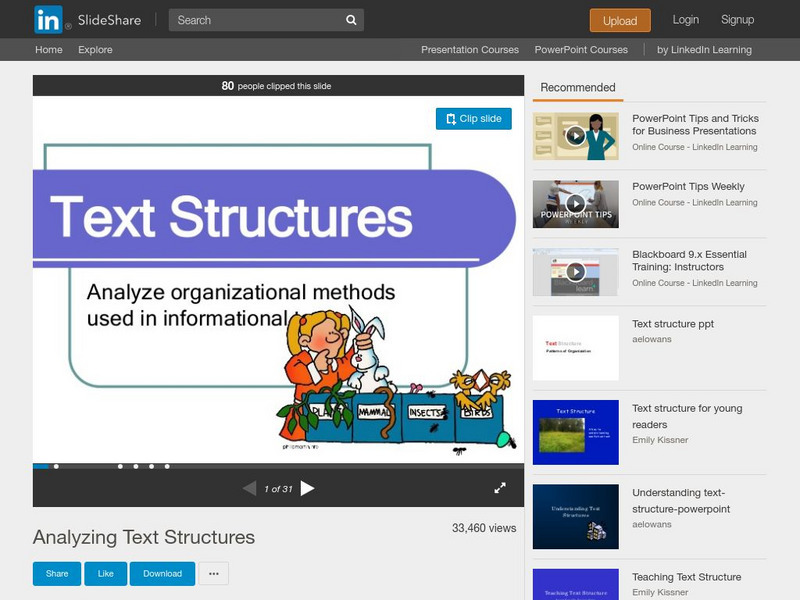
Slide Share: Text Structures: Analyze Organizational Methods
This slideshow focuses on text structures for informational texts including how the author's purpose helps determine the organizational pattern to use and how the reader can use clues to identify the text structure used. Five...

Other
Reading Quest: Strategies for Reading Comprehension: Problem Solution
Working with students on identifying problem and solution in their reading? Here is a simple concept, with a printable chart, for teaching and reinforcing this concept. Applicable for any subject area, could be used (modified) at any level.
Texas Education Agency
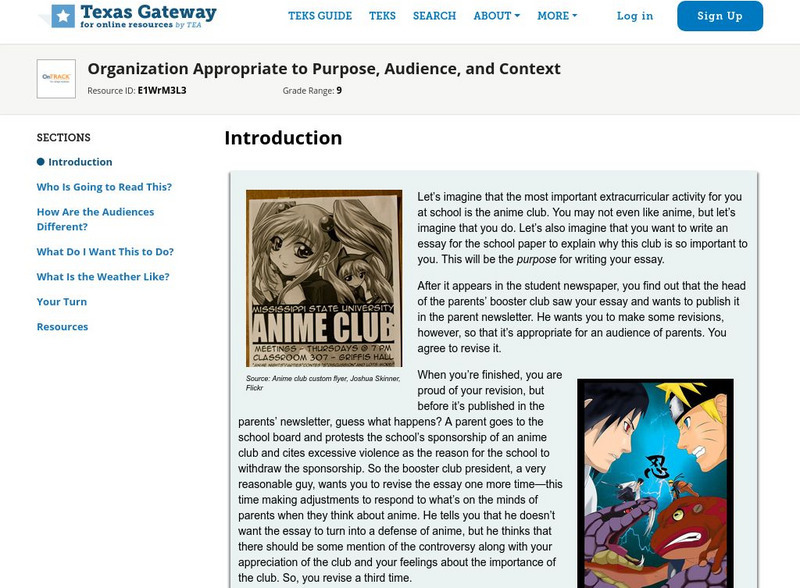
Texas Gateway: Organization Appropriate to Purpose, Audience, and Context
[Accessible by TX Educators. Free Registration/Login Required] This lesson will teach you how to write and organize an essay so that it addresses different purposes, different audiences, and different contexts.

Thinkport Education
Thinkport: Show Me the Money/economic Systems
In this activity, students identify the organizational text structure used in passages that explain different forms of economic systems, and how the economic system of the United States works.
Better Lesson
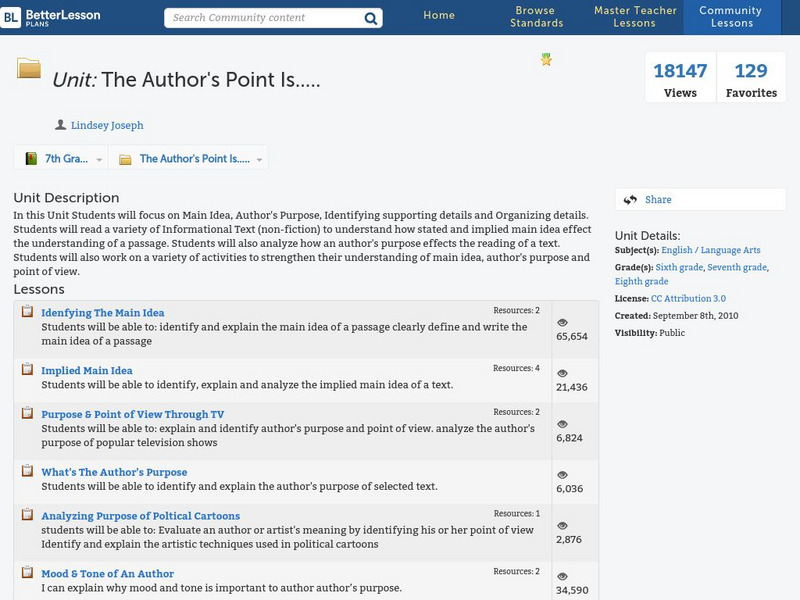
Better Lesson: Unit: The Author's Point Is
Students will focus on Main Idea, Author's Purpose, Identifying supporting details and Organizing details. Students will read a variety of Informational Text (non-fiction) to understand how stated and implied main idea effect the...
Scholastic
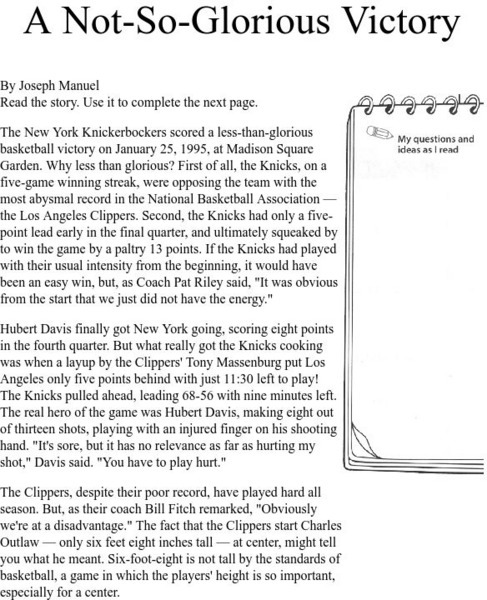
Scholastic: A Not So Glorious Victory
After reading "A Not-So-Glorious," Victory, which is included on this page, have your students practice identifying cause and effect using the printable worksheet.
Other
Fdlrs: Thinking Maps: Examples From Brevard Public Schools
See examples of the use of the eight graphic organizers from Thinking Maps. These maps help students organize their learning and identify ways to reflect different kinds of text. The several examples from each grade K-6 show how to use...
ReadWriteThink
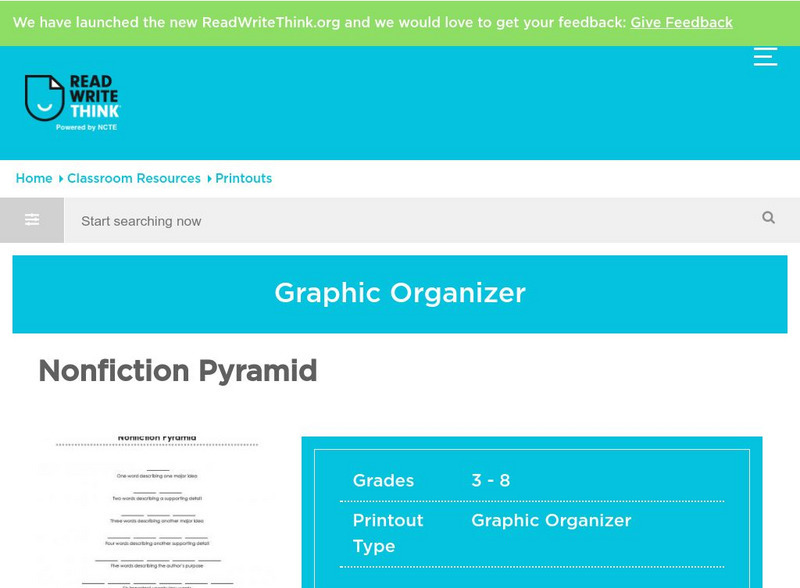
Read Write Think: Nonfiction Pyramid
A printable pyramid for use with nonfiction texts while students identify the main ideas and supporting details within a text. Students also determine author's purpose and key vocabulary words. Directions on how to use this type of...