Hi, what do you want to do?






Southwest Educational Development Laboratory
The Human Body
Nothing is more relevant than the study of the human body. A series of 10 human body lessons begins with growth, ends with reproduction, and hits all the major systems in between. Each lesson provides opening and closing activities as...

Core Knowledge Foundation
The Human Body—Systems and Senses Tell It Again!™ Read-Aloud Anthology
Nine lessons over three weeks explore the human body through read-alouds. Third graders listen to and discuss a reading followed by extension activities, including word work and comprehension practice. Learners draft a narrative essay.

NASA
Collecting Electromagnetic Radiation
Astronomy is literally over your head, but this lesson will explain how we study it. Young scientists make telescopes, calculate and compare the light gathering power of lenses, and simulate detection of infared radiation....

Curated OER
It's All About Me!
Students study the five major body system in this unit. They examine how to keep themselves healthy.
TED Talks
Ted: Ted Ed: What if We Could Look Inside Human Brains?
The brain is what makes us function, yet we understand so little about how it works. We are learning more about the brain by using new technology to monitor epilepsy patients during surgery. Moran Cerf explains the process doctors use to...
TED Talks
Ted: Ted Ed: Diagnosing a Zombie: Brain and Behavior
Video explores diagnosing a zombie by relating its symptoms to various human brain and behavior disorders. [3:44] Includes a brief quiz and a list of additional resources to explore.
TED Talks
Ted: Ted Ed: Diagnosing a Zombie: Brain and Body
Video explores diagnosing a zombie by relating its symptoms to various human brain disorders, such as Parkinson's disease. [3:47] Includes a brief quiz and a list of additional resources to explore.
TED Talks
Ted: Ted Ed: What Are Mini Brains?
Shielded by our thick skulls and swaddled in layers of protective tissue, the human brain is extremely difficult to observe in action. Madeline Lancaster shares how to make a brain in a lab.
CK-12 Foundation
Ck 12: Life Science: Organization of the Human Body
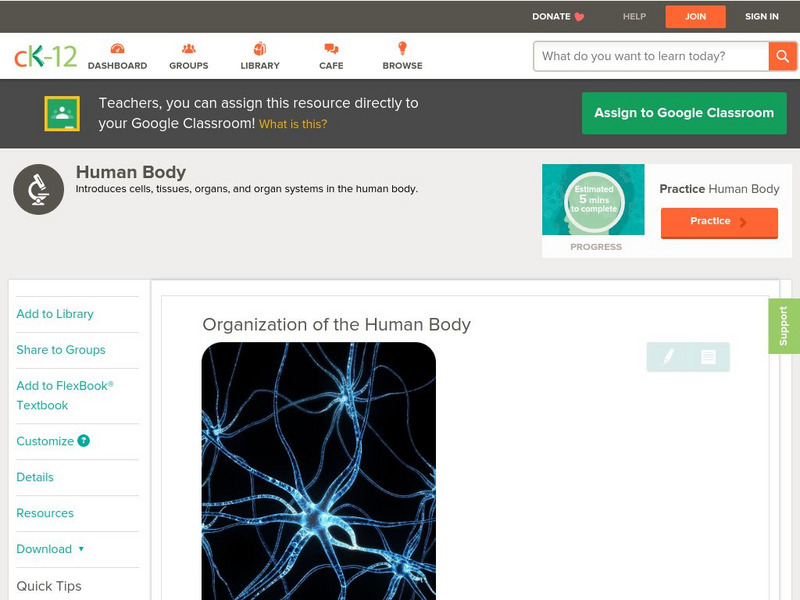
[Free Registration/Login may be required to access all resource tools.] Cells, like these nerve cells, do not work in isolation. To send orders from your brain to your legs, for example, signals pass through many nerve cells. These cells...
CK-12 Foundation
Ck 12: Life Science: Human Vision
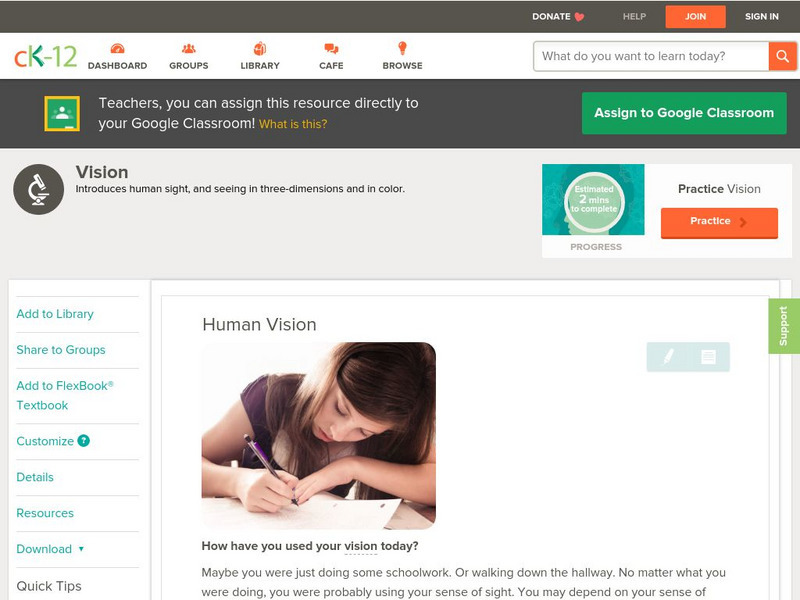
[Free Registration/Login may be required to access all resource tools.] Sight, or vision, is the ability to see light. It depends on the eyes detecting light and forming images. It also depends on the brain making sense of the images, so...
TED Talks
Ted: Ted Ed: What Is Dyslexia?
Kelli Sandman-Hurley urges us to think again about dyslexic brain function and to celebrate the neurodiversity of the human brain. [4:35]
CK-12 Foundation
Ck 12: Life Science: Central Nervous System
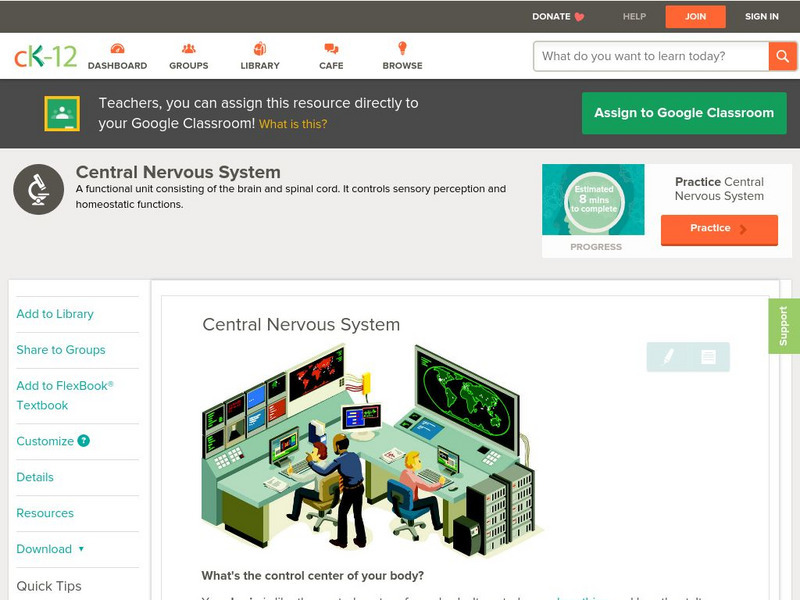
[Free Registration/Login may be required to access all resource tools.] The central nervous system (CNS) is the largest part of the nervous system. It includes the brain and the spinal cord. The bony skull protects the brain. The spinal...
TeachEngineering
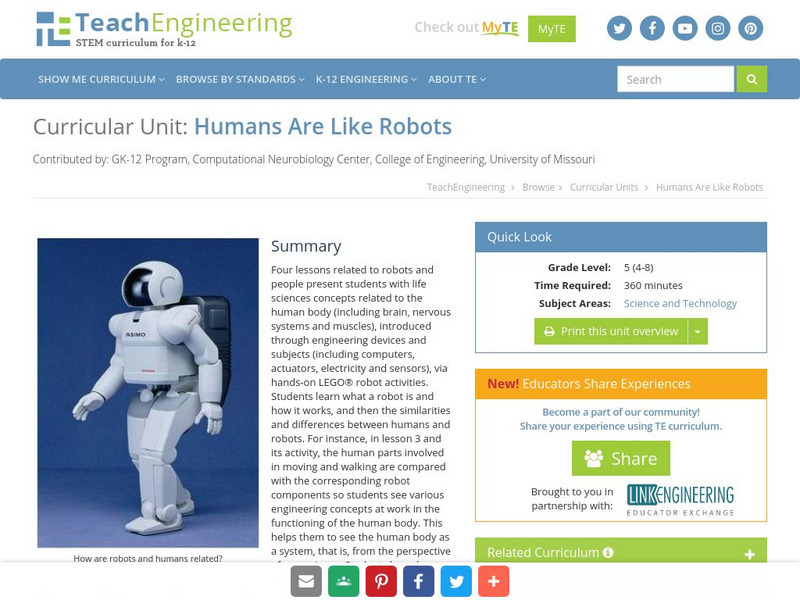
Teach Engineering: Humans Are Like Robots
Four lessons related to robots and people present students with life sciences concepts related to the human body (including brain, nervous systems and muscles), introduced through engineering devices and subjects (including computers,...

National Cancer Institute at the National Institutes of Health
Seer Training Modules: Introduction to the Nervous System
Self-guided learning activity where students learn about the structure and function of the human nervous system. There is a short quiz at the end of the lesson to check for understanding.
TED Talks
Ted: Ted Ed: Can You Solve the Passcode Riddle?
In a dystopian world, your resistance group is humanity's last hope. Unfortunately, you've all been captured by the tyrannical rulers and brought to the ancient coliseum for their deadly entertainment. Will you be able to solve the...
TED Talks
Ted: Ted Ed: The Difference Between Classical and Operant Conditioning
Peggy Andover explains how the brain can associate unrelated stimuli and responses, proved by Ivan Pavlov's famous 1890 experiments, and how reinforcement and punishment can result in changed behavior. [4:13]
TED Talks
Ted: Ted Ed: How Do We Smell?
An adult human can distinguish up to 10,000 odors. You use your nose to figure out what to eat, what to buy and even when it's time to take a shower. But how do the molecules in the air get translated into smells in your brain? This...
TED Talks
Ted: Ted Ed: Inside Your Computer
How does a computer work? The critical components of a computer are the peripherals (including the mouse), the input/output subsystem (which controls what and how much information comes in and out), and the central processing unit (the...
TED Talks
Ted: Ted Ed: How Does Your Body Know What Time It Is?
Being able to sense time helps us do everything from waking and sleeping to knowing precisely when to catch a ball that's hurtling towards us. And we owe all these abilities to an interconnected system of timekeepers in our brains. But...
TED Talks
Ted: Ted Ed: What's an Algorithm?
An algorithm is a method of solving problems both big and small. Though computers run algorithms constantly, humans can also solve problems with algorithms. David J. Malan explains how algorithms can be used in seemingly simple...
TED Talks
Ted: Ted Ed: The Pattern Behind Self Deception
Michael Shermer says the human tendency to believe strange things- from alien abductions to dowsing rods- boils down to two of the brain's most basic, hard-wired survival skills. He explains what they are and how they get us into...
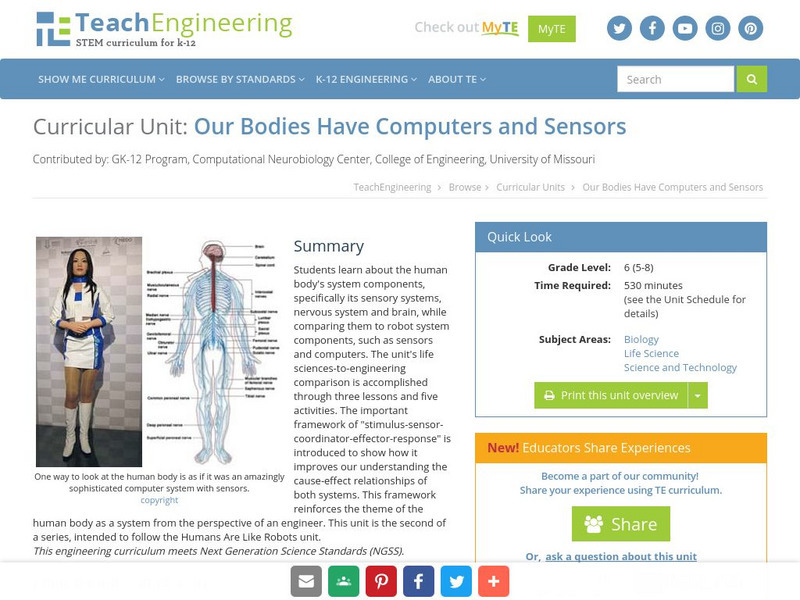
TeachEngineering
Teach Engineering: Our Bodies Have Computers and Sensors
Students learn about the human body's system components, specifically its sensory systems, nervous system and brain, while comparing them to robot system components, such as sensors and computers. The unit's life sciences-to-engineering...