
Curated OER
BUGS-INSECTS
Students participate in a theme study while teaching primary students basic skills according to Individual Education Plan (IEP) goals in Reading, Math, and Writing. The lesson plan is concerned primarily with the concept of insects.

Curated OER
Locke's Second Treatise on Civil Government
In this online interactive history worksheet, students respond to 10 short answer and essay questions about Locke's Second Treatise on Civil Government.
Sophia Learning
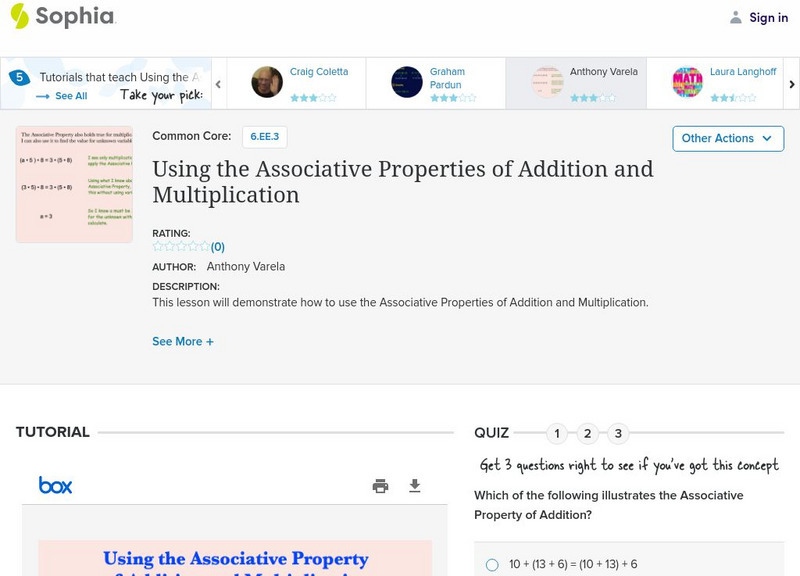
Sophia: Using the Associative Properties of Addition and Multiplication
This lesson will demonstrate how to use the Associative Properties of Addition and Multiplication.

Sophia Learning
Sophia: Using Associativity: Lesson 1
This lesson will demonstrate how to use the Associative Properties of Addition and Multiplication. It is 1 of 4 in the series titled "Using Associativity."
TeachEngineering
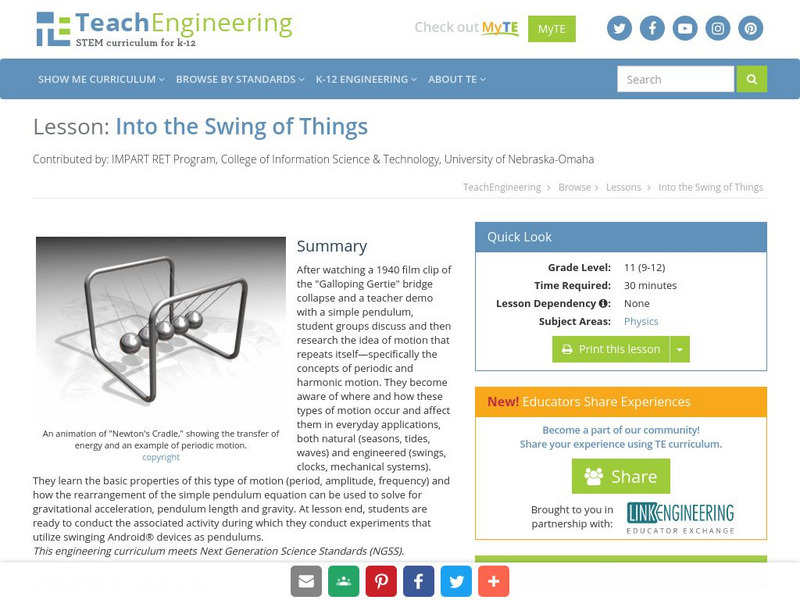
Teach Engineering: Into the Swing of Things
Students learn the basic properties of periodic and harmonic motion, and how the rearrangement of the simple pendulum equation can be used to solve for gravitational acceleration, pendulum length, and gravity. At lesson end, students are...
Texas A&M University
Wtamu Virtual Math Lab: Intermediate Algebra: Properties of Real Numbers
After finishing this tutorial, you'll be well versed in various properties of real numbers: identity and inverse properties, commutative and associative properties, and distributive properties. You'll also know about the various symbols...
TeachEngineering
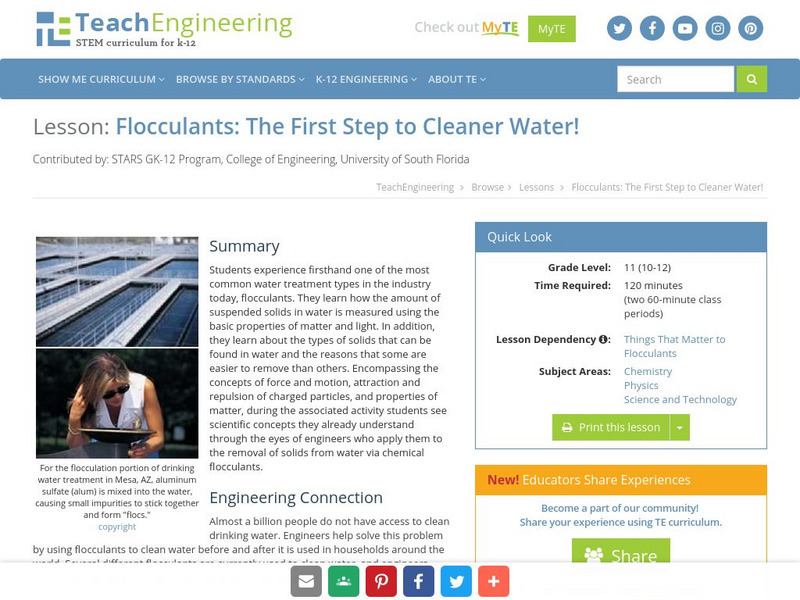
Teach Engineering: Flocculants: The First Step to Cleaner Water!
Students experience firsthand one of the most common water treatment types in the industry today, flocculants. They learn how the amount of suspended solids in water is measured using the basic properties of matter and light. In...
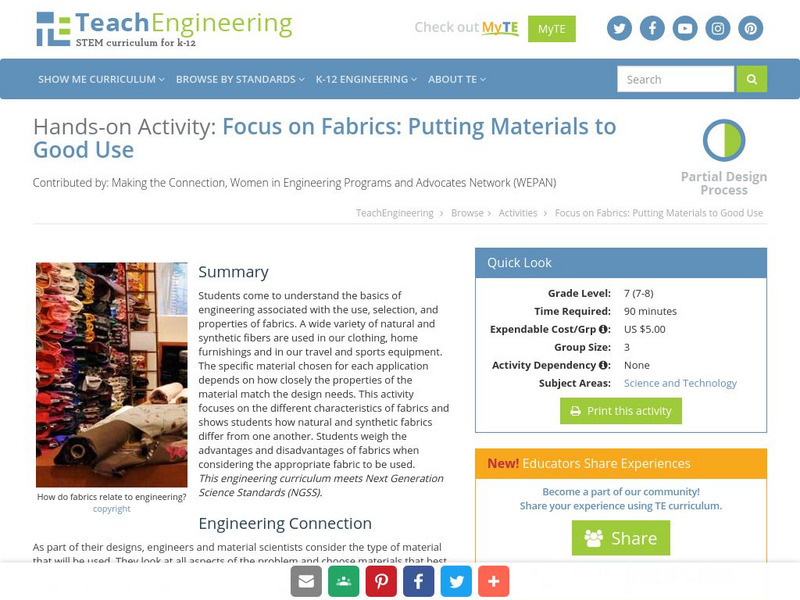
TeachEngineering
Teach Engineering: Focus on Fabrics: Putting Materials to Good Use
The goal is for students to understand the basics of engineering associated with the use, selection, and properties of fabrics. A wide variety of natural and synthetic fibers are used in our clothing, home furnishings and in our travel...
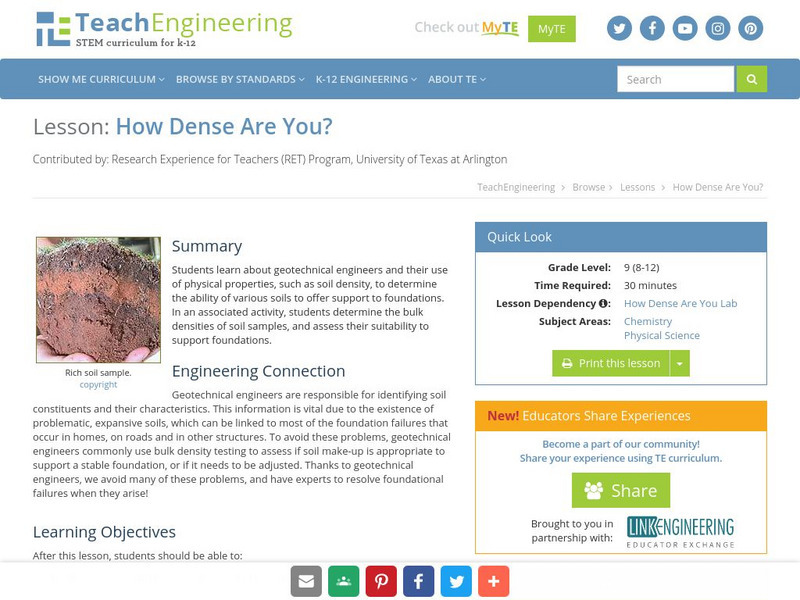
TeachEngineering
Teach Engineering: How Dense Are You?
Young scholars learn about geotechnical engineers and their use of physical properties, such as soil density, to determine the ability of various soils to offer support to foundations. In an associated activity, students determine the...
![Design Build: Exploring the Fundamental Requirements of Structural Design [Pdf] Lesson Plan](https://static.lp.lexp.cloud/images/attachment_defaults/resource/large/FPO-knovation.png "Design Build: Exploring the Fundamental Requirements of Structural Design [Pdf] Lesson Plan")
Other
Design Build: Exploring the Fundamental Requirements of Structural Design [Pdf]
For this lesson unit from the Science Teachers' Association of Ontario (STAO), young scholars fold paper to explore the properties and shapes of materials that give structures their stability and strength. They record their ideas as they...

TeachEngineering
Teach Engineering: Laser Types and Uses
Through two classroom demos, students are introduced to the basic properties of lasers through various mediums. In the Making an Electric Pickle demonstration, students see how cellular tissue is able to conduct electricity, and how this...
Other
American Statistical Association: Using Dice to Introduce Sampling Distributions
In this lesson, young scholars use a dice simulation to investigate how random sampling affects the properties of the distribution of a sample proportion, and are introduced to the sampling distribution of the sample proportion.
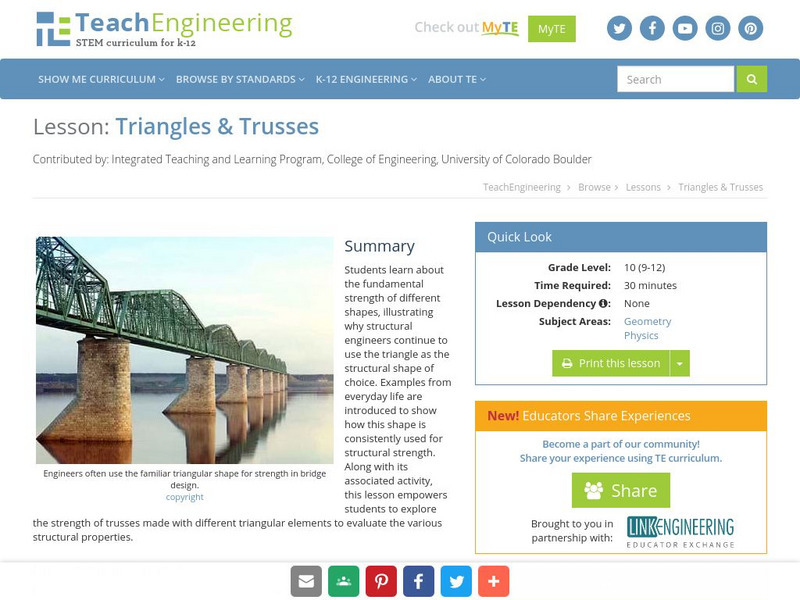
TeachEngineering
Teach Engineering: Triangles & Trusses
Students learn about the fundamental strength of different shapes, illustrating why structural engineers continue to use the triangle as the structural shape of choice. Examples from everyday life are introduced to show how this shape is...
TeachEngineering
Teach Engineering: Creepy Silly Putty
Students learn about viscoelastic material behavior, such as strain rate dependence and creep, by using silly putty, an easy-to-make polymer material. They learn how to make silly putty, observe its behavior with different strain rates,...
Saddleback College
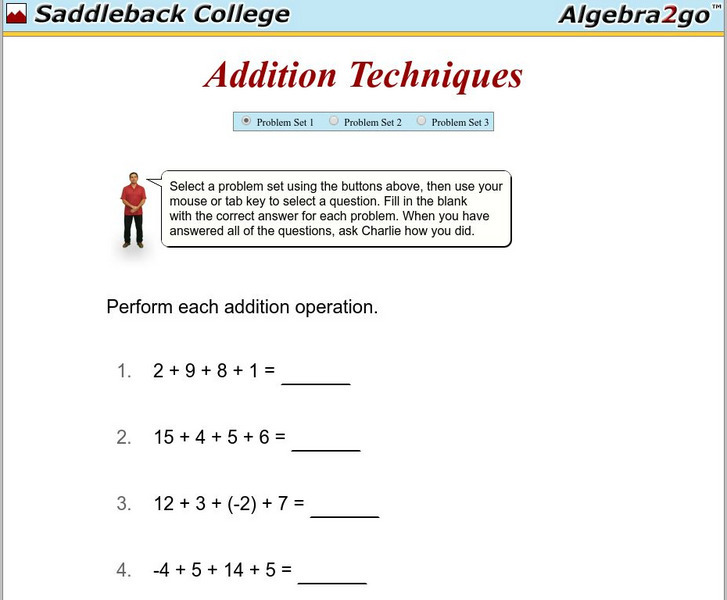
Algebra2go: Addition Techniques: Problem Sets
This resource has three problem sets to practice addition using associtaive and commutative property of addition. Select a problem set, then select a question. Fill in the blank with the correct answer for each problem. When you have...
TeachEngineering
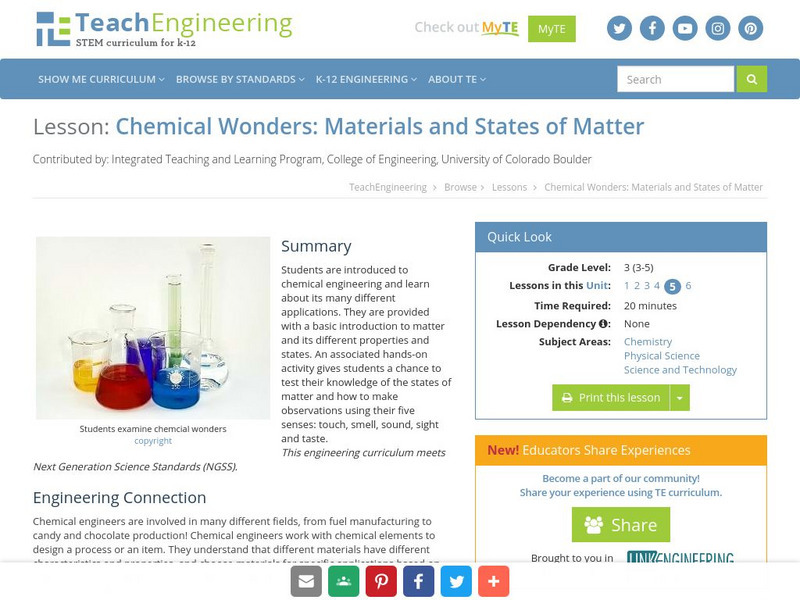
Teach Engineering: Chemical Wonders
Students are introduced to chemical engineering and learn about its many different applications. They are provided with a basic introduction to matter and its different properties and states. An associated hands-on activity gives...
TeachEngineering
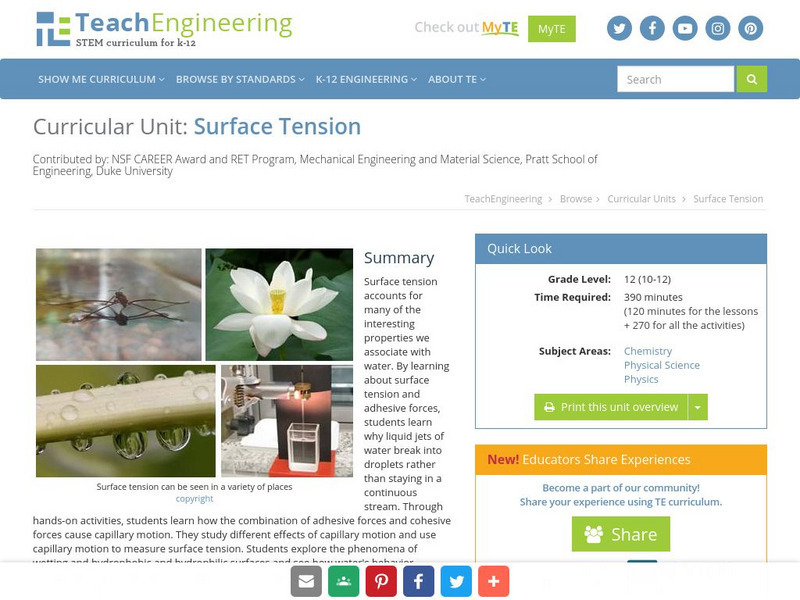
Teach Engineering: Surface Tension
Surface tension accounts for many of the interesting properties we associate with water. By learning about surface tension and adhesive forces, students learn why liquid jets of water break into droplets rather than staying in a...
TeachEngineering
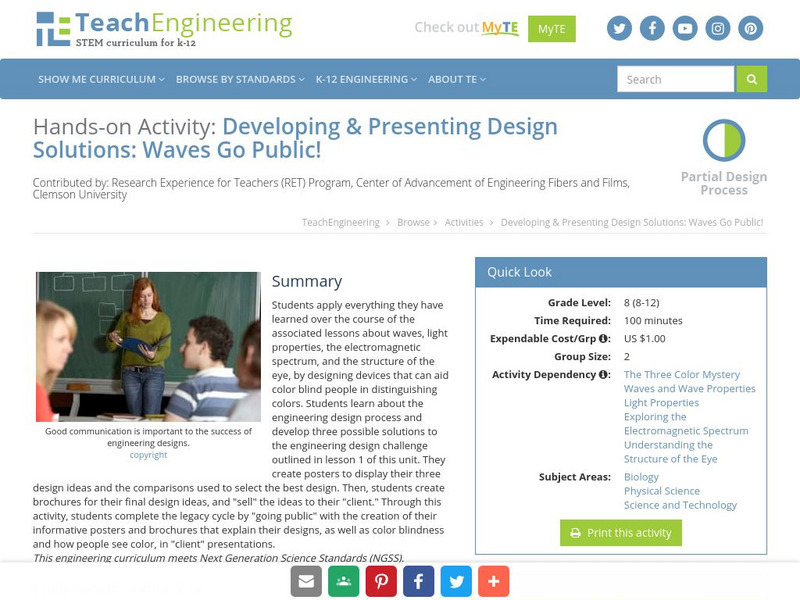
Teach Engineering: Waves Go Public!
Students apply everything they have learned over the course of the associated lessons about waves, light properties, the electromagnetic spectrum, and the structure of the eye, by designing devices that can aid color blind people in...
TeachEngineering
Teach Engineering: Start Networking!
To get a better understanding of complex networks, students create their own, real social network example by interacting with their peers in the classroom and documenting the interactions. They represent the interaction data as a graph,...