Hi, what do you want to do?





Ibis Communications
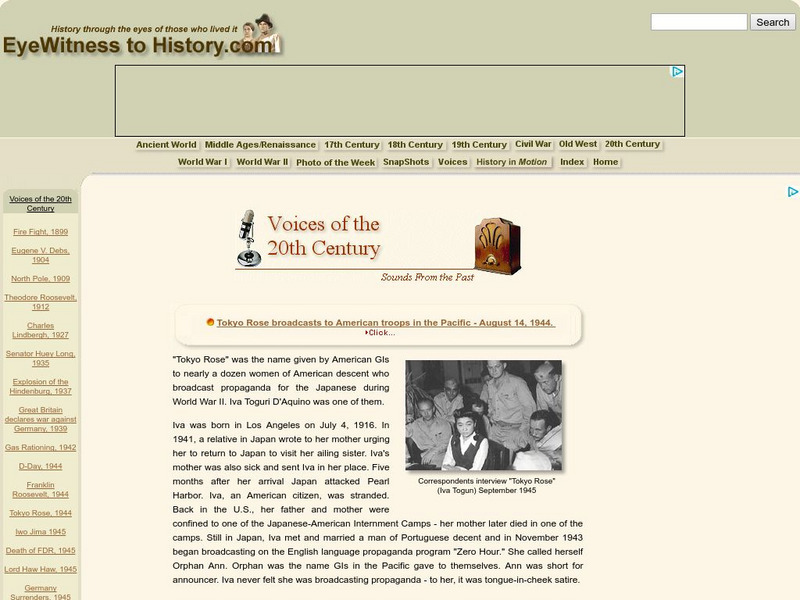
Eyewitness to History: Tokyo Rose
Students investigate ?Tokyo Rose? the name given by American GIs to nearly a dozen women of American descent who broadcasted propaganda for the Japanese during World War II. The resource consists of an audio clip of Tokyo Rose broadcasts...

Khan Academy
Khan Academy: Ap Us History: 1890 1945: The United States in World War I
Discusses what triggered World War I, why the United States joined the war, and the impact the war had on life in the United States. Includes questions for students at end.

Other
Civil War News: Roswell Women Exiled
This site from The Civil War News discusses the story of the women of Georgia's Roswell mills who were forced from their homes and jobs during the American Civil War. The factories which employed these women were destroyed, and as a...
Ibis Communications
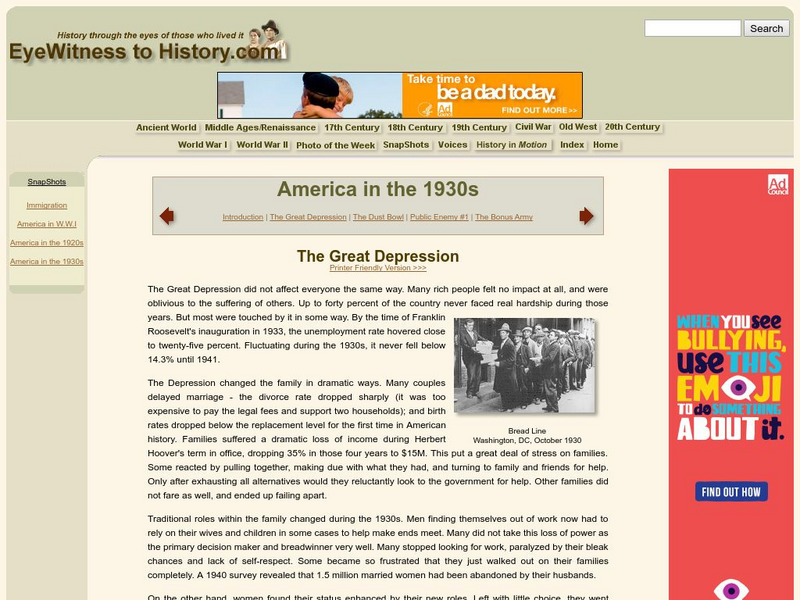
Eyewitness to History: America in the 1930s: Great Depression
This history of the Great Depression looks at its effect on American citizens, including the changes to women's societal roles. Includes photographs.
Stephen Byrne
History for Kids: Pocahontas
A collection of folklore and facts of one of the most famous Native American women in history. Get to know who Pocahontas was and why she is remembered in social studies lessons.
National Women's Hall of Fame
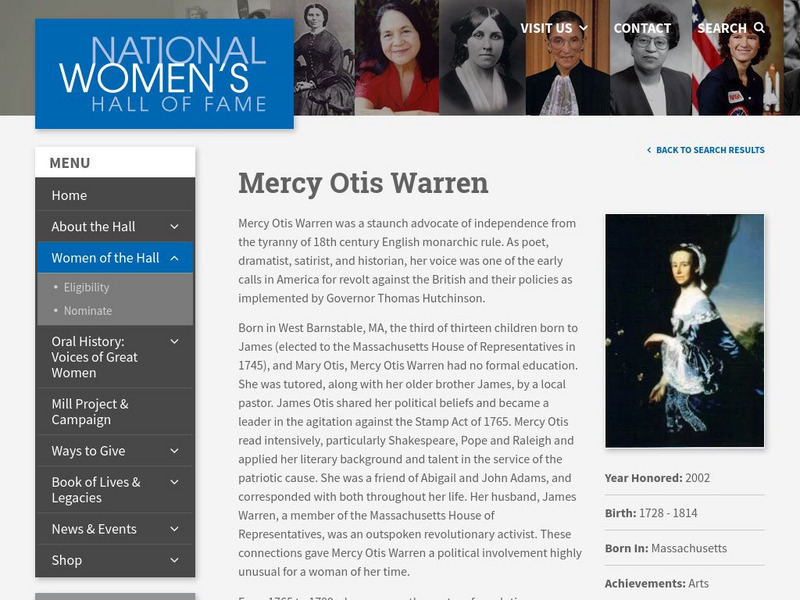
National Women's Hall of Fame: Mercy Otis Warren
Short biographical sketch on Mercy Otis Warren, an American revolutionary activist who called for revolt against the British.
Other
Women in History: Phillis Wheatley
This fact sheet provides dates and details about the life and work of the poet Phillis Wheatley.
Other
Women in History: Harriet Beecher Stowe
This site provides a brief listing of Harriet Beecher Stowe's education, family background, and her accomplishments.
Digital History
Digital History: How Revolutionary Was the American Revolution?
How did the American Revolution reflect a change in American society? Read about how political participation increased across the classes, and see how the question of slavery and women's rights became a thorn in the side of those...

Independence Hall Association
U.s. History: The Emergence of "Women's Sphere"
The Cult of Domesticity and the Women's Sphere pertained to upper-middle class white women, but the ideals spread out into American culture. Read about how such women were supposed to behave, and see what privileges these women might...
Independence Hall Association
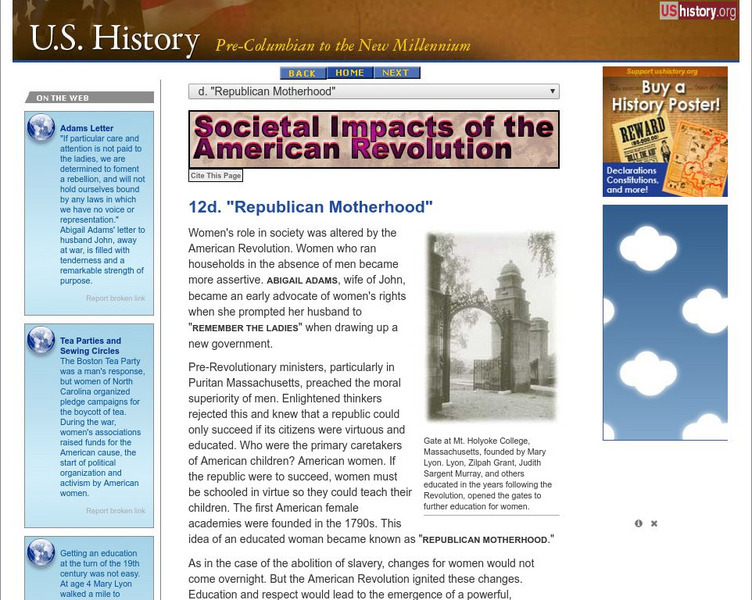
U.s. History: "Republican Motherhood"
Although brief, this article makes clear the change in the role and perception of women in the new United States. See why it was deemed important for women to have the chance to be educated.
The History Cat
The History Cat: The California Gold Rush
Describes the events that led to the California Gold Rush, the lives of the miners, the discrimination faced by Chinese immigrant miners and African Americans, the women who mostly stayed behind when their husbands went west as well as...
National Women’s History Museum
National Women's History Museum: The Sit in Movement
Being served at a lunch counter was normal for whites, but African Americans were not allowed to sit at lunch counters throughout the South. Learn details of the Greensboro Sit-In.
Digital History
Digital History: Impact of the Revolution
These four Digital History excerpts from primary source documents attest to the impact the Revolutionary War did (and did not) have upon society and the status of and attitudes toward women and slaves in the newly established United States.
Independence Hall Association
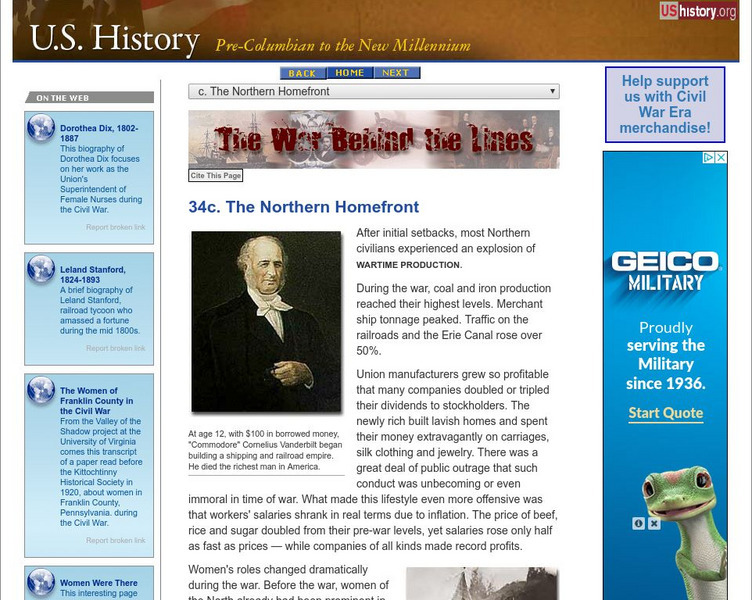
U.s. History: The Northern Homefront
The military-industrial complex thrived in the North during the Civil War, but read about how inflation affected the ordinary worker. See how the role of women expanded to fill in for men who were away fighting. Women also had an impact...
PBS
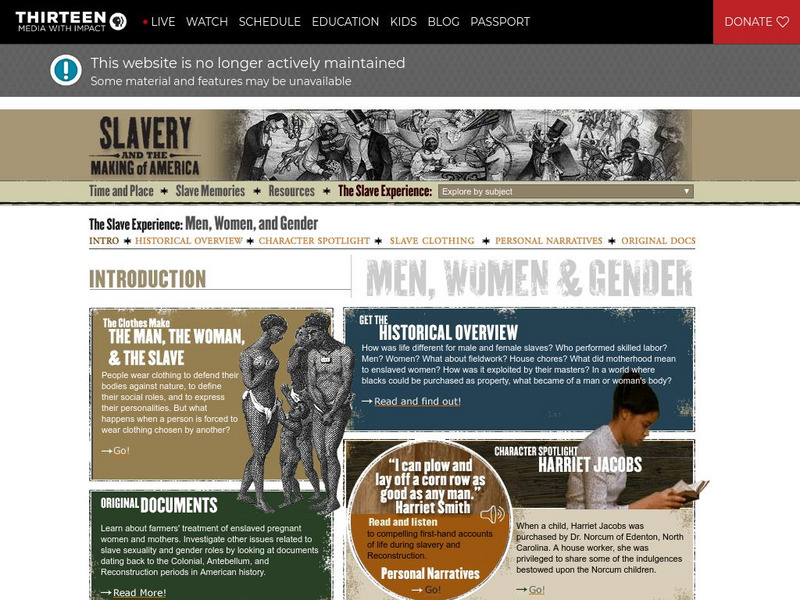
Wnet: Thirteen: Slavery & Making of America: The Slave Experience: Men, Women & Gender
Learn about issues related to slave gender roles at this PBS series site that features illustrations and documents dating back to the Colonial, Antebellum, and Reconstruction periods in American history.