Hi, what do you want to do?





Utah State Office of Education
Utah Science: Properties and Behaviors of Heat, Light and Sound
How can scientists lump heat, light and sound together when investigating properties and behaviors? This learning module will address that question through a series of activities.
Concord Consortium
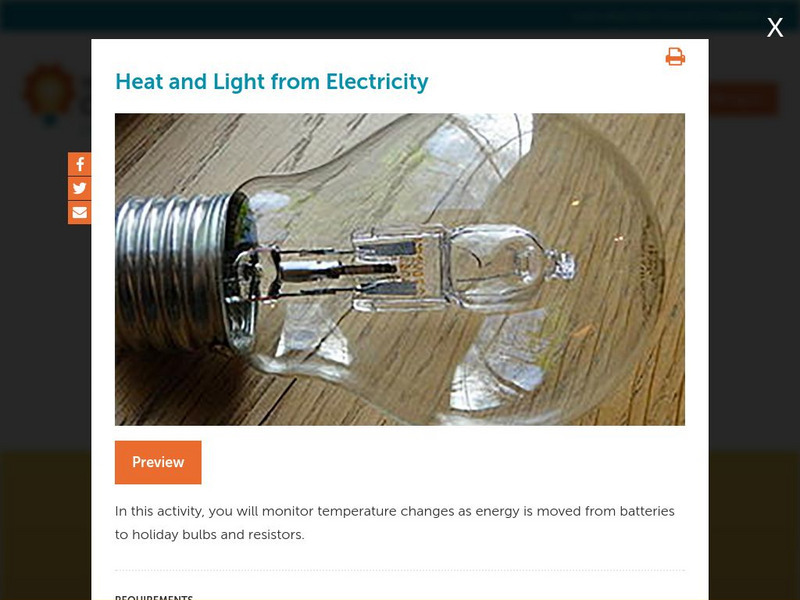
Concord Consortium: Stem Resources: Heat and Light From Electricity
Understand the energy transformations that happens when you light a bulb with a battery. Activity requires students to build a simple circuit and take temperature and time measurements. Lab includes procedure with questions that can be...

OpenSciEd
Open Sci Ed: 6.2 Thermal Energy
This Thermal Energy unit has students investigating two ways to transfer energy into a drink: (1) the absorption of light and (2) thermal energy from the warmer air around the drink. They are then challenged to design their own drink...
Science Education Resource Center at Carleton College
Serc: How Greenhouse Gases Absorb Heat
In this experiment learners observe two model atmospheres: one with normal atmospheric composition and another with an elevated concentration of CO2. These two contained atmospheres will be exposed to light energy in a sunny window or...

TeachEngineering
Teach Engineering: Energy
Through nine lessons, students are introduced to a range of energy types--electrical, light, sound and thermal-as well as the renewable energy sources of wind, hydro (water) and solar power. Subjects range from understanding that the...
TeachEngineering
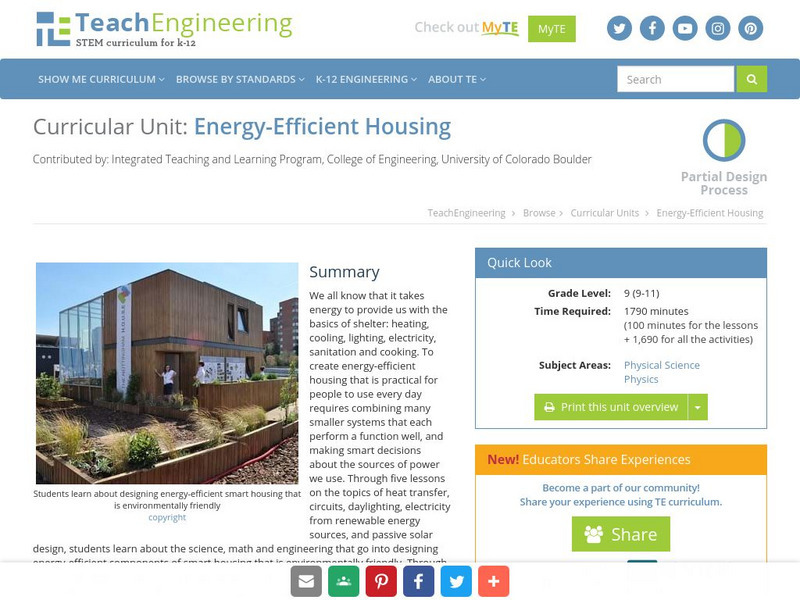
Teach Engineering: Energy Efficient Housing
We all know that it takes energy to provide us with the basics of shelter: heating, cooling, lighting, electricity, sanitation and cooking. To create energy-efficient housing that is practical for people to use every day requires...
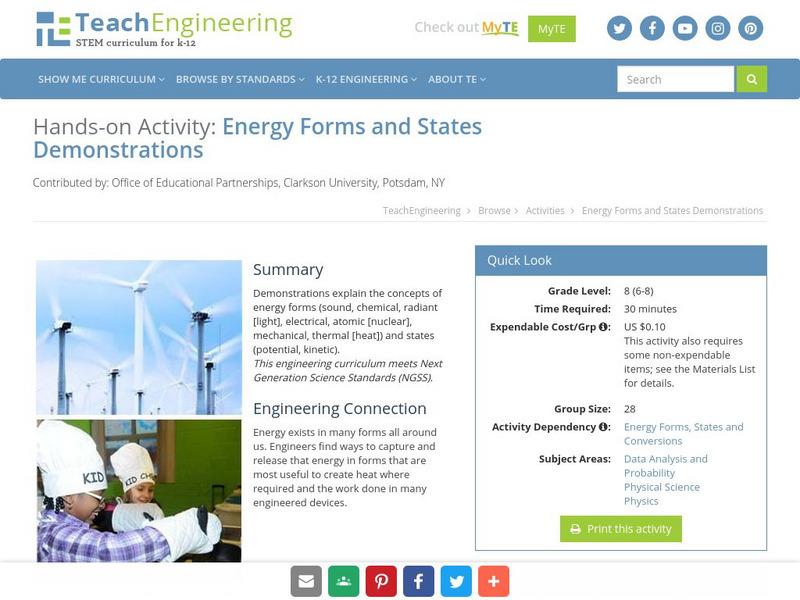
TeachEngineering
Teach Engineering: Energy Forms and States Demonstrations
Demonstrations explain the concepts of energy forms (sound, chemical, radiant [light], electrical, atomic [nuclear], mechanical, thermal [heat]) and states (potential, kinetic).
E-learning for Kids
E Learning for Kids: Science: Antilles: What Are the Different Forms of Energy?
Students will learn about the different types and sources of energy, including heat and light, electrical, potential, and kinetic energy.

Scholastic
Scholastic: Study Jams! Science: Energy, Light and Sound: Heat
A video and a short quiz on heat, covering its difference from temperature, thermal energy, and the means by which heat is transferred.
US Department of Energy
U.s. Dept. Of Energy: Comparing Light Bulbs [Pdf]
A guided activity for students to compare incandescent and CFL light bulbs observing the production of heat and light.
Science Education Resource Center at Carleton College
Serc: Getting the Lightbulb to Light Up
Learners construct a simple electrical circuit using wires, batteries, and a lightbulb. From constructing a circuit the students will discover that when energy is produced there is heat.
Kidport
Kidport: Light
Did you know that light is a form of energy and always travels in a straight line? Discover some more interesting facts about light.
TeachEngineering
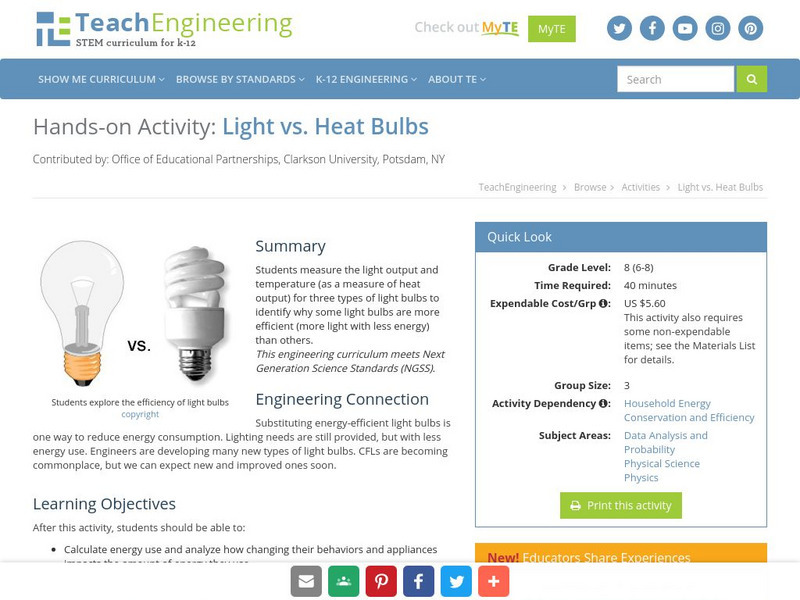
Teach Engineering: Light vs. Heat Bulbs
Students measure the light output and temperature (as a measure of heat output) for three types of light bulbs to identify why some light bulbs are more efficient (more light with less energy) than others.
TeachEngineering
Teach Engineering: Optimize! Cleaner Energy Options for Rural China
Students work in engineering teams to optimize cleaner energy solutions for cooking and heating in rural China. They choose between various options for heating, cooking, hot water, and lights and other electricity, balancing between the...
SMART Technologies
Smart: Forms of Energy
Expose students to this introduction to several different forms of energy.

Nobel Media AB
The Nobel Prize: The Nobel Prize in Physics 1918: Max Planck
Use this site to learn about the scientific work of physicist, Max Planck (1858-1947 CE), whose studies in radiation and light earned him the 1918 Nobel Prize in Physics. Read his Nobel Lecture, "The genesis and present state of...
Museum of Science
The Atoms Family
Let this classic family of monsters guide you as you learn about energy. Interactive exercises, experiments, and demonstrations help to build knowledge and raise questions.
McREL International
Mc Rel: Whelmer #42 Learning Activity: Fire Sandwich
An easy to do activity if you have a Bunsen burner. The activity investigates combustion and heat conductivity. The activity is in lesson plan format that meets NSES standards.
Science is Fun
Science Is Fun: The Fireproof Balloon
In this experiment, two balloons are each placed over a lighted match, but the one that has had water placed inside it does not burst. Includes an explanation of why that is so.
Science Education Resource Center at Carleton College
Serc: Flame Test
In this physical science experiment, students investigate the release of energy by observing the color of light produced when salts are heated in the flame of a burner. Students will identify the metal ion of the substance by the color...
Scholastic
Scholastic Instructor: Sun Sational Science
Discover more about the sun when you visit this educational resource. The content of this site includes solar fun facts, experiments, and activities.
University of Kentucky
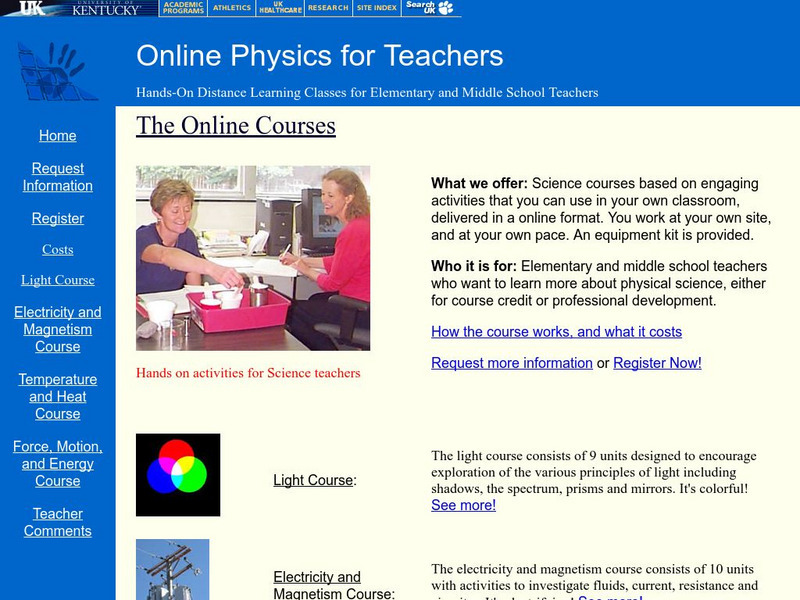
University of Kentucky: Online Physics for Teachers
A set of four online courses in Physics for elementary and middle school teachers. Each course targets a different topic area - light, electricity & magnetism, temperature & heat, and force, motion, & energy.
Other
Unit conversion.org: Online Unit Converter
Need a unit converter? Links to the most common converters provide access to the answers you need quickly.
Lawrence Berkeley National Laboratory
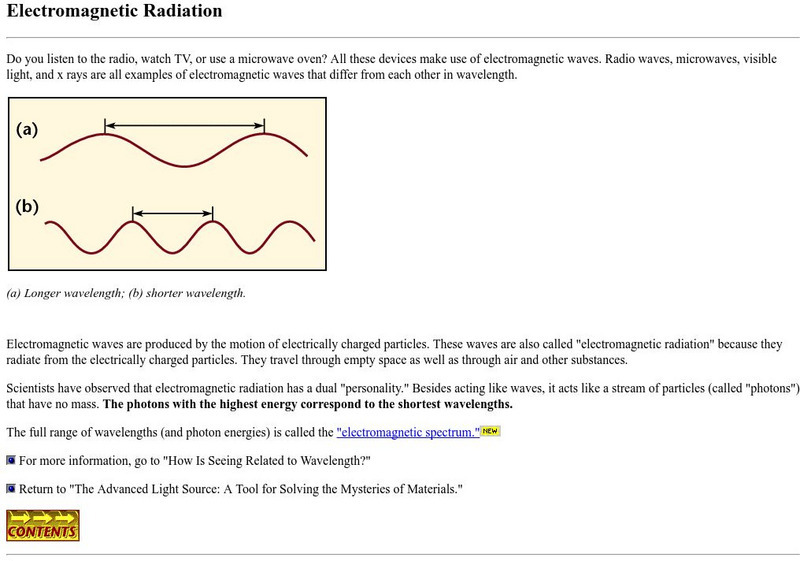
Berkeley Lab: University of California: Electromagnetic Radiation
This page defines electromagnetic radiation. Included are links to more information.