
Curated OER
Characteristics of Energy
Fourth graders view a video and create a KWL to identify energy sources. In this energy sources lesson, 4th graders explore the meaning of energy, kinetic energy, potential energy, thermal energy, radiant energy, and electrical energy....

Curated OER
Electricity and Thermodynamics Review
In this electricity and thermodynamics worksheet, students review the major concepts of both series circuits and parallel circuits, they review types of thermal transfer, they match electricity terms with their definitions, they fill in...

Curated OER
Transition Metals
Students identify and describe transition metals. They discuss alloys and their benefits. Students research one common, alloy, its composition, properties, and uses. They are asked for some common properties of most transition metals....

Curated OER
Transition Metals (II)
Learners discuss transition metals, their properties, and where they are located on the periodic table as well as why transition metals are ideal for coins. After discussion, they conduct an experiment using copper in the form of old...

Curated OER
The Periodic Table
In this science activity, learners use a periodic table to complete the first four rows of a chart. Students use the Internet or research books to complete the last column.

Curated OER
Physical Science Review 5th Grade
In this review of physical science worksheet, students use recall to answer multiple choice questions about electricity and chemical changes. Students answer 25 questions.

Curated OER
Other Metals
Students identify the properties of transition metals. In this chemistry lesson, students research facts and uses of one aluminum product they choose. They create an advertisement highlighting aluminum's useful properties.

Curated OER
Series/Parallel Circuits
Students engage in a instructional activity that is concerned with the concept of series and parallel circuits. They conduct research using a variety of resources. They have class discussion and the instructional activity includes...

Curated OER
Energy
Students distinguish between kinetic an potential energy. They recognize that energy is conserved when changing from one form to another. Students compare the scientific meaning of work with its everyday meaning.

Curated OER
Characteristics of Energy
Students explore Earth science by completing energy worksheets in class. In this energy forms lesson, students identify and define a list of energy vocabulary terms and a K-W-L chart. Students view a matter video clip in class and...

Curated OER
Metals, Non-Metals, Metalloids
Students describe properties of various elements. They arrange the elements based on properties in order to explain the organization of the periodic table. They label elements as metal, non-metal, or metalloid.

Curated OER
V, R, and I in Parallel Circuits
In this parallel circuits instructional activity, students learn parallel circuits basics and determine how to calculate total resistance and total current. This instructional activity has 6 matching and 15 problems to solve.

Curated OER
Resistance
In this resistance worksheet, students use batteries, a breadboard, washers and more to make a parallel circuit and create resistance. Students then answer 7 questions.

Curated OER
Physics Quiz
For this physics worksheet, students complete short answer questions about physics concepts such as electricity, space, light, and more. Students complete 20 short answer questions.

Curated OER
Types of Trains
Third graders explore different types of trains. In this science lesson, 3rd graders study the "Orphan Train" and write a paragraph about what it would feel like to be riding a train during this time period.

Curated OER
Metalloids
Middle schoolers discuss metalloids, their use as semiconductors, and their impact on the computer industry. They work in groups to create a visual timeline showing the evolution of the computer.

Curated OER
Scouting for Circuits
Fifth graders investigate electricity and how it used in a circuit to be useful energy. They also use this investigation in order to understand how energy can change forms and still be considered useful if put into the right form.

Curated OER
The Story of the Transistor
Pupils brainstorm on how certain items have become smaller as technology advances. They watch a video about the history of the transistor.
Concord Consortium
Concord Consortium: Molecular Workbench Showcase: Heat and Temperature
A tutorial that explores the concepts of heat and temperature, the transfer of energy between substances, the relationship of temperature and the movement of atom, and thermal radiation. The tutorial includes animations, interactive...
Utah State Office of Education
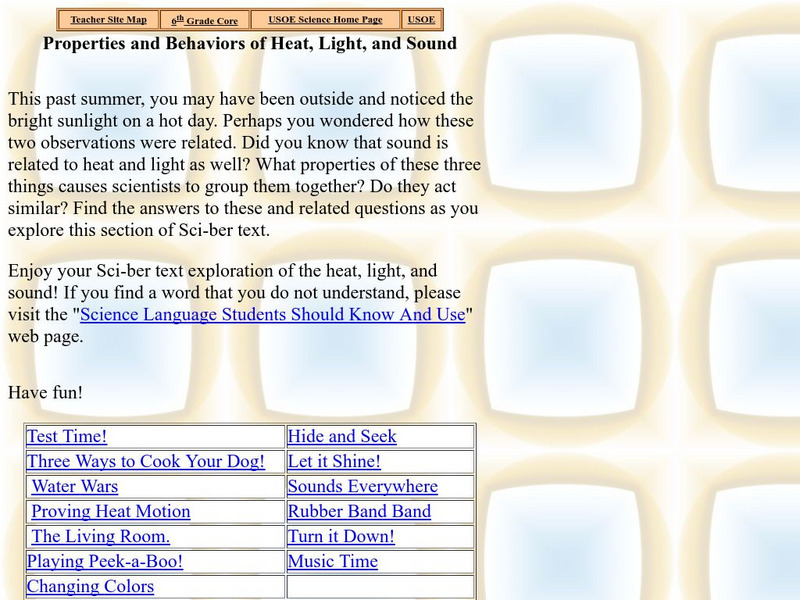
Utah Science: Properties and Behaviors of Heat, Light and Sound
How can scientists lump heat, light and sound together when investigating properties and behaviors? This learning module will address that question through a series of activities.

BBC
Bbc Schools: Ks2 Bitesize: Science: Materials: Heat
A short, illustrated tutorial about how heat energy moves. After reading the material, take a quick quiz to check for understanding.

Physics Classroom
The Physics Classroom: Thermal Physics: Rates of Heat Transfer
Through illustrated examples and interactive examples, students investigate the topic of the rate of heat transfer.
Science and Mathematics Initiative for Learning Enhancement (SMILE)
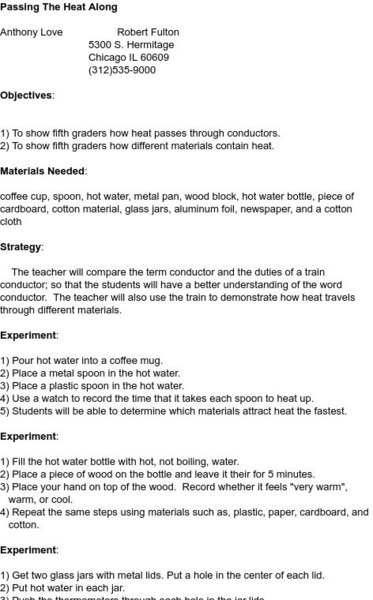
Smile: Passing the Heat Along
This lesson plan explores the way heat passes--transfers--through various conductors.
TeachEngineering
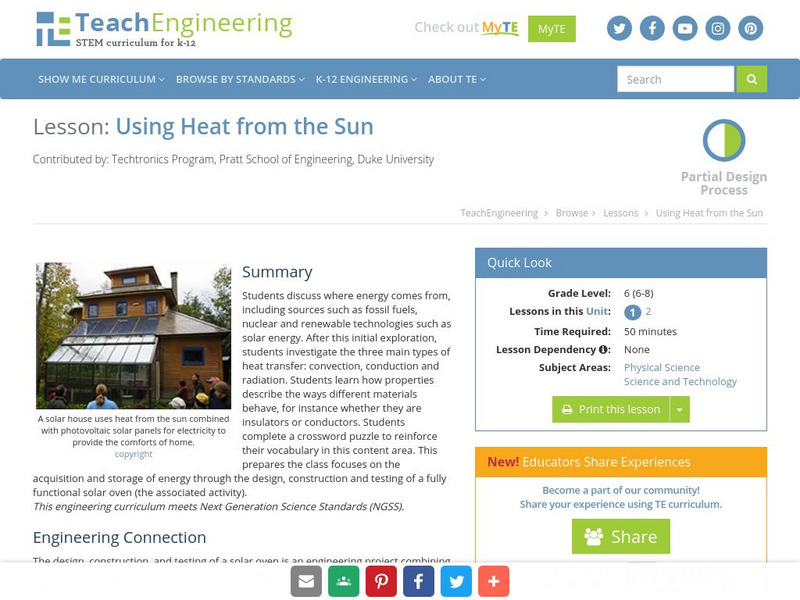
Teach Engineering: Using Heat From the Sun
In this lesson plan, students will first discuss where energy comes from, including sources such as fossil fuels, nuclear, and such renewable technologies as solar. After this initial exploration, students will investigate the three main...