Hi, what do you want to do?






Virginia Middle School Engineering Education Initiative
Save the Penguins: An Introduction to Thermodynamics and Heat Transfer
Heat things up in your physical science class with this interactive lesson series on thermodynamics. Through a series of class demonstrations and experiments, young scientists learn how heat is transferred through conduction,...

NASA
The Heat is On: Urban Heat Islands, Detection Strategies, and Mitigation Solutions
It's sure getting hot out there! Scholars analyze satellite data on land use and surface temperatures, and then learn how to ground truth satellite data through an activity. They apply technology to identify urban heat islands and...

Next Generation Science Storylines
Why Do Some Things Get Colder (or Hotter) When They React?
Some reactions absorb heat while others release it. Young scholars investigate both types of reactions in a 12-lesson unit. Each lesson presents a lab investigation that monitors temperature and considers the types of reactions taking...

NASA
States of Matter
Water, one of the basic needs of humans, is found in all three states of matter on Earth; no other planet—that we know of—possesses this quality. Here is a unit that allows learners to explore through experimentation what it...

Curated OER
Meet Meteorology
Students explore meteorology, discuss Earth's atmosphere, create drawings of the water cycle, create meteorology journals, and role play forecasters. Nine lessons on one page; includes unit test.
Sophia Learning
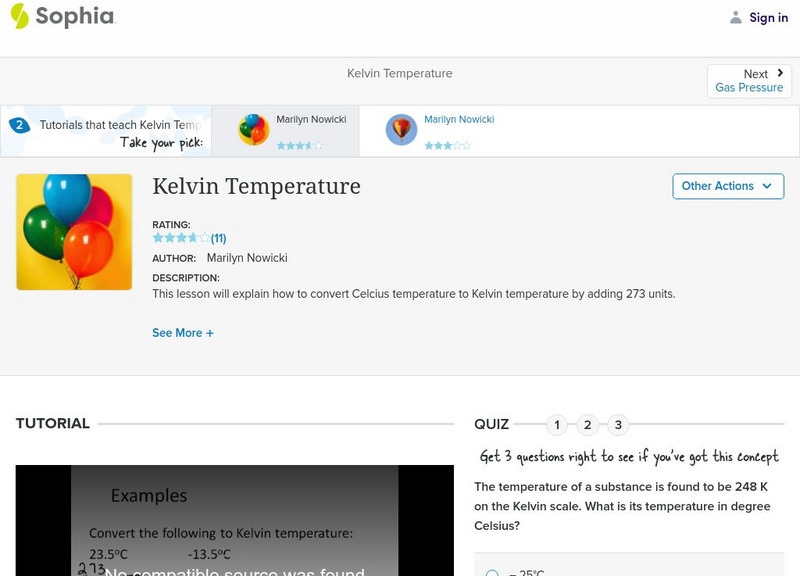
Sophia: Kelvin Temperature: Lesson 1
This lesson will explain how to convert Celcius temperature to Kelvin temperature by adding 273 units. It is 1 of 2 in the series titled "Kelvin Temperature."