Hi, what do you want to do?






Read Works
Read Works: The Legend of the Goddess Tin Hau, or Mazu
[Free Registration/Login Required] This fiction passage focuses on Mazu and her power to guide her brothers to safety from a terrible storm at sea while weaving quietly in her house. Can she save them? A comprehension question set and a...
![Reading Rockets: Accommodating Students With Dyslexia [Pdf] Primary](https://content.lessonplanet.com/knovation/original/455094-6068d9fb1538e8714296414836e7e449.jpg?1661416312 "Reading Rockets: Accommodating Students With Dyslexia [Pdf] Primary")
Reading Rockets
Reading Rockets: Accommodating Students With Dyslexia [Pdf]
This five page PDF resource guide provides great information on accommodating students who have dyslexia in all classroom settings. Accommodations on materials, instruction, and student performance are included.
ibiblio
Ibiblio: Burma Myanmar: How to Read the Generals' "Roadmap"
A thoughtful explanation of the "roadmap" laid out by the head of the military junta as a guide for a national constitutional convention. Many primary source links included.
National Humanities Center
National Humanities Center: Toolbox Library: The Gilded and the Gritty: 1870 1912: Progress: The Meaning of the Machine
Nine primary source resources describing the way people thought about progress during the Gilded Age, 1870-1912. Includes guided reading, links to supplemental material, and timeline.

National Humanities Center
National Humanities Center: Toolbox Library: Gilded and Gritty: America, 1870 1912: Power: Taming the Octopus
A series of primary resources for students and teachers explores public response to the economic and political shifts during the Gilded Age. Includes questions for guided reading and links to supplemental material.
National Humanities Center
National Humanities Center: Toolbox Library: Reading Guide: Elizabeth Cady Stanton: "Seneca Falls Address"
A powerful call for women's rights, particularly for suffrage, expressed in the "Declaration of Sentiments" and issued at the 1848 Seneca Falls Convention by Elizabeth Cady Stanton. Includes discussion questions.
National Humanities Center
National Humanities Center: Toolbox Library: Reading Guide: George Fitzhugh: Chap. 5, "Negro Slavery"
A chapter in George Fitzhugh's apology for slavery in which he argues that slavery brings clear benefits to those who were enslaved.

CommonLit
Common Lit: At the Zoo by William Makepeace Thackeray
William Makepeace Thackeray (1811-1863) was an English writer who was best known for his stories about life in England. In this poem, a speaker describes animals at the zoo. It also offers guided reading, an assessment, and discussion...
PBS
Pbs: Cet: Africans in America: David Walker's Appeal
A description of the impact of David Walker's "Appeal" calling for slaves to revolt. Click on the link to read the original text. Click on Teachers Guide for teaching resources

National Humanities Center
National Humanities Center: Toolbox Library: Reading Guide: David Walker, From "Appeal"
Brief biographical information about David Walker and a link to the complete text of his famous writing, "Appeal," written in 1830.

National Humanities Center
National Humanities Center: Toolbox Library: Reading Guide: Henry David Thoreau, "Walden"
Thoreau offers in this excerpt from Walden the Transcendentalist observation that each human must search for religious meaning within himself and not as a quest to glorify God.

National Humanities Center
National Humanities Center: Toolbox Library: Reading Guide: John C. Calhoun
An essay by the South Carolina Senator John C. Calhoun, outlining his belief in a "concurrent majority" and the power of individual majority groups to determine whether to follow a particular law that had been passed.
Lumen Learning
Lumen: Early American Literature: "Verses Upon the Burning of Our House"
"Verses upon the Burning of our House" (July 10, 1666) is a poem by Anne Bradstreet. She wrote it to express the traumatic loss of her home and most of her material. However, she expands the understanding that God had taken them away in...

Lumen Learning
Lumen: American Romanticism: The Indian Burying Ground by Philip Morin Freneau
This is the text and video reading of the poem "The Indian Burying Ground" by Philip Morin Freneau, an American poet, nationalist (also known as Federalist), polemicist, sea captain, and newspaper editor sometimes called the "Poet of the...

National Humanities Center
National Humanities Center: Toolbox Library: Gilded and Gritty: People: Assimilation and the Crucible of the City
Collection of ten primary resources on the culture, economy and politics of the Gilded Age between 1870-1913, with reading guide for discussion, timeline and links to supplemental material.
National Humanities Center
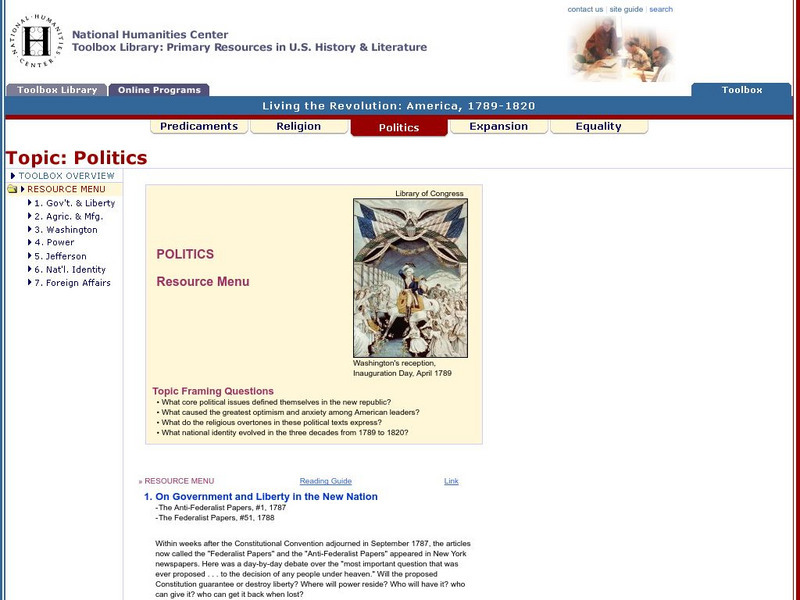
National Humanities Center: Toolbox Library: Living the Revolution: America, 1789 1820: Politics
Primary source materials from the post-Revolutionary War period in America, 1789-1820, which depict the sense of politics in a newly formed nation with a developing national identity. Includes reading guide, questions for discussion and...
National Humanities Center
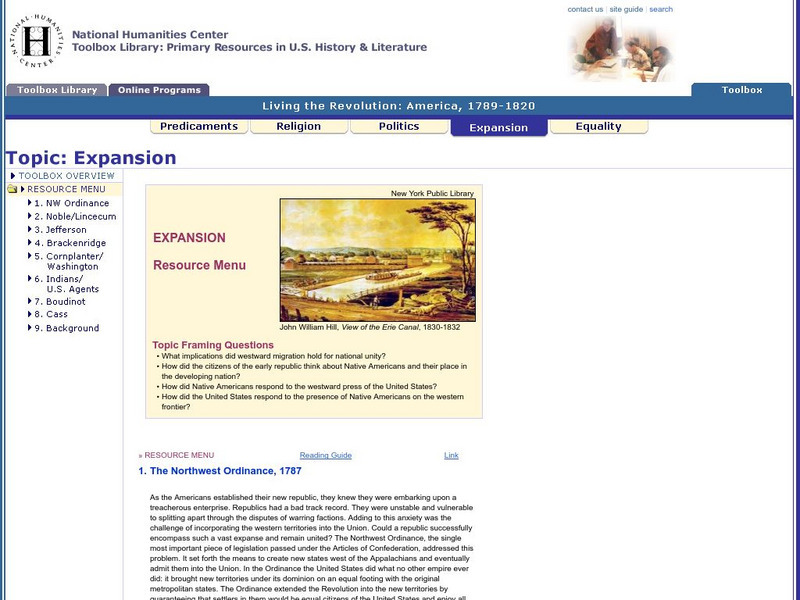
National Humanities Center: Toolbox Library: Living the Revolution: Expansion
Primary source documents on westward expansion convey the impact expanison had on national unity and provides a sense of interactions with Native Americans. Includes reading guide, links to supplemental material, and questions for...
National Humanities Center
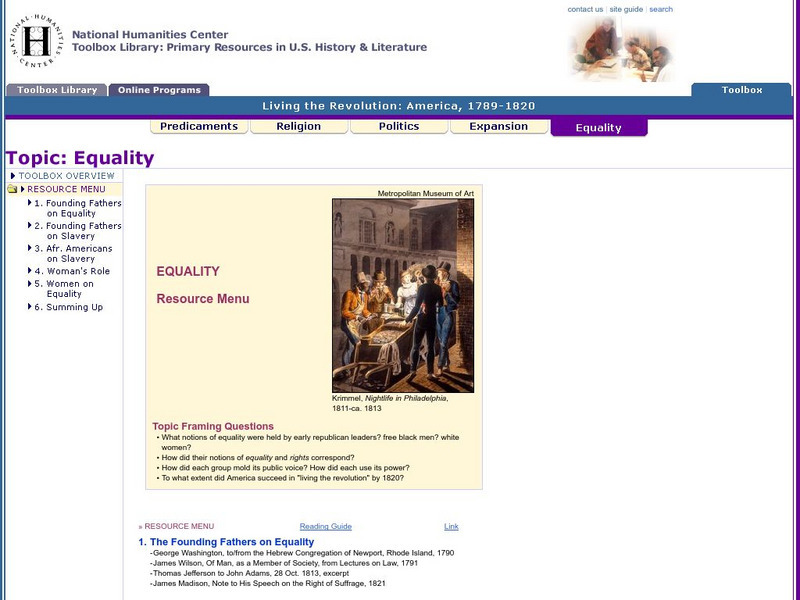
National Humanities Center: Toolbox Library: Living the Revolution: 1789 1820: Equality
Primary source documents on equality provides a look into various perspectives surrounding the discussion on rights for slaves, African Americans, women and equality in general between 1789-1920. Includes questions for discussion,...
National Humanities Center
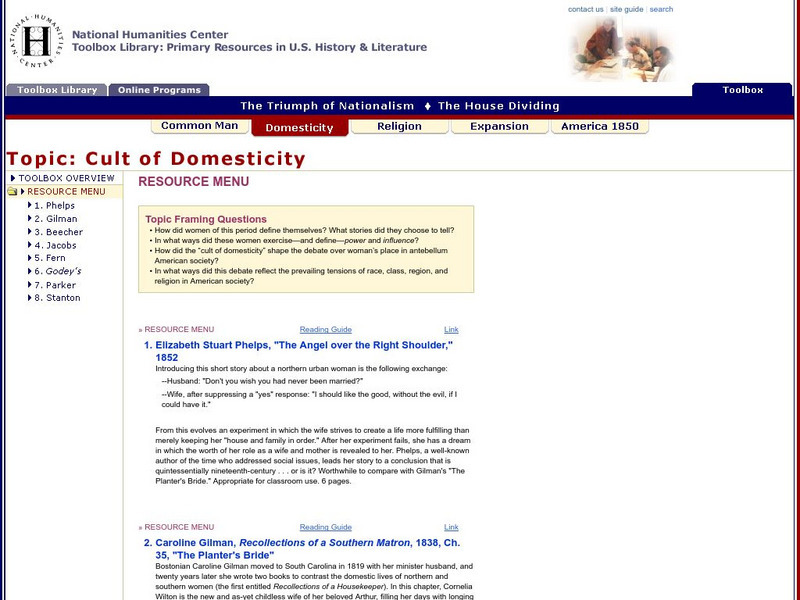
National Humanities Center: Toolbox Library: Cult of Domesticity: Resource Menu
A collection of eight primary resources and reading guides focusing on women's issues in the 1800s including domesticity, slavery, and suffrage.
National Humanities Center
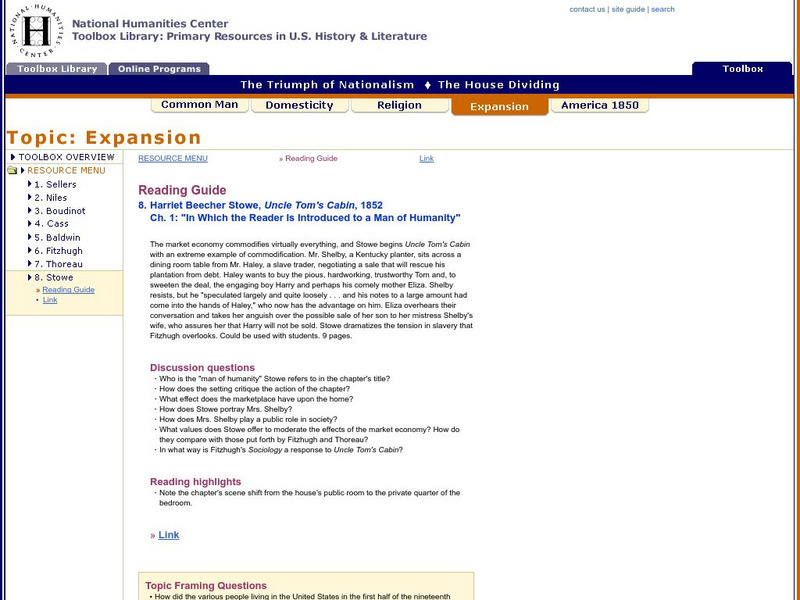
National Humanities Center: Toolbox Library: Expansion: Harriet B. Stowe: Uncle Tom's Cabin, Ch. 1
Discussion questions that guide the reading of Chapter 1 of Harriet Beecher Stowe's influential novel, Uncle Tom's Cabin. Hyperlink to the entire text.
National Humanities Center
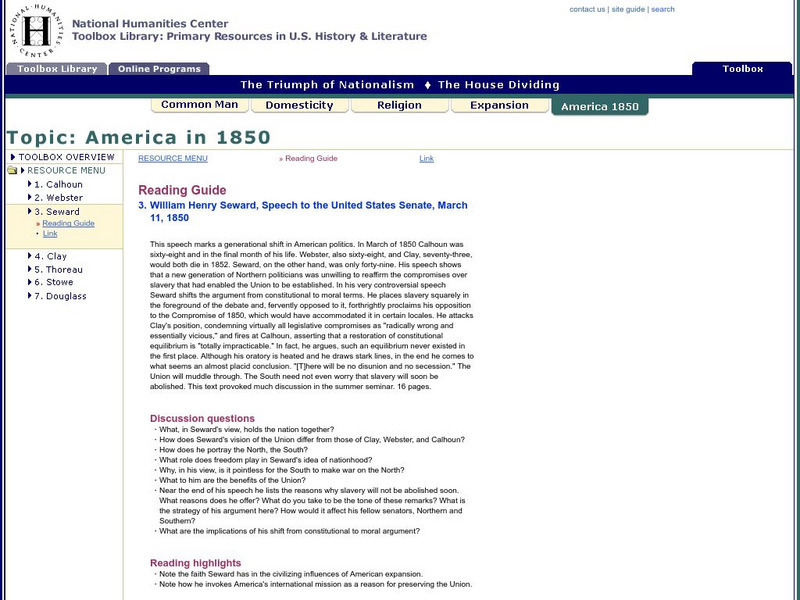
National Humanities Center: Toolbox Library: William Seward, Triumph of Nationalism: America, 1815 1850
The National Humanities Center present a reading guide that links to a speech in the Senate by William Seward, one that expresses moral outrage over the compromises allowing the expansion of slavery.
Digital Public Library of America
Dpla: The Freedmen's Bureau
This collection of documents, images, and readings from the era give an overview of the work done by the Freedmen's Bureau and the racial and political struggles the agency faced during the Reconstruction Era. Includes a teaching guide.
Digital Public Library of America
Dpla: American Imperialism: Negro League Baseball
In this primary source set, students will view original photographs, listen to oral history recordings, and read historical texts to gain a better understanding of the lives and experiences of Negro League baseball players. Includes...
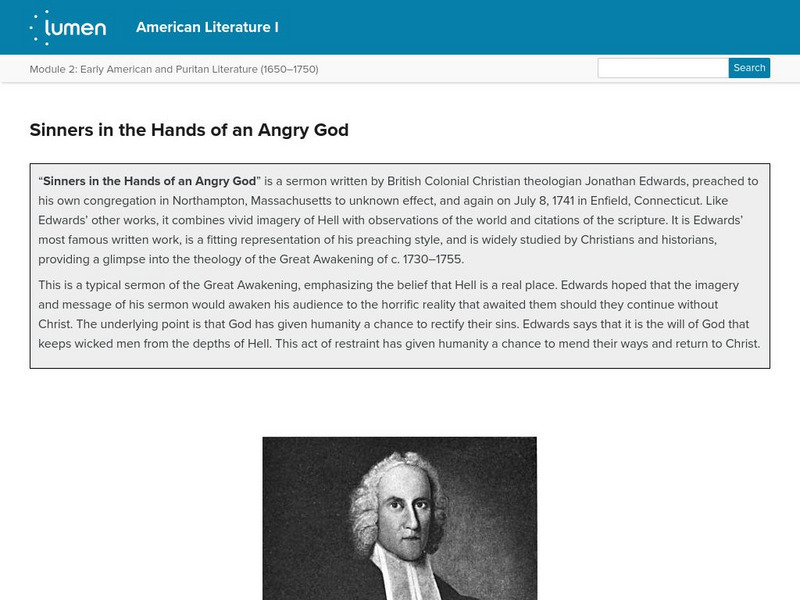
Lumen Learning
Lumen: American and Puritan Literature: Sinners in the Hands of an Angry God
"Sinners in the Hands of an Angry God" is a sermon written by British Colonial Christian theologian Jonathan Edwards, preached to his own congregation in Northampton, Massachusetts to an unknown effect, and again on July 8, 1741, in...
Other popular searches
- Guided Reading Comprehension
- Flat Stanley Guided Reading
- Guided Reading Lesson Plans
- Guided Reading Lessons
- Guided Reading Activities
- Guided Reading Fluency
- Dinosaur Guided Reading
- Guided Reading Elementary
- Guided Reading Lessons Plans
- Reading Comprehension Guided
- Guided Reading Cam Jansen
- Guided Reading Prediction