Hi, what do you want to do?






Curated OER
Structure and Function of Seeds
Students study the functions of seeds. For this biology lesson plan, students observe the structure of a seed as they show the function of the cotyledons in providing nourishment to the plant during the early times after germination.

Curated OER
Incredible Seeds
Second graders are given a group of seeds and put in small groups. They classify their seeds based on their observations with 90% accuracy. Students draw a picture of each seed showing at least 2 characteristics of each. They write 1...

Curated OER
What Plants Need
Pupils plant seeds in milk cartons, over the next two weeks, they watch the plants closely to see how they grow and change. They keep a photo journal to record the growth of the plant.

Curated OER
Soggy Seeds
Students conduct experiments to learn about seed germination. In this seed germination lesson, students write a hypothesis for the seed experiment. students complete the experiment for seed germination and graph the data obtained from...

Curated OER
Benny's Pennies
Students read Benny's Pennies and predict what Bennie will buy with each penny based on the illustrations. They locate rhyming words and make a chart of what Benny bought and also for what they would have bought.

Curated OER
Land Use Issues
Students discover seeds are a source of life. They also label the parts of a seed and examine the conditions which are needed for the seed to start growing. They follow the life cycle of seeds.

Curated OER
The Plastic Bag Greenhouse
Third graders observe plants and record their growth. They describe the parts of plants in detail including the roots, stems and leaves.

Curated OER
The Length of My Foot
Here is an excellent instructional activity for young learners who are just beginning to explore the concept of using units to measure length. They rotate through four classroom centers in order to gain practice in utilizing this...

Curated OER
Survival of the Spiniest
For this earth science worksheet, students identify and discover the amazing ways that desert plants adapt to harsh habitats. They use discussion and drawing to explore their existing knowledge about deserts. Then, students respond to 15...

Curated OER
Plant Parts
Ninth graders identify plant parts by using different classification methods. In this plant lesson students observe and draw different types of leaves then classify them according to species.

Curated OER
Plant Life Cycle Activities and Lesson Plans
Curb spring fever by bringing some of the great outdoors into your classroom with plant life cycle activities.

Curated OER
Seed Sorting 101
Students sort through numerous seeds to find similarities and differences. In this sorting and classifying lesson, students divide up different plant seeds based on their similarities and differences, while keeping record of their findings.


Curated OER
The Length of my Foot
Students review the concept of measuring length. In groups, they travel to various centers throughout the classroom. They experiment with using different objects to measure the length of items given to them by their teacher. They are...

Curated OER
Sharks in Decline
Students investigate common fishing methods used to capture sharks. They decide why these methods and the shark's reproductive biology are contributing to the quick reduction in the shark population.

Curated OER
Planting
Students form groups to conduct an experiment. They plant seedlings to test the effects of sunlight, water and soil, on the growth of seedlings.
Science Education Resource Center at Carleton College
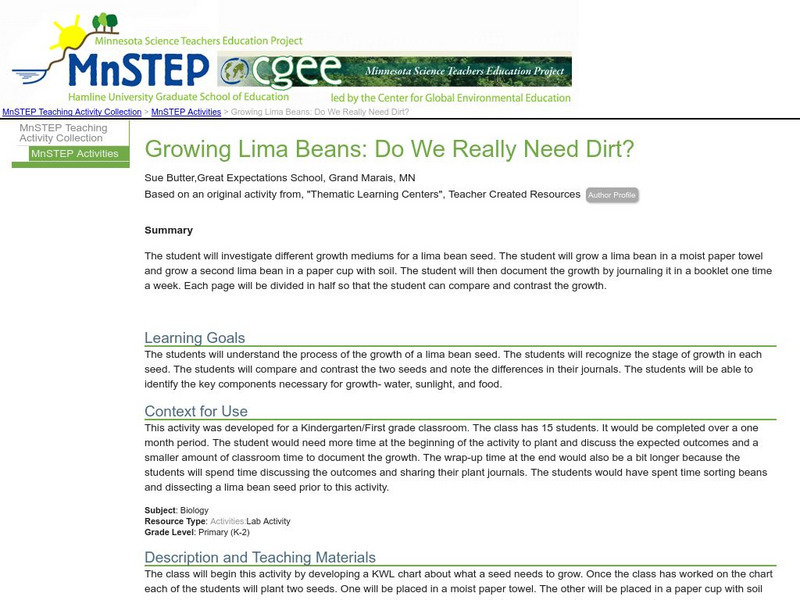
Serc: Growing Lima Beans: Do We Really Need Dirt?
Students investigate different growth mediums for a lima bean seed: a wet paper towel and a paper cup with soil.

Countries and Their Cultures
Countries and Their Cultures: Fipa
The Fipa are a Bantu-speaking people of southwestern Tanzania in East-Central Africa. The name "Fipa" appears to have been bestowed on them by nineteenth-century traders and means "people of the escarpment." It was later adopted by...