Hi, what do you want to do?





TeachEngineering
Teach Engineering: Move It!
Mechanical energy is the most easily understood form of energy for students. When there is mechanical energy involved, something moves. Mechanical energy is a very important concept to understand. Engineers need to know what happens when...
TeachEngineering
Teach Engineering: Car Collision Testing & Tradeoffs: Don't Crack Humpty
Student groups are provided with a generic car base on which to design a device/enclosure to protect an egg as it rolls down a ramp at increasing slopes. During this activity, student teams design, build and test their prototype...
Exploratorium
Exploratorium: Science Snacks: Physics/mechanics (Force and Motion)
A collection of mechanics activities. Many pertain to Newton's laws of motion. Step-by-step directions provided with illustrations. Great for teacher demos or student projects.

Other
Bscs: Forces and Motion Content Background Document
In this document, we will try to answer a fundamental question of physical science, "Why do things start to move, slow down, speed up, stop moving or change direction?" In answering these core questions we can develop concepts that can...
Other
National Research Council: Elementary Particle Physics
The Committee on Elementary-Particle Physics, part of the U.S. National Research Council, presents this massive report on particle physics. It's a definitive document. Surprisingly readable, totally detailed. Start with the Table of...
Wikimedia
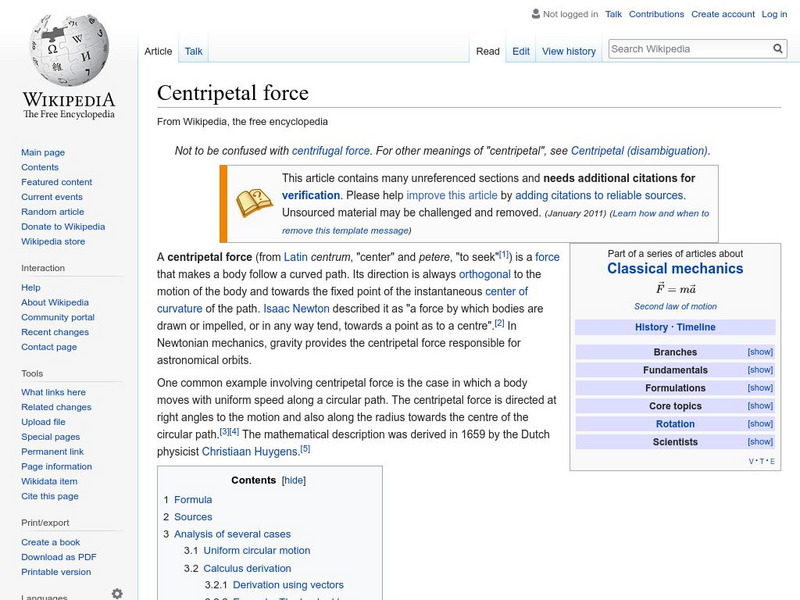
Wikipedia: Centripetal Force
Wikipedia's site on centripetal force provides a section explaining the difference between centripetal force and centrifugal force. Includes formulas and hyperlinked terms.
Science Education Resource Center at Carleton College
Serc: Investigating Forces: Pop Bottle Rockets
In this lab, students will work on scientific inquiry skills: observation, developing questions, conducting an experiment, and collecting data. They will investigate forces using pop bottle rockets that they have designed.
Science Education Resource Center at Carleton College
Serc: Measuring Reaction Time
Young scholars investigate each other's reaction time by measuring how far a ruler falls before they can catch it. They will interpret the data and turn in a lab report describing the procedure they used and the results they discovered.
Other
Uc Riverside: Usenet Relativity Faq
A physics usenet listing of frequently asked questions relating to relativity, answered by a number of scientists. Administrivia and Reference, Speed of Light, Special Relativity, General Relativity and Cosmology, Black Holes. Loads of...
Other
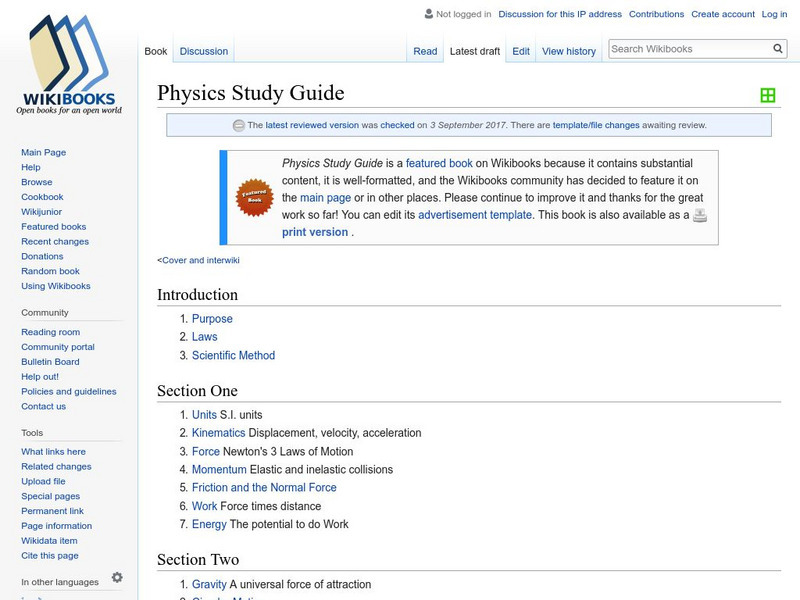
Wikibooks: Physics Study Guide
A handy resource that gives an overview of equations and definitions pertinent to an introductory, college-level physics course, with two of its three sections focusing on motion-related topics and principles.
Other
Center for Education Partnerships: The Marble Roll
In this Science-athon, students try to make their marble roll the farthest across a flat surface, using their knowledge of forces, motion, and energy to guide them through their apparatus design. Teachers must enroll online.
Curated OER
Hyper Physics: Earth Orbits
An equation for the law of universal gravitation is stated. The weight equation (W=m*g) is related to the law. An interactive Javascript form allows the user to practice determining the force of gravity and the acceleration of gravity...
Curated OER
Hyper Physics: Earth Orbits
An equation for the law of universal gravitation is stated. The weight equation (W=m*g) is related to the law. An interactive Javascript form allows the user to practice determining the force of gravity and the acceleration of gravity...
MadSci Network
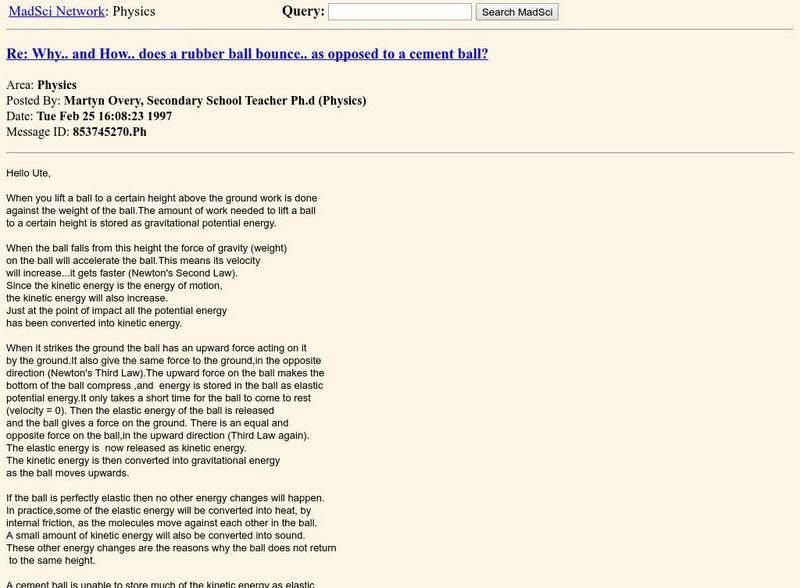
The Mad Scientist Network: Bouncing Rubber Ball
A question and answer format is used to relate elastic potential energy to the bounce of a rubber ball. Explanation of this simple phenomenon is thorough, complete, and free of trite statements.