Hi, what do you want to do?






NASA
Nasa: Vectors
This site from NASA provides an excellent tutorial on vectors and their use in physics to describe the motion of objects. Vector addition and resolution are illustrated.

TeachEngineering
Teach Engineering: How Do Things Fall?
Students learn that it is incorrect to believe that heavier objects fall faster than lighter objects. By close observation of falling objects, they see that it is the amount of air resistance, not the weight of an object, which...
Wikimedia
Wikipedia: The Black Hole
This site examines the black hole as an object in astrophysics. Delve into this comprehensive resource that covers this concept from its history, to qualitative physics, the reality of black holes, mathematical physics and more.
Soft Schools
Soft Schools: Physics Quizzes: Newton's Three Laws
Assess your understanding of Newton's three laws of motion and the ability to distinguish between the three with this interactive multiple choice quiz. Receive immediate feedback to your answers.

Physics Classroom
The Physics Classroom: Circular and Satellite Motion: Satellite Motion Math
In this interactive physics tutorial, students explore the variety of mathematical equations that describe the motion of satellites.
Department of Defense
Do Dea: Free Fall Constants for Earth
When you work with equations that show position, velocity, acceleration of objects that are flying or falling through the air, you will be using the constant that is the acceleration due to gravity. View formulas, explanations, and...
Other
Fermi Laboratory:how Strong Is the Strong Force?
Use this site to learn about the four forces of nature. Also learn what determines the strength of a force. This question and answer site is a link of the Fermi National Accelerator Laboratory.
Sophia Learning
Sophia: Gravitational Force & Newton's Second Law of Motion
This lesson explains how gravitational force is related to free fall, acceleration due to gravity, and Newton's second law of motion.

Annenberg Foundation
Annenberg Learner: Amusement Park Physics: The Principles of Free Fall
An article describing free fall principles in roller coaster rides. In addition to the explanation of free fall, an experiment is described that allows you to test free fall with a cup of water. Part of a larger presentation on roller...
NASA
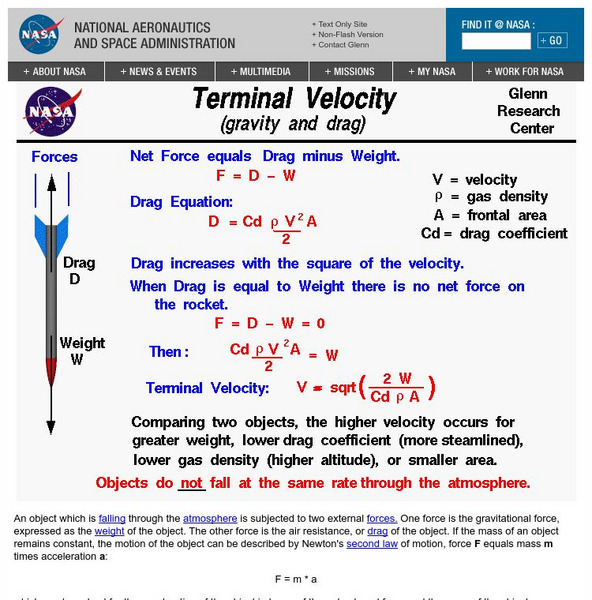
Nasa: Beginner's Guide to Aerodynamics
This site from NASA uses a colorful graphic to illustrate why objects reach terminal velocity. Provides equation for the terminal velocity of an object. Graphic is accompanied by a simple explanation.
University of Virginia
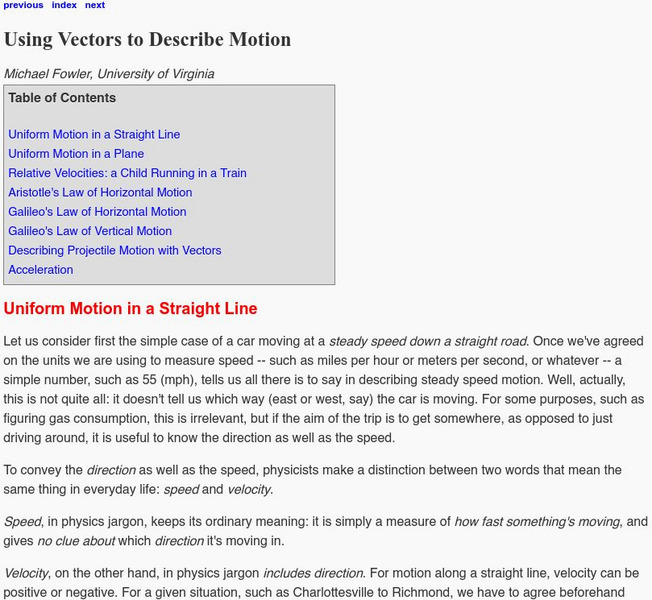
Uva Physics: Using Vectors to Describe Motion
Background information on vectors and their use in describing motion in two dimensions. A comparison of Aristotle's and Galileo's perspectives on force and motion is given.
Boston University
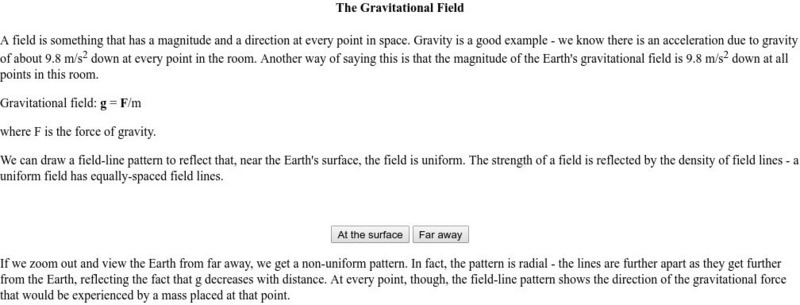
Boston University: The Gravitational Field
Defines what a gravitational field is, its value, and how to calculate it. Field-line patterns are also drawn and explained.
University of Virginia
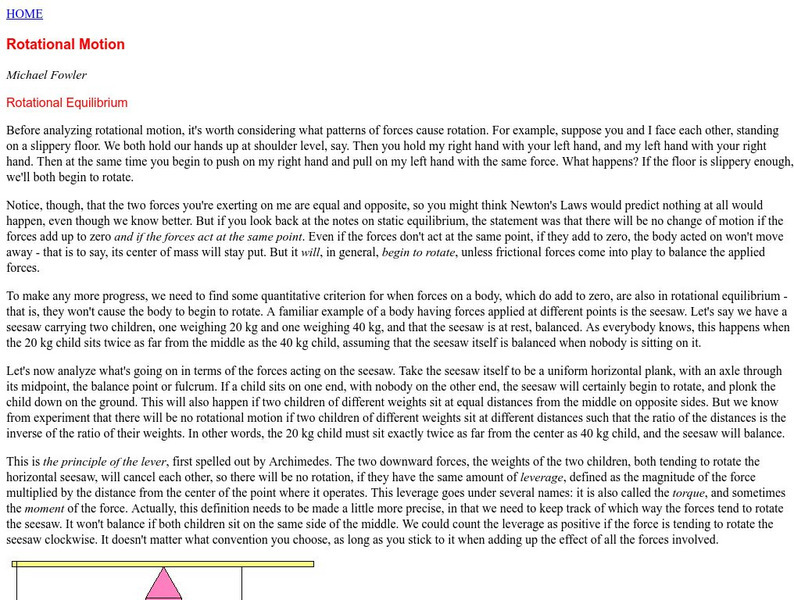
University of Virginia: Rotational Motion
A page describing rotational equilibrium and non-equilibrium situations. Includes graphics, equations, and many examples.
Science Education Resource Center at Carleton College
Serc: Investigating Calculating the Effect of Mass, Length and Displacement
In this physics lab activity learners investigate how mass, length and angular displacement affect the period of a simple pendulum. Students control variables, testing one variable at a time, using manual techniques (stopwatch, human...
TeachEngineering
Teach Engineering: The Big Mo
Momentum is not only a physical principle; it is a psychological phenomenon. Students learn how the "Big Mo" of the bandwagon effect contributes to the development of fads and manias, and how modern technology and mass media accelerate...
TeachEngineering
Teach Engineering: Sliding Textbooks
In this culminating activity of the unit which highlights how forces play a role in engineering design and material choices, students explore and apply their knowledge of forces, friction, acceleration, and gravity in a two-part experiment.
Texas Education Agency
Texas Gateway: Kinematics in Two Dimensions: Projectile Motion
By the end of this section, you will be able to identify and explain the properties of a projectile, such as acceleration due to gravity, range, maximum height, and trajectory; determine the location and velocity of a projectile at...
Physics Classroom
The Physics Classroom: 1 D Kinematics
A six-lesson e-textbook covering topics in one dimension kinematics. Lessons include informational text, interactive activities, and quick, interactive comprehension checks along the way.
PBS
Pbs Learning Media: Einstein: How Smart Was He?
This essay from the NOVA Web site explores the impact Einstein made on physics and most everything we know about the cosmos.
Physics Aviary
Physics Aviary: Vertical Motion of Firework Level 2
Find the maximum height and the time to reach the maximum height for a firework that is fired vertically upward and explodes at the point where it would have started coming back down again. Information about the planet will be given to...
Physics Aviary
Physics Aviary: Vertical Motion of Firework Level 3
Find the explosion height and the time to explosion for a firework that is fired vertically upward and explodes at the point where it already coming back down again. Information about the planet will be given to them so that they can...
Physics Aviary
Physics Aviary: Pendulum Lab
This lab is designed to have students investigate the factors that affect the rate at which a pendulum oscillates. Students can change the length of the pendulum, the angle of release, and the heavenly body on which the pendulum is...

Georgia Department of Education
Ga Virtual Learning: Physical Science: Force and Motion
In this student-paced module, students apply Newton's Laws of Motion to everyday life, calculate mathematical relationships involving force and motion using algebraic formulas, and understand the difference between mass and weight.
University of New South Wales (Australia)
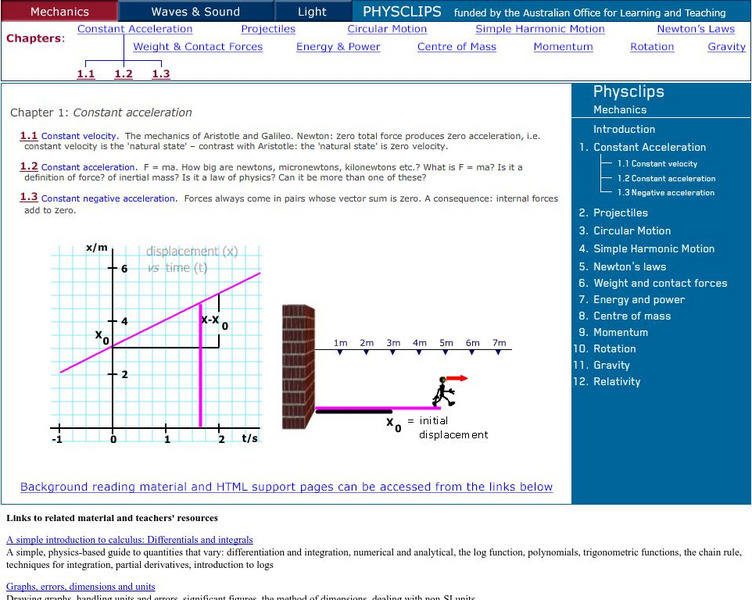
University of New South Wales: School of Physics: Physclips
Physiclips thoroughly presents mechanics concepts with animations and film clips.