Hi, what do you want to do?





OpenStax
Open Stax: Projectile Motion
The following interactive helps students understan how to identify and xplain the properties of a projectile, such as acceleration due to gravity, range, maximum height, and trajectory. They will determine the location and velocity of a...
Science Buddies
Science Buddies: The Chills and Thrills of Roller Coaster Hills
Lots of people enjoy roller coasters, but not many understand why they feel the strange excitement they do when riding them. In this science fair project, you will build and use an accelerometer to figure out and measure gravity-induced...

Bill Nye
Bill Nye: Falling for Science
Try this at-home science experiment to learn about acceleration due to gravity.
NASA
Nasa: The Way Things Fall
This site from NASA compares free falling motion to falling with air resistance. Discusses Galileo's experiment. Explains why we believe all objects free fall with the same acceleration.
Lawrence Berkeley National Laboratory
Berkeley Lab: The Particle Adventure
Visit this site for an interactive tour of the atom and all aspects of particle physics. View the animations available with almost every description on this site. A great place for the fundamentals of particles and forces including a...
PBS
Pbs Learning Media: Relativity and the Cosmos
This illustrated essay from the NOVA Web site introduces the basic concepts of Einstein's General Theory of Relativity and what we know about cosmology as a result.
PBS
Pbs Learning Media: Galileo: His Experiments
This interactive activity from the NOVA Web site samples Galileo's experiments with falling objects, projectiles, inclined planes, and pendulums.
Physics Classroom
The Physics Classroom: Vectors: Inclined Planes
Through examples and interactive practice problems, this physics tutorial helps students understand how forces behave on an object on an inclined plane.
Texas Education Agency
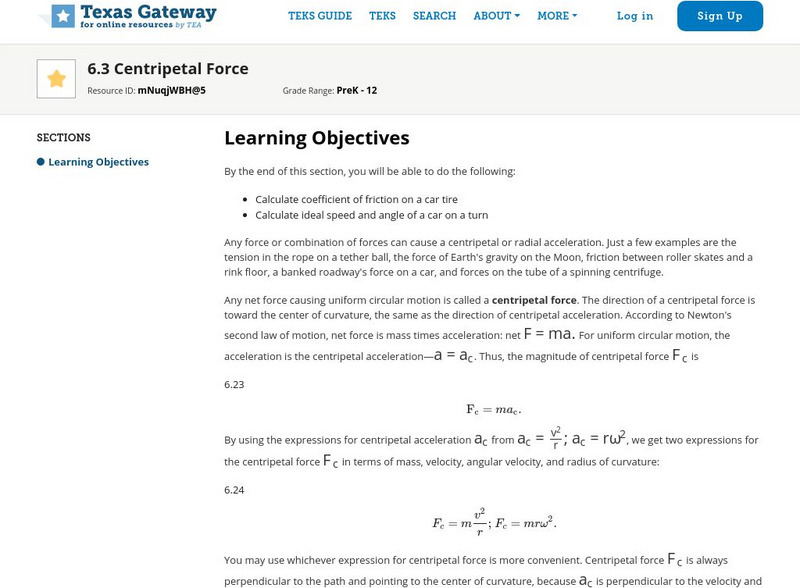
Texas Gateway: Uniform Circular Motion and Gravitation: Centripetal Forces
By the end of this section, you will be able to calculate coefficient of friction on a car tire and to calculate ideal speed and angle of a car on a turn.

Concord Consortium
The Concord Consortium: Molecular Workbench: A Pendulum
Change the mass of a suspended object to see how its movement and forces are affected by gravity.

Khan Academy
Khan Academy: Start: How Do Computers Simulate the Motion of Virtual Particles?
For this lesson we'll explore how we use fairly simple physics to draw particles which move according to the forces we feel in the real world (such as wind & gravity).
Physics Classroom
The Physics Classroom: Circular, Satellite, Rotational: Roller Coaster G Forces
Roller coaster rides are notorious for creating accelerations and g-forces. The magnitude and direction of normal force and gravity during the motion through a coaster's loop are depicted this animation.
Science Education Resource Center at Carleton College
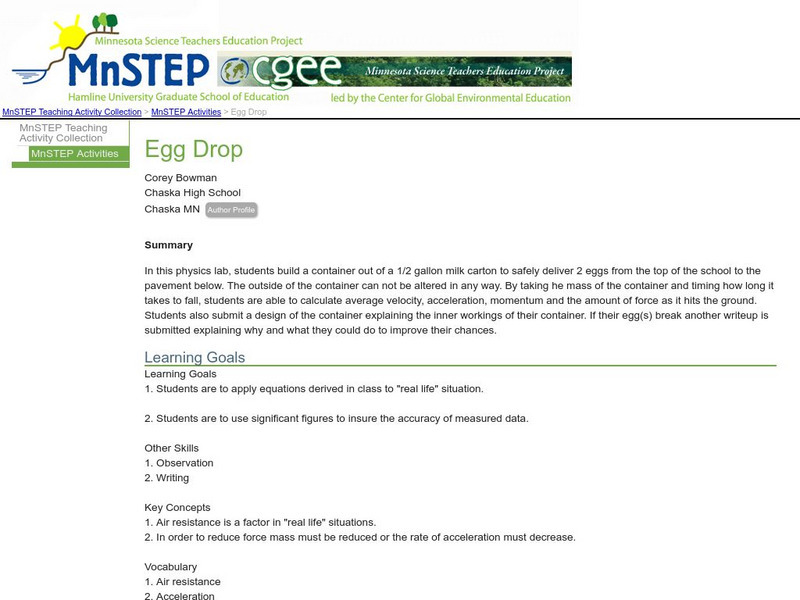
Serc: Egg Drop
In this physics lab, students build a container to safely deliver two eggs from the top of the school. Students calculate average velocity, acceleration, momentum, and the amount of force as it hits the ground. If their egg breaks, they...
Physics Classroom
The Physics Classroom: Circular Motion Principles for Satellites
From The Physics Classroom. Uses easy- to-understand language to discuss how circular motion principles apply to the motion of satellites. Describes the tangential velocity and centripetal acceleration of a satellite. Includes many...
Physics Classroom
The Physics Classroom: Mathematics of Satellite Motion
The mathematics associated with the motion of satellites is described. Equations (for period, velocity, acceleration and force) are stated, symbols described, and sample problems solved. Includes five practice problems with solutions and...
Physics Aviary
Physics Aviary: Practice Problems: High School Toss Level 1
Students will determine maximum height obtained by an object tossed upward off the roof of a high school. They will also find the total time aloft and the speed with which the object will impact the ground. The acceleration due to...
Physics Classroom
The Physics Classroom: 1 D Kinematics: The Big Misconception
An introduction to the ideas behind the misconception and misunderstanding of why all objects accelerate at the same rate. This explanation involves the concepts of force and mass.

Khan Academy
Khan Academy: Freefall Review
Review the key concepts and skills for acceleration due to gravity, including analyzing motion of objects in freefall.
Science Education Resource Center at Carleton College
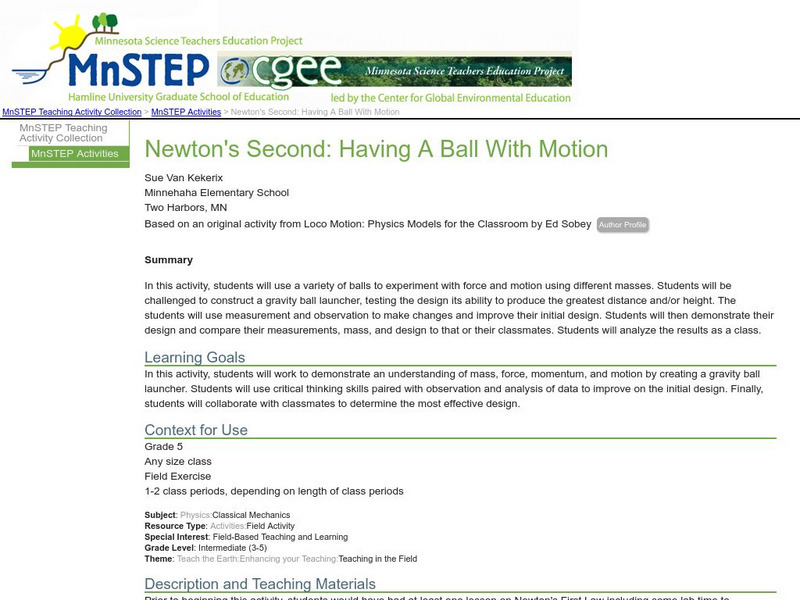
Serc: Newton's Second: Having a Ball With Motion
Students will create a gravity ball launcher to demonstrate their understanding of mass, force, momentum, and motion. The students will use critical thinking, measurement, and observation and analysis of data to make changes and improve...
Physics Aviary
Physics Aviary: Deep Sea Diver Lab
Examine the factors affecting the pressure under a fluid. Run this simulation on "Earth-Like" planets with the same atmospheric pressure but different accelerations due to gravity.
Physics Aviary
Physics Aviary: Practice Problems: Dump Tower Level 1
Students must find the acceleration due to gravity on a planet and the impact speed of an object that has been falling from the top of a garish tower.
Concord Consortium
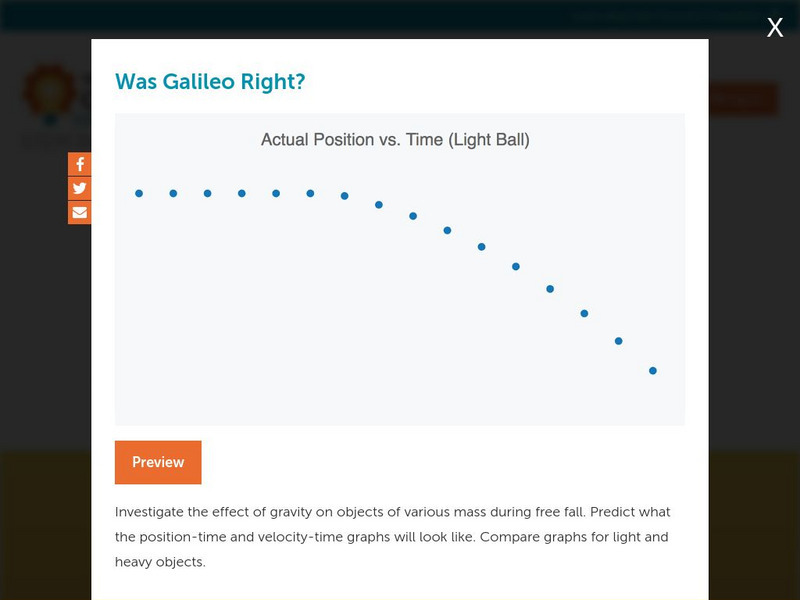
Concord Consortium: Was Galileo Right?
Investigate the effect of gravity on objects of various mass during free fall. Predict what the position-time and velocity-time graphs will look like. Compare graphs for light and heavy objects.
Curated OER
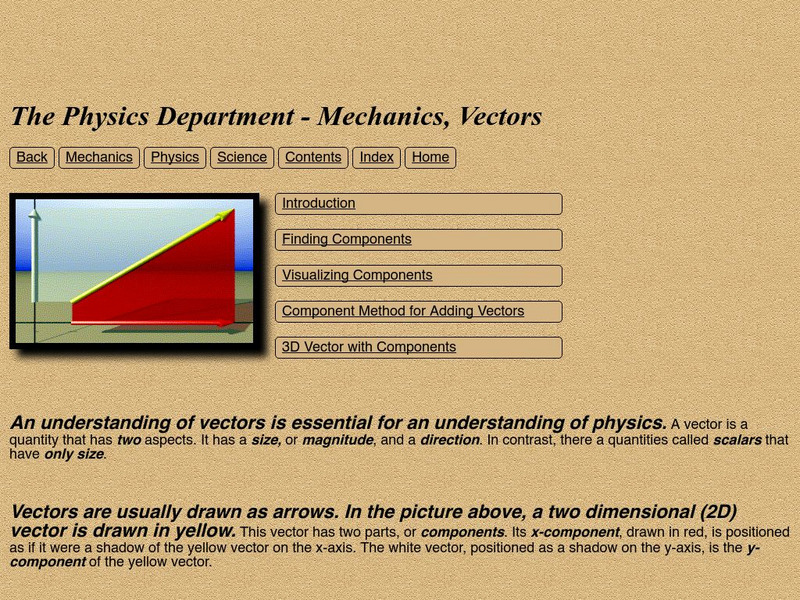
Zona Land: Mechanics and Vectors
An exceptional tutorial on the topic of vectors that offers many helpful graphics, some of which are interactive.
Physics Classroom
The Physics Classroom: 1 D Kinematics: How Fast? And How Far?
Students understand the physics of a free falling object through these illustrated example problems.