Hi, what do you want to do?






Curated OER
Kincaid Creatures
Students brainstorm a list of nocturnal and diurnal wild animals they see in their community and discuss how the animals would be different if they were living during the Ice Age. Using a handout, they discover how archeologists record...

Curated OER
Kincaid Shelter Stratigraphy
Seventh graders illustrate how archeologists use stratigraphy to help determine environmental changes in a specific area since the Pleistocene Era, and to point out that these changes have affected the animals living in that area.

Curated OER
Wildlife Conservation (Senior, Science)
Twelfth graders explore wildlife and the diversity that makes up the living part of the planet Earth. The exploration part of the assignment is done on the Internet using selected web sites.

Curated OER
Language Arts- Word Origins
Sixth graders locate, access, and select appropriate information from a variety of resources, including electronic sources. They analyze the audience and purpose of the task to make decisions about content and format.

Curated OER
Poetic Expression
Ninth graders evaluate the effectiveness of literary techniques including figurative language.
They demonstrate an understanding of the main ideas, events, or themes of a variety of novels, stories, poetry, other print material, and...

Curated OER
A My Name Is Alice
Fourth graders brainstorm and research to find information that fits with their assigned letter. They decide with their group which items to be used in their book page. Students participate in the illustration of the group page.

Curated OER
Words to Warm the Winter: Keeping Things Organized
Fifth graders are in Literary Circles according to the book they've chosen and choose roles.

Curated OER
Counties of Michigan
Fourth graders complete an atlas worksheet to become familiar with the types of information found in an atlas.

Curated OER
Survival Story
Students discuss the pros and cons of being deserted on an uninhabited island. Then they write their own survival stories and complete a story jacket.

Curated OER
My Wilderness Adventure
Young scholars use a story starter and given questions to continue their adventure. They use the Internet and books to research about winter survival skills, how to find food, water and shelter in the snowy mountains and discover...

Curated OER
Technology: Rating Inventions
Third graders brainstorm a list of inventions used daily. They use Kidspiration to create a web with inventions in the middle. Students choose three inventions from the web and rank them according to interest.

Curated OER
John Lawson's Emigration Impact: Short Essay
Learners review John Lawson's writings to discover the impact they had on emigration to America. Using the writings, they analyze the influence of them and review the early settlement of the colonies. They write their own essay sharing...

Curated OER
Connecting Poetry with Philanthropy
Students examine the different types of poetic conventions. They write a poem about philanthropy using these conventions. They illustrate their poem with artwork of their choice.

Curated OER
Flat Stanley Letter
Fourth graders write a letter requesting that the recipient assist the student in his/her Flat Stanley project.

Curated OER
Heads-Up Probability
Second graders use tree diagrams to predict the possible outcomes of coin tosses. The data they collect and graph also help them predict the likelihood of getting heads or tails when tossing coins the next time.

Curated OER
Positively Precise Organization
Fourth graders go online to critique the organization of student writing. They access the Yahooligans website to view the writing pieces. They utilize a worksheet imbedded in this plan which guides their scoring.

Curated OER
Lewis and Clark Encounters with Native Americans
Students research what the exchange was between the various Native American groups and Lewis and Clark. They are able to write reflections after truly considering the issue with the help of research.

Curated OER
Presenting Your Community
Middle schoolers research the history of a notable building and prepare a Power Point presentation to be used on the online scrapbook. They research the location of the building in the community, the architectural style and the date of...

Other
Reading Quest: Strategies for Reading Comp.: History Frames: Story Maps
This activity will help you teach students chronological order as well as identifying key people and events. Printable worksheets.
ReadWriteThink
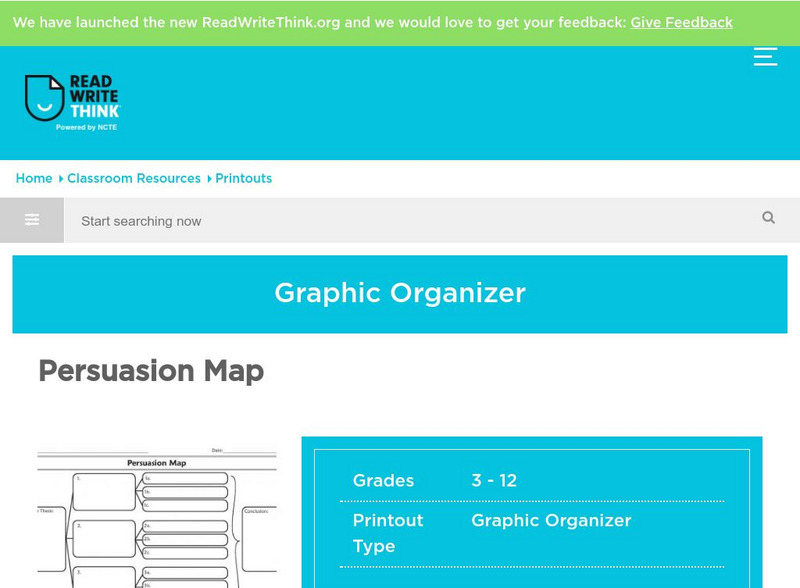
Read Write Think: Persuasion Map
A printable graphic organizer for students to use when writing on opinion or persuasive essay. Directions on how to use this type of graphic organizer as well as lists of teaching ideas, lesson plans, and other resources are also...
ReadWriteThink
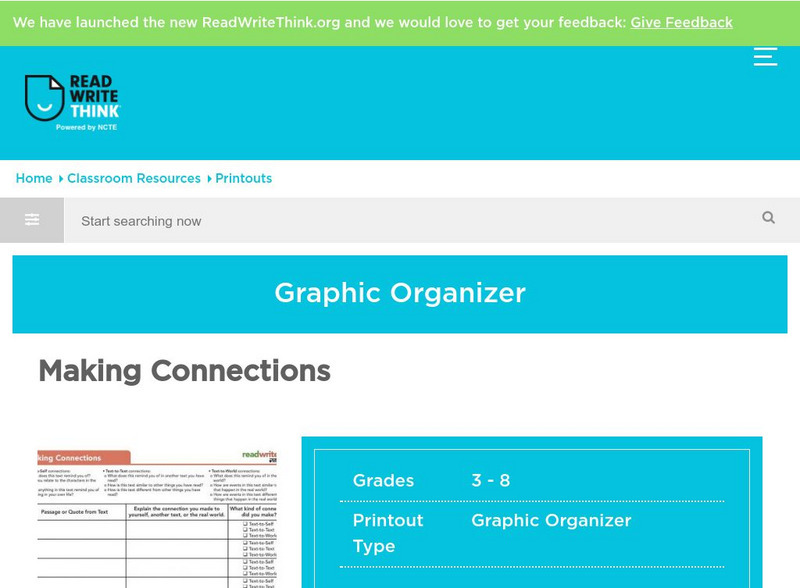
Read Write Think: Making Connections
A printable graphic organizer for students to use when making text to self, text, and world connections while reading a text. Directions on how to use this type of graphic organize as well as lists of teaching ideas and related resources...
ReadWriteThink
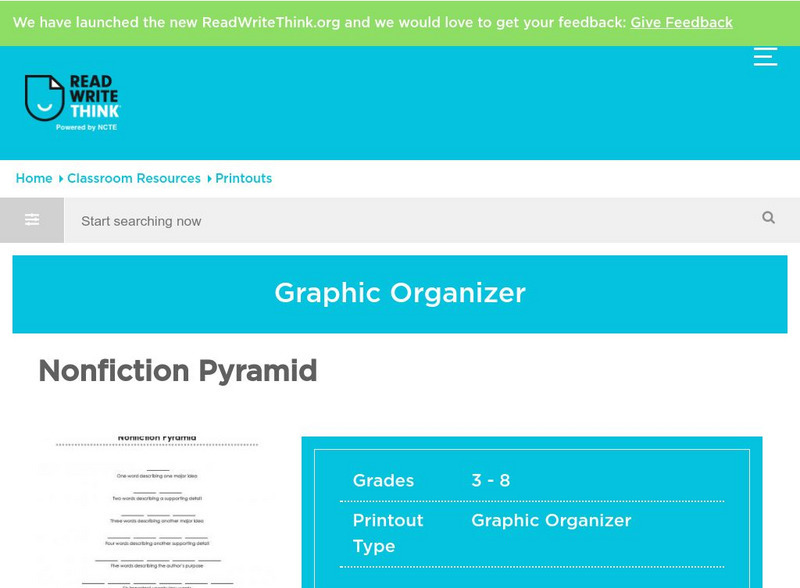
Read Write Think: Nonfiction Pyramid
A printable pyramid for use with nonfiction texts while students identify the main ideas and supporting details within a text. Students also determine author's purpose and key vocabulary words. Directions on how to use this type of...
ReadWriteThink
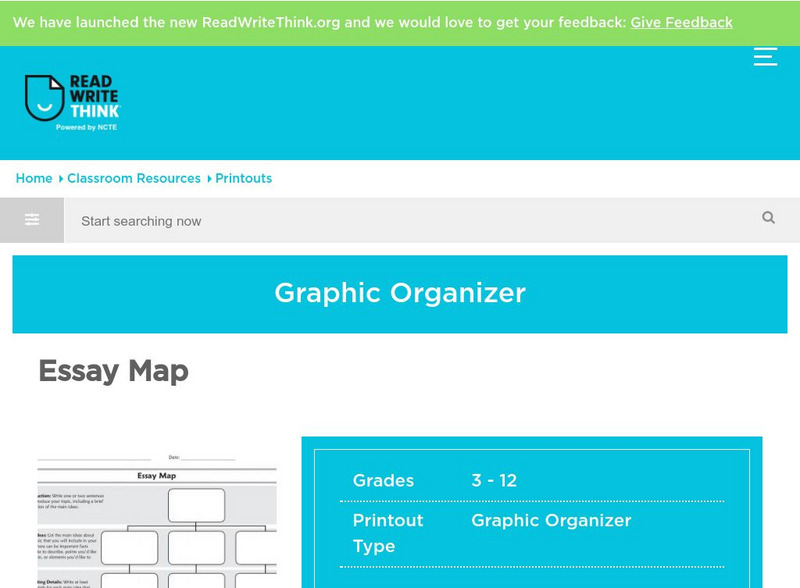
Read Write Think: Essay Map
A fillable essay map in PDF format with boxes for an introduction, main ideas, supporting details, and a conclusion. Directions on how to use this type of graphic organizer as well as lists of teaching ideas and related resources are...
ReadWriteThink
Read Write Think: Venn Diagram, 3 Circles
A printable Venn Diagram with three circles to use when comparing and contrasting three things or topics. Directions on how to use this graphic organizer as well as lists of teaching ideas and related resources are also provided.