Hi, what do you want to do?






The Dirksen Congressional Center
Congress for Kids: Checks and Balances
The system of checks and balances in place for maintaining the power relationships within the United States government is explained in kid-friendly terms. Suggestions for research projects, resource links and some activities are...
Other
Word Wizards: The Role of Limited Government in a Free Society
This site provides a well-balanced article that looks at the role of America's limited government in its free society, examining differing perspectives to achieve a consensus.
This Nation
This nation.com: Executive Order 13132 of August 4, 1999
This Executive Order signed by President Bill Clinton on 8/4/99 is an order that describes the balance between state and federal governments, as warranted by the Framers of the Constitution and federalism.
Schools of California Online Resources for Education
Score: The u.s. Constitution Power Grab Game
Politicians like power, but who actually gets to use their powers in different situations? Take this quiz to sort out the checks and balances that are used on the various power plays.

Annenberg Foundation
Annenberg Classroom: Tenth Amendment
Annenberg Classroom resource on the 10th Amendment which attempts to create a balance of power between federal and state government. With links to related news articles and resources.
Constitutional Rights Foundation
Constitutional Rights Foundation: Proposed Changes in the Way the Federal Government Operates
Examine amendments made to aid the government in balancing the budget and income tax as well as the debate over term limits.
University of Groningen
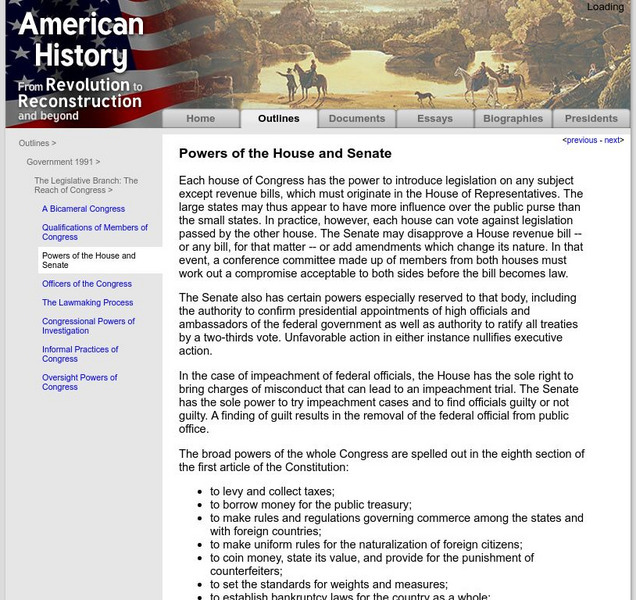
American History: Outlines: The Legislative Branch: The Reach of Congress
This well-written and well-organized site from The Legislative Branch provides a thorough overview of congressional powers, inherent checks and balances, as well as links to related information.
A&E Television
History.com: How the u.s. Constitution Has Changed and Expanded Since 1787
Through amendments and legal rulings, the Constitution has transformed in some critical ways. The U.S. Constitution, written in 1787 and ratified by nine of the original 13 states a year later, is the world's longest-surviving written...

iCivics
I Civics: Three Branches: Laws in Action
Embark on his WebQuest to follow the path an idea takes to eventually become a law. Read a short description regarding the role of each branch of government and then answer a follow-up question using the link provided.
iCivics
I Civics: Montesquieu Mini Lesson
Meet the Baron de Montesquieu, one of the great thinkers of the 18th century. He spent a lot of time thinking about how governments should be created and maintained. These ideas guided the Founding Fathers when they wrote the...

ClassFlow
Class Flow: Government Glossary
[Free Registration/Login Required] In this lesson Activotes are used to access student's prior knowledge of the principles of the US constitutional government. Student knows the essential principles stated in the US Constitution-...
Curated OER
Map: Imperialism and the Balance of Power
World maps of the Colonial Empires of 1914 as well as their revenues during that time period. There are also maps depicting urban growth, type of government, wars and atrocities, and living conditions of the world in 1900.
Curated OER
Map: Imperialism and the Balance of Power
World maps of the Colonial Empires of 1914 as well as their revenues during that time period. There are also maps depicting urban growth, type of government, wars and atrocities, and living conditions of the world in 1900.

The Dirksen Congressional Center
Dirksen Congressional Center:congress for Kids: Introduction to the Constitution
Explore the history of the United States Constitution: information about the writing the Constitution, the Great Compromise, the Constitution's signers, the Bill of Rights, the Amendments to the Constitution, federal powers, checks and...
The Dirksen Congressional Center
Congress Link: Lesson Plans
The Dirksen Congressional Center provides abundant lesson plans on all aspects of the US Congress and the US Constitution. All lessons contain time frames, objectives, and links to material, and are built around Bloom's taxonomy.
ClassFlow
Class Flow: Challenges Faced by the New Nation
[Free Registration/Login Required] This unit covers the content area featuring the challenges faced by the new nation including the writing of the Constitution, government powers, the Bill of Rights and the War of 1812.
Digital History
Digital History: Completing a Final Draft
Read about the committee that produced a final draft of the Constitution to present to the entire Constitutional Convention. Find out what the delegates to the convention kept in the final draft and what they changed.
Social Studies for Kids
Social Studies for Kids: The Presidential Veto
The President of the United States has extraordinary power over the shaping of federal laws. He or she can veto any law passed by Congress.
Digital History
Digital History: The Clinton Presidency
Short, but comprehensive, synopsis of Clinton's two terms as president. Included in the article is the 1992 campaign, successful and controversial legislation, and the scandals that would eventually become part of his presidential legacy.
Claremont Institute
Founding.com: Ronald Reagan
The content of a speech given by Ronald Reagan in 1964 where he talks about the fine power and economic balance a government must maintain when providing social and humanitarian services.