Hi, what do you want to do?





National Earth Science Teachers Association
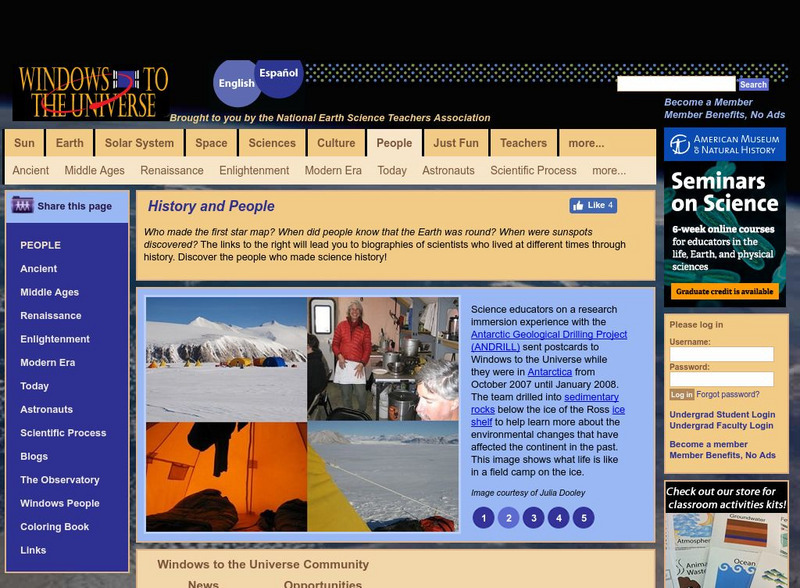
Windows to the Universe: History & People
Biographies of people throughout history who looked at the sky and wondered what was there. Links to a detailed description of the planets and interactive activities.
NASA
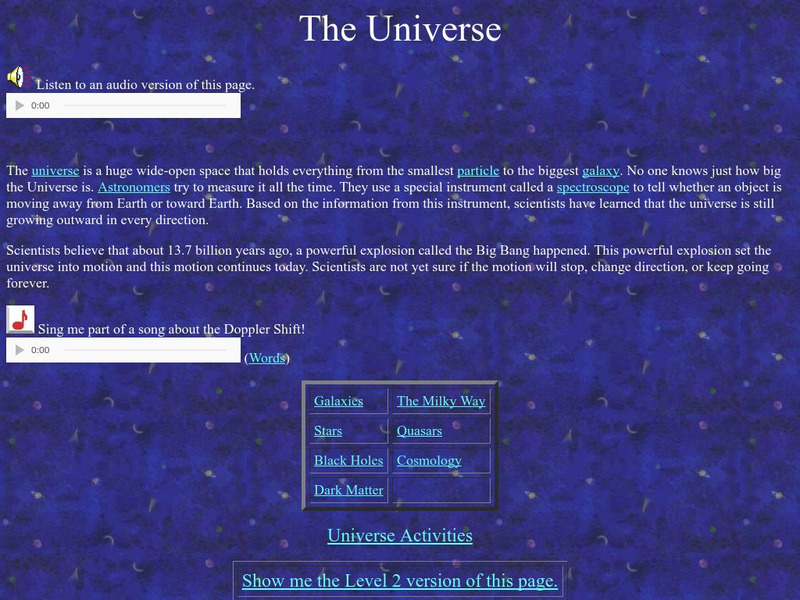
Nasa Star Child: The Universe (Level 1)
This site provides an introduction to the origin of the universe for the young child and the Big Bang theory. There is also a song about the Doppler Shift. Vocabulary glossary and printable version available.

American Museum of Natural History
American Museum of Natural History: O Logy: How Did the Universe Begin?
Bite-size introduction to two scientists-Hubble and Lemaitre-who played key roles in formulating the theory of the origin of the universe known as the big bang. Includes an interactive timeline on which you can plot out the approximate...

Khan Academy
Khan Academy: Gallery: Structure in the Universe
The Universe is very diverse and contains many unique elements that can be observed in this gallery of pictures.
NASA
Nasa: Imagine the Universe: Fa Qs on Quasars
A list of answers to many questions related to quasars and active galaxies.
European Space Agency
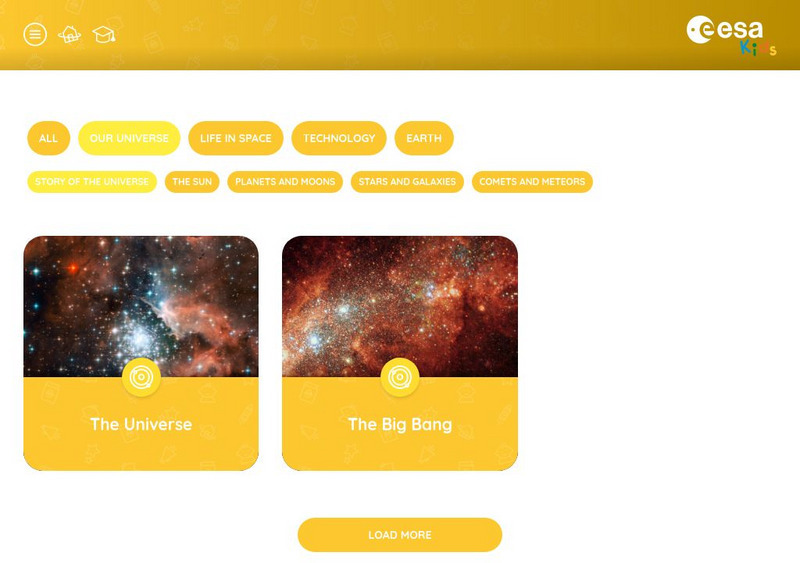
European Space Agency: Story of the Universe
The story of the universe is told in this engaging site by the European Space Agency. The history of European space science is timelined with dates ranging from 1066 to present day. The birth of galaxies, the big bang, and the beginnings...
Scholastic
Scholastic: Study Jams! Science: Our Solar System: The Universe
A video and a short multiple-choice quiz on the Universe and what it is made up of.

Other
An Atlas of the Universe
What does the universe look like? This website offers visitors a collection of images that serve as an "atlas" of our universe. See multiple charts showing the Earth's distance from the Sun and other stars, find helpful terms in a...
ACT360 Media
Act Den: Sky Den
This journey will help you solve big questions about the universe. You will be able to see beyond human capabilities and will learn what scientists are discovering.

Space Telescope Science Institute
Nasa: Hubble Space Telescope: Galaxies
At this site from HubbleSite you can learn all about galaxies and black holes. Click on the movie link and discover how old the universe is or study about what happens when two galaxies collide!
Other
Astromador: Astronomia Para Amadores
This resources focuses exclusively on astronomy. It's packed with historical facts about space exploration, famous people who pioneered the study of stars and planets. It features chronological list of space exploration, current news,...
NASA
Nasa: Image Science Center: Ask the Space Scientist
A NASA scientist, Dr. Sten Odenwald, answers many students' questions. Topics include planets, galaxies, black holes, the origin of the universe, and common misconceptions about space.
University of Illinois
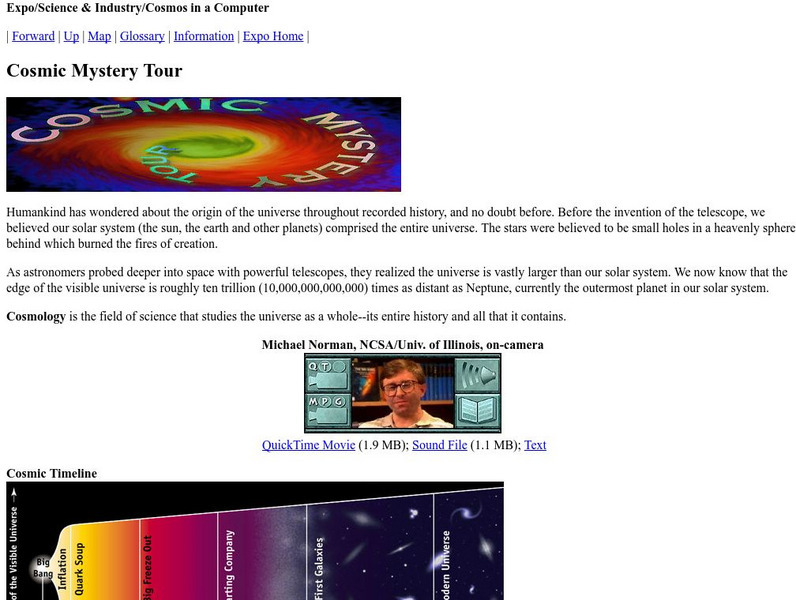
University of Illinois: Cosmic Mystery Tour
This multimedia tour is extremely dense with information about the origin of the universe. There are videos and simulations to assist with understanding, but it is definitely for advanced students.

NASA
Nasa: Imagine the Universe: X Ray Binary Stars
Site provides a brief introduction to binary stars. Additional resources for students and teachers on this topic are offered as well as related topics.
Other
University of Cambridge Cosmology: Galaxies
This site from the University of Cambridge allows you to view information on spiral, elliptical, and Milky Way galaxies, as well as galaxy clusters. Provides basic facts about each one.
Space Telescope Science Institute
Galaxy Hunter: A Cosmic Photo Safari
Travel the universe and learn about galaxies. Investigate Hubble Deep Field observations to learn more.
Wikimedia
Wikipedia: The Black Hole
This site examines the black hole as an object in astrophysics. Delve into this comprehensive resource that covers this concept from its history, to qualitative physics, the reality of black holes, mathematical physics and more.
Space Telescope Science Institute
Nasa: Hubble Space Telescope: Universe
At this site from HubbleSite you can discover the universe by taking a look back toward the beginning of time. Site contains links to information on planets, stars, galaxies, and much more.
NASA
Nasa: Star Child: Elementary Astronomy Unit
Learn everything you can about outer space with this interactive astronomy unit. 2 levels of difficulty with modules on the solar system, the universe, other "space stuff" and a glossary of terms. Links for parents and other great website.
American Museum of Natural History
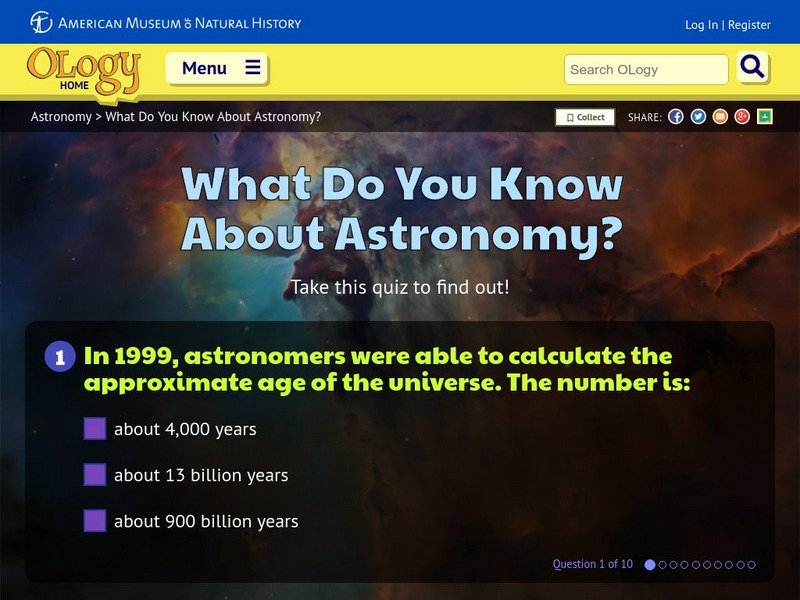
American Museum of Natural History: O Logy: What Do You Know? Astronomy
Take this ten-question self-scoring quiz to test your knowledge of astronomy facts: age of the universe, why stars and planets are spheres, where other life might exist in the outer space, the Milky Way, and more.
PBS
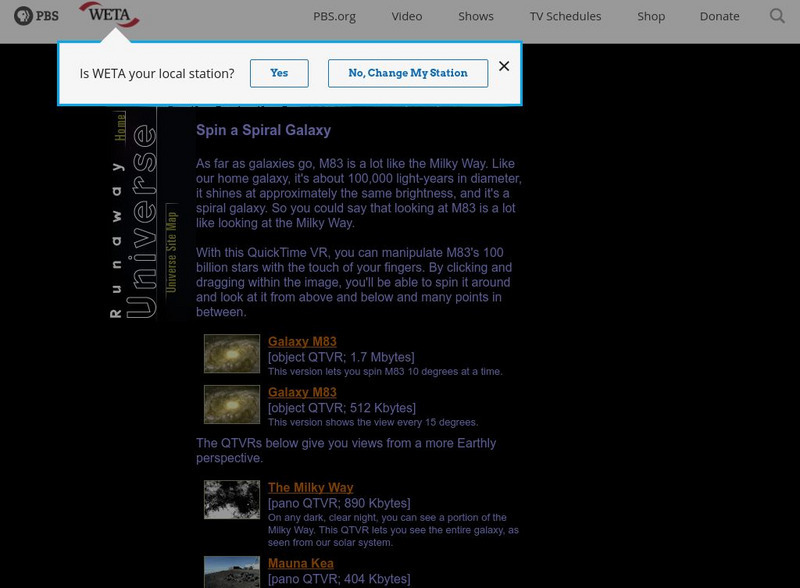
Pbs Nova Online: Spin a Spiral Galaxy
PBS site provides various views of spiral galaxies. (Quick Time required) With this technology, you can manipulate the image to spin it around and look at it from various angles.

A&E Television
History.com: The Space Race: Interactive Universe
A virtual journey through space offers photos and facts about Earth and its neighboring planets, comets, other celestial bodies of the Solar System, and the Milky Way and Andromeda galaxies.
BBC
Bb Ci: The Hitchhiker's Guide to the Galaxy
Fun site containing information about the world created by the book. Also contains links to information on the author, Douglas Adams.
University of Wisconsin
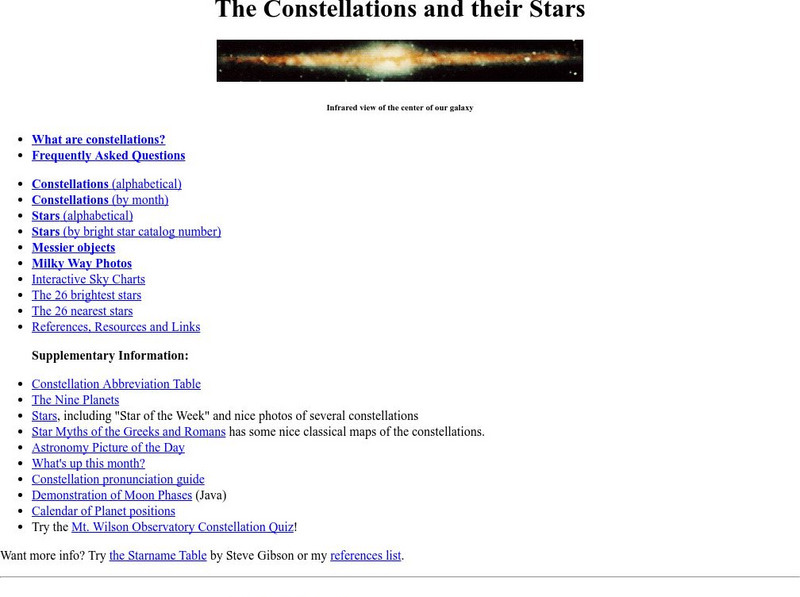
University of Wisconsin: The Constellations and Their Stars
An excellent site dedicated to the constellations and information about the objects which make them up. Contains a great deal of information about various stars, galaxies and other objects, as well as details on how best to observe them.