Hi, what do you want to do?





BBC
Bbc: Space Race
There are galaxies far, far away, but just how big is our own solar system? Scroll through this interactive to quickly observe just how much we know and have learned about our solar system.
NASA
Nasa: The Space Place
This site from the National Aeronautics and Space Administration allows students to explore topics related to planet earth and outer space. A number of games and interactive features are available.

Space Telescope Science Institute
Amazing Space: Galaxy Hunter
Journey to the wildest regions of space, and wrestle with cosmic giants, galaxies. Explore the Hubble Deep Fields from a statistical point of view.
TeachEngineering
Teach Engineering: Beyond the Milky Way
When we look at the night sky, we see stars and the nearby planets of our own solar system. Many of those stars are actually distant galaxies and glowing clouds of dust and gases called nebulae. The universe is an immense space with...

NASA
Nasa Star Child: Infrared Astronomy Satellite (Iras) (Level 2)
A brief description of Infrared Astronomy Satellite (IRAS) project and its discoveries. Complete with graphics, links to a glossary of terms, and a printable version of the page.
NASA
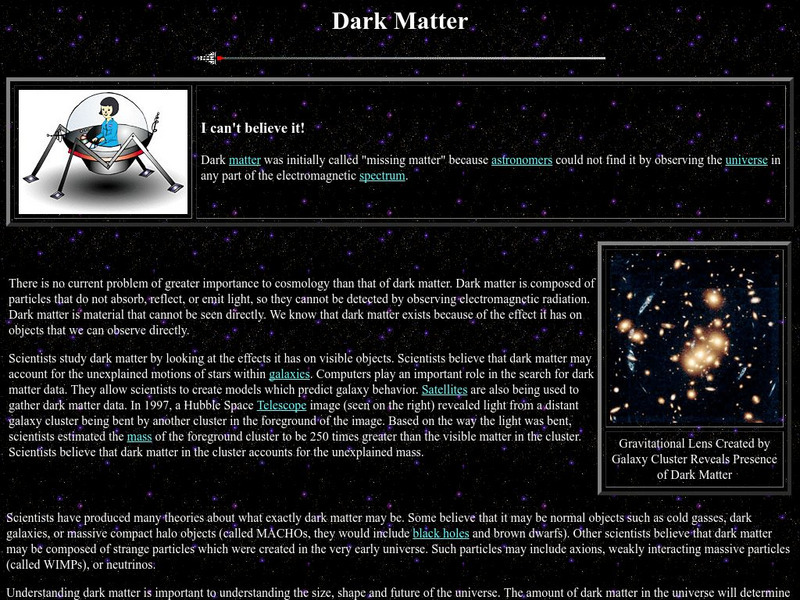
Nasa Star Child: Dark Matter (Level 2)
This site provides a description of "dark matter" and how scientists study it. Vocabulary words linked to a glossary of terms, and a printable version are also available on the site.

TED Talks
Ted: Ted Ed: How Small Are We in the Scale of the Universe?
In 1995, scientists pointed the Hubble Telescope at an area of the sky near the Big Dipper. The location was apparently empty, and the whole endeavor was risky- what, if anything, was going to show up? But what came back was nothing...

Natural History Museum
Natural History Museum: Our Place in the Universe
Part of a larger online exhibit on the moon and space, this site deals with one's place in the universe. The topics covered include the sun and solar system, the galaxy, and the universe.
European Space Agency
European Space Agency: Esa Kids: Our Universe: Supernovas
A basic overview of supernovas. Links to more information about starts, planets and other objects in our solar system and galaxy are included.
Harvard University
Chandra X Ray Observatory: Video Podcasts: The Incredible Two Inch Universe
A set of podcasts outlining a four-step process for understanding the vastness of our universe, from the vicinity of the Earth and Moon, out into distant galaxies. Downloadable instructions and a handout are included, as well as...
NASA
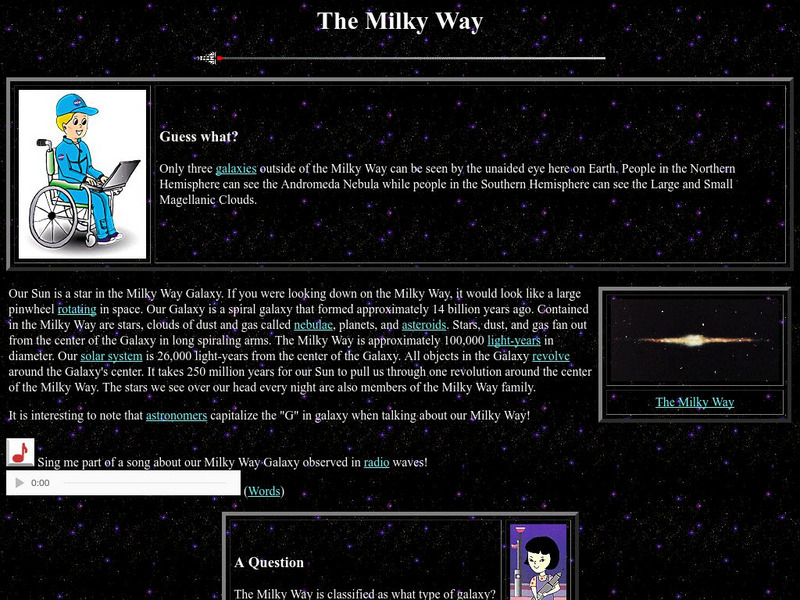
Nasa Star Child: The Milky Way
The information, geared mainly for younger viewers, provides simple and basic information about the Milky Way, and includes several embedded links to related information.
NASA
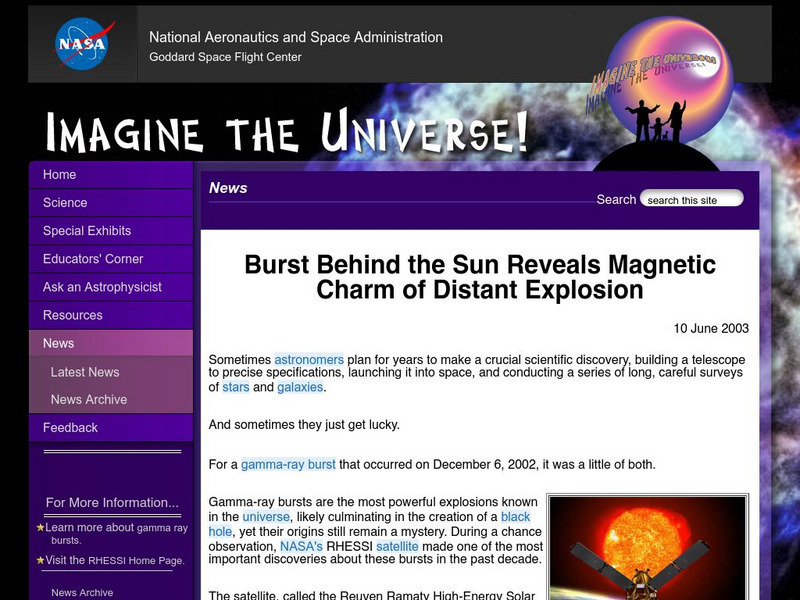
Nasa: Imagine the Universe: "Burst Behind the Sun"
Site provides the article, "Burst Behind the Sun Reveals Magnetic Charm of Distant Explosion," that details on a gamma-ray burst that occurred on December 6, 2002. Provides graphics and links to learn more about gamma-ray bursts.
University of Wisconsin
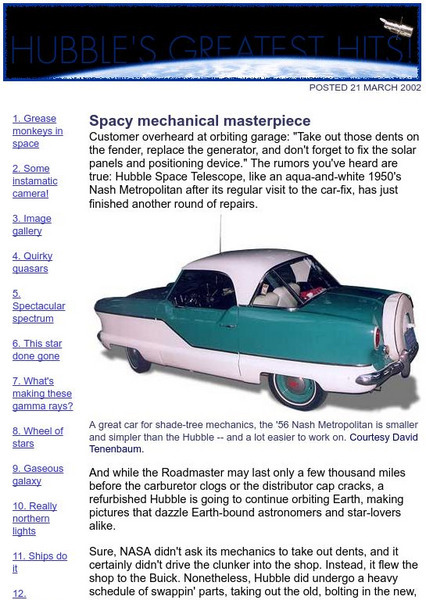
The Why Files: Spacy Mechanical Masterpiece
An interesting article describing repairs which were completed on the Hubble telescope in 1993 and 1997. Also contains links to pictures taken by the telescope.
Society for Science and the Public
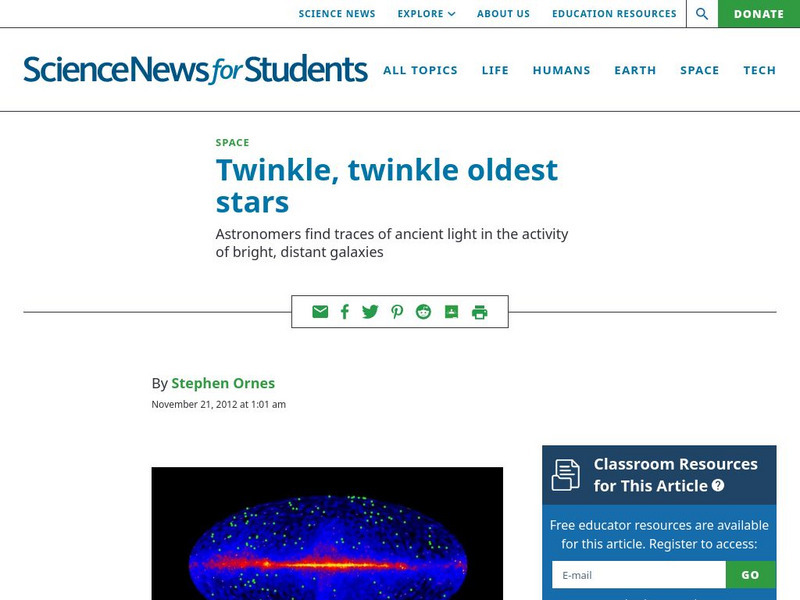
Science News for Students: Twinkle, Twinkle Oldest Stars
Astronomers have determined how super-bright galaxies can be used to detect the faint glow of "cosmic fog." Cosmic light is light that has left every star and now lingers in the universe, including light from stars that have burned out.
Physics4kids
Physics 4 Kids: Where Traditional Physics Stops
We're about to move into the modern age of physics. In the early 1800's, scientists began examining the basis of matter, space, and time. Sometimes it gets very confusing, but the big idea is that Newton's physics describe about 90% of...
PBS
Pbs Teachers: Demonstrating the Distances of Stars
Investigate the use of the parallax effect for determining distance in space, and explore the arrangement and relative distance of stars in the galaxy. Create a sample star field and transform it into a three-dimensional model.