Hi, what do you want to do?





Science Buddies
Science Buddies: Slip Sliding Away: Experimenting With Friction
As you headed up the mountain to enjoy your last ski trip, you may have noticed a sign reading: Hazard. Icy Roads Ahead, Put On Your Chains. Putting chains on car tires increases the resistance between the tires and the road allowing the...

Center of Science and Industry
Cosi Columbus: Hover Cup
Science experiment in which you make a hovercraft, a machine that uses compressed air to do work, from a paper cup. Includes full list of materials, procedures, and scientific explanation of how air flow can minimize friction and cause...
TeachEngineering
Teach Engineering: It Takes Two to Tangle
Students explore the theme of conflict in literature. They learn the difference between internal and external conflict and various types of conflicts, including self against self, self against other, and self against nature or machine....
Science Buddies
Science Buddies: Project Ideas: Whirl Y Bird vs. Whale Y Bird
Improve the design of a very simple aircraft, the whirlybird, and learn about hydrodynamics and biomimicry in this science experiment. The Science Buddies project ideas are set up consistently beginning with an abstract, objective, and...
Science Buddies
Science Buddies: The Swimming Secrets of Duck Feet
By comparing the feet of different water birds you can discover how they propel the birds through the water. This Science Buddies project show you how to modify swim fins to simulate ducks' feet, greebes' feet, and the feet of...
Science Buddies
Science Buddies: You Nailed It! Hammering Force for Different Types of Wood
This Science Buddies project explains how to build a mechanism that will reproducibly swing a hammer so you can determine the amount of force needed to hammer a nail through various densities of wood. The Science Buddies project ideas...
Science Buddies
Science Buddies: Rubbing Up Against Static Electricity
A tried and true balloon activity is to rub a balloon on your head to make your hair stand up. Learn how the rubbing builds up static electricity using this experiment to see if the number of rubs makes a difference.
Science Buddies
Science Buddies: What a Drag!
What makes some objects more streamlined than others? Find out which ordinary objects around your house are made to move smoothly through the water in this easy experiment. Which objects will produce the most drag when pulled through the...
TeachEngineering
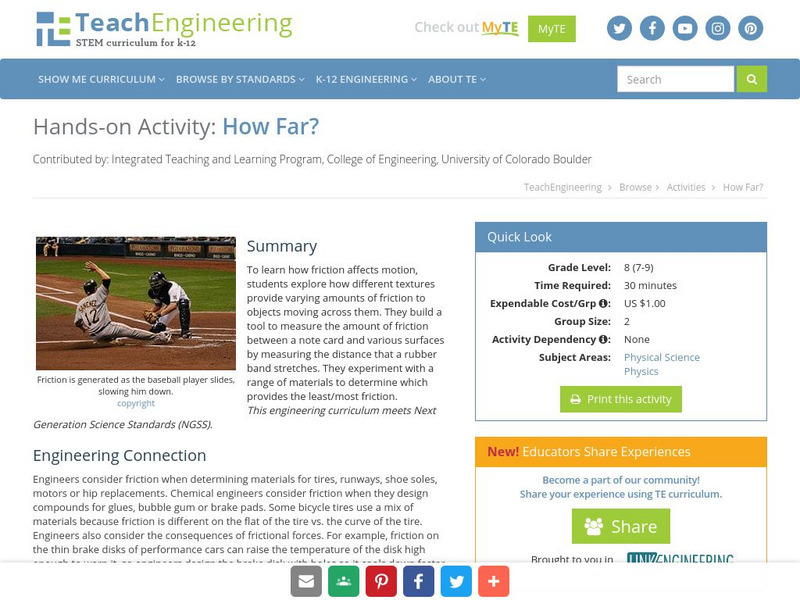
Teach Engineering: How Far?
To learn how friction affects motion, students explore how different textures provide varying amounts of friction to objects moving across them. They build a tool to measure the amount of friction between a note card and various surfaces...
TeachEngineering
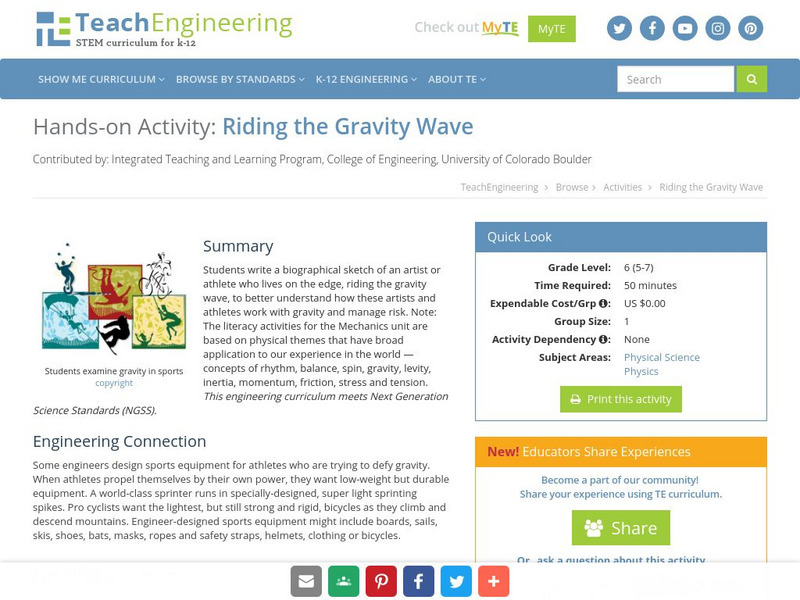
Teach Engineering: Riding the Gravity Wave
Students write a biographical sketch of an artist or athlete who lives on the edge, riding the gravity wave, to better understand how these artists and athletes work with gravity and manage risk. Note: The literacy activities for the...
TeachEngineering
Teach Engineering: Couch Potato or Inertia Victim?
Students design a simple behavioral survey, and learn basic protocol for primary research, survey design and report writing. Note: The literacy activities for the Mechanics unit are based on physical themes that have broad application to...
TeachEngineering
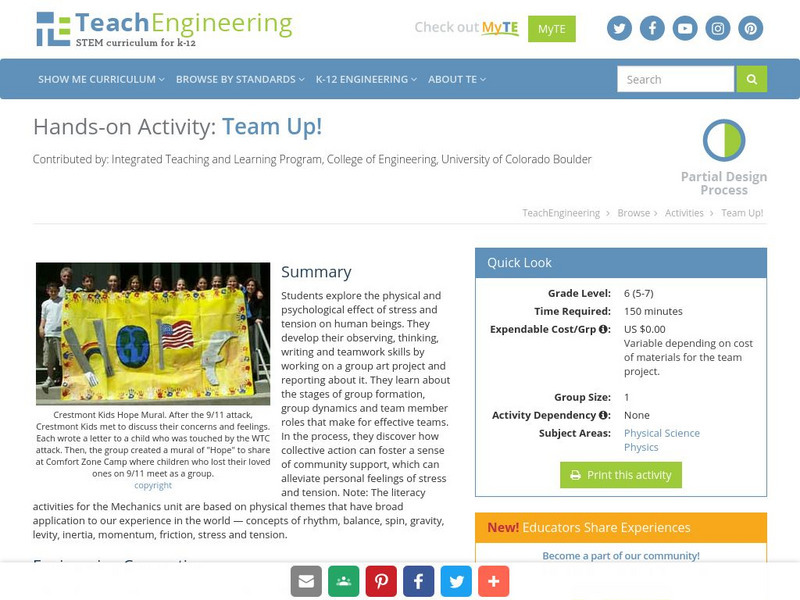
Teach Engineering: Team Up!
Students explore the physical and psychological effect of stress and tension on human beings. They develop their observing, thinking, writing and teamwork skills by working on a group art project and reporting about it. They learn about...
TeachEngineering
Teach Engineering: Stress, Inc.
Students explore the physical and psychological effect of stress and tension on human beings. Concepts of stress and stress management are introduced. Students discover how perception serves to fuel a huge industry dedicated to...
TeachEngineering
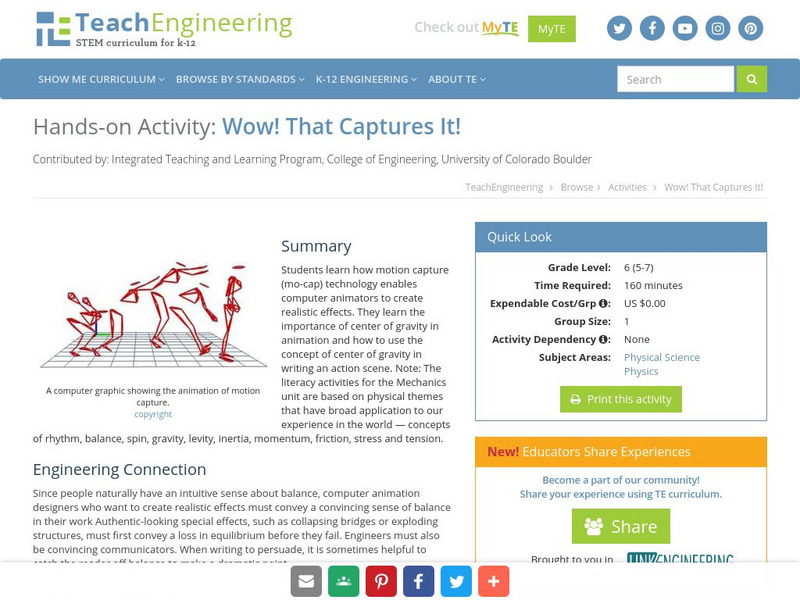
Teach Engineering: Wow! That Captures It!
Students learn how motion capture (mo-cap) technology enables computer animators to create realistic effects. They learn the importance of center of gravity in animation and how to use the concept of center of gravity in writing an...
TeachEngineering
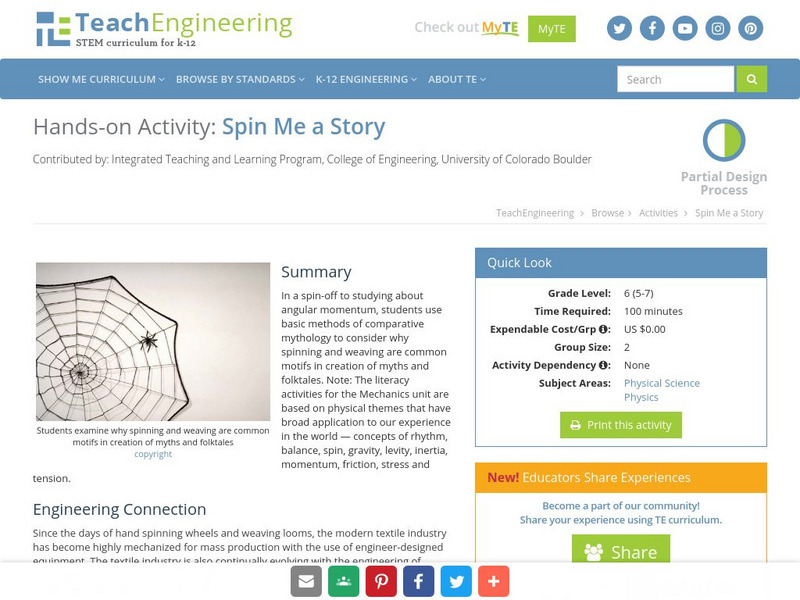
Teach Engineering: Spin Me a Story
In a spin-off to studying about angular momentum, students use basic methods of comparative mythology to consider why spinning and weaving are common motifs in creation myths and folktales. Note: The literacy activities for the Mechanics...
University of Oregon
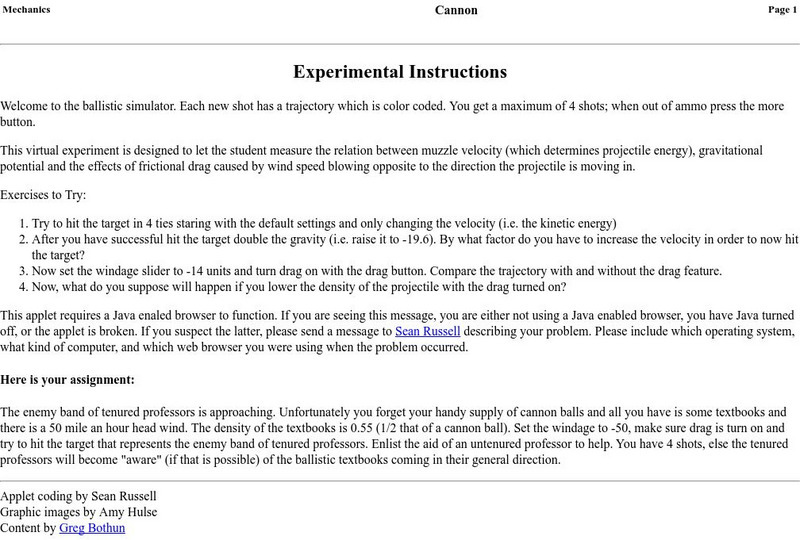
Uo: Cannon Simulator: Experimental Instructions
This virtual experiment is designed to let the student measure the relation between muzzle velocity (which determines projectile energy), gravitational potential and the effects of frictional drag caused by wind speed blowing opposite to...
Other popular searches
- Friction Experiments Free
- Heat Friction Experiments
- Fluid Friction Experiments
- Friction Experiments Speed
- Kinetic Friction Experiments
- Friction Experiments Water
- Light Friction Experiments