Hi, what do you want to do?






Columbus City Schools
Making Waves
Learning about waves can have its ups and downs, but a demo-packed tool kit has the class "standing" for more! Learners gain experience with several different wave types, organizing observations and data, and wave...

Curated OER
Earthquakes: Sixth Grade Lesson Plans and Activities
Young seismologists learn more about plate tectonics with a set of pre-lab, lab, and post-lab lessons plans on earthquakes. After exploring how waves travel through various materials, sixth graders record their observations and...

Mathematics Vision Project
Module 6: Trigonometric Functions
Create trigonometric functions from circles. The first lesson of the module begins by finding coordinates along a circular path created by a Ferris Wheel. As the lessons progress, pupils graph trigonometric functions and relate them to...

Texas Education Agency
Texas Gateway: Physics of Hearing: Speed of Sound, Frequency, and Wavelength
By the end of this section, you will be able to define pitch; describe the relationship between the speed of sound, its frequency, and its wavelength; describe the effects on the speed of sound as it travels through various media; and...
CK-12 Foundation
Ck 12: Wave Speed Calculations
[Free Registration/Login may be required to access all resource tools.] Students investigate and analyze characteristics of waves, including velocity, and calculate the relationship between wave speed, frequency, and wavelength.
BBC
Bbc: Gcse Bitesize: General Properties of Waves
Light travels as waves. Waves can be described by their amplitude, wavelength and frequency. The speed of a wave can be calculated from its frequency and wavelength.

CK-12 Foundation
Ck 12: Physical Science: Wave Speed
[Free Registration/Login may be required to access all resource tools.] Definition of wave speed and how it is related to wavelength and wave frequency, how to calculate wave speed and how it is related to the medium of a wave.
CK-12 Foundation
Ck 12: Light
[Free Registration/Login may be required to access all resource tools.] In the following tutorial students will describe the relationships between speed, wavelength, and frequency of light. They will understand the photoelectric effect...

Physics Classroom
The Physics Classroom: The Wave Equation
A thorough explanation of the wave equation (Speed = Wavelength * Frequency). A data table and questions to check one's understanding are also part of this lesson.
CK-12 Foundation
Ck 12: The Quantum Mechanical Model
[Free Registration/Login may be required to access all resource tools.] In the following online tutorial students will calculate the wavelength, frequency, and energy of light using Planck's constant and the speed of light. They will...
Physics Classroom
The Physics Classroom: Formation of Standing Waves
How are standing wave formations formed? Why are they only formed when the medium is vibrated at specific frequencies? What makes these so-called frequencies so special and magical? These questions are answered in this exploration of...
CK-12 Foundation
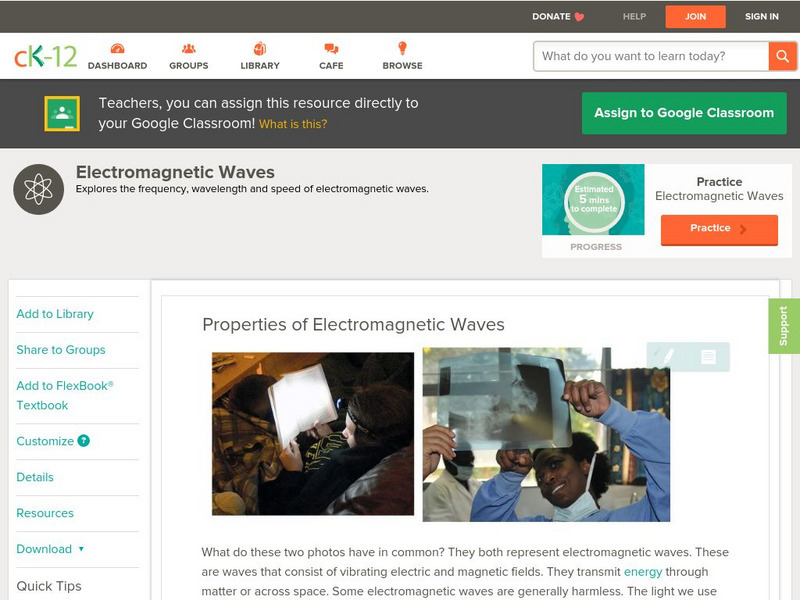
Ck 12: Physical Science: Properties of Electromagnetic Waves
[Free Registration/Login may be required to access all resource tools.] The speed of electromagnetic waves, their wavelengths and frequencies and how to calculate wavelength or wave frequency.
Texas Education Agency
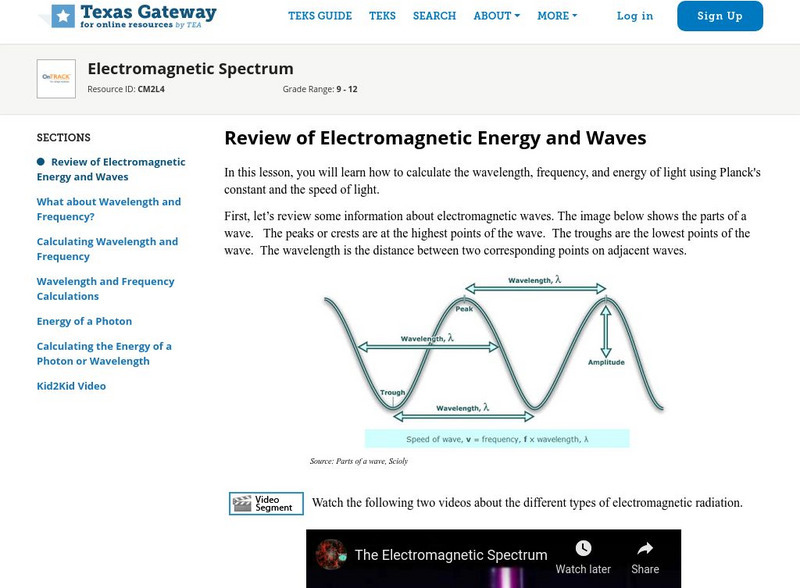
Texas Gateway: Electromagnetic Spectrum
This tutorial explores using Planck's constant and the speed of light to calculate the wavelength, frequency, and energy of light.
Georgia Department of Education
Ga Virtual Learning: Ap Physics 1: Waves and Sound
Students will understand and predict wave phenomena, and investigate the energy contained in waves. They will gain a deeper understanding of waves and wave interference that will enable characterization and engineering of matter from the...
Texas Education Agency
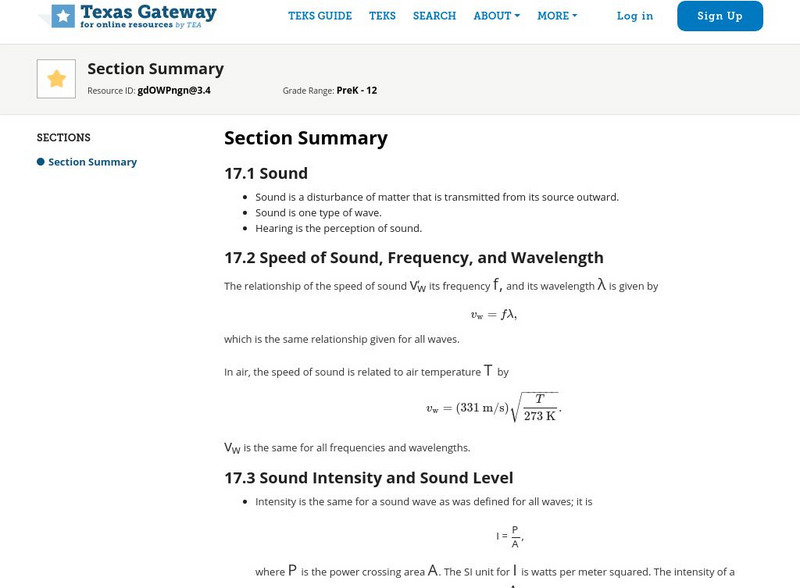
Texas Gateway: Physics of Hearing: Summary
This page provides a summary of the content of each section of Chapter 17: Physics of Hearing from the AP Physics online text.