BBC
Bbc: Gcse Bitesize: General Properties of Waves
Light travels as waves. Waves can be described by their amplitude, wavelength and frequency. The speed of a wave can be calculated from its frequency and wavelength.
CK-12 Foundation
Ck 12: Wave Speed Calculations
[Free Registration/Login may be required to access all resource tools.] Students investigate and analyze characteristics of waves, including velocity, and calculate the relationship between wave speed, frequency, and wavelength.

NASA
Nasa: Space Place: The Electromagnetic Spectrum
Find out how energy, frequency, and wavelength are related in terms of the electromagnetic spectrum.

Khan Academy
Khan Academy: Light: Electromagnetic Waves, Electromagnetic Spectrum and Photons
This article discusses the properties of electromagnetic radiation and photons.
Physics Aviary
Physics Aviary: Wavelength Lab
This lab is designed to have students investigate the relationship between the speed of a wave, the frequency of the wave and the wavelength of the wave. Students can vary wave speed and frequency. Each of these should be varied while...
NASA
Nasa: Imagine the Universe: What's the Frequency, Roy G. Biv
In this very detailed lesson plan from NASA, students investigate wavelength and frequency within the electromagnetic spectrum.
University of Kentucky
The Physics and Math of Music
Read about a math research project done by three college students which helps us see physics and math in music. Here's a great approach for integrating curriculum!
Texas Instruments
Texas Instruments: Blackbody Radiation
This program will produce the blackbody radiation curve for one or two objects when the student inputs the temperature(s) in kelvin. The program will also display on the curve the peak frequency and wavelength when one object is selected.
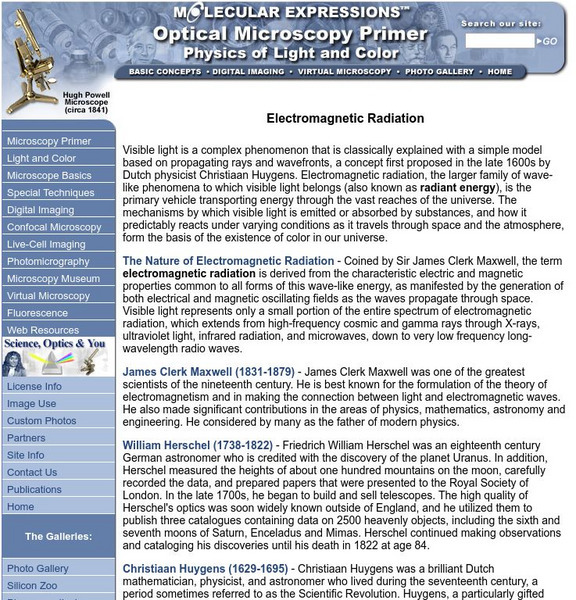
Florida State University
Florida State University: Molecular Expressions: Electromagnetic Radiation
This Florida State University page introduces light as an electromagnetic wave and discusses the frequency and wavelength range of the various regions of the electromagnetic spectrum. Includes links to some interactive Java applets.

Pennsylvania State University
Kettering University: Doppler Effect and Sonic Boom
Incredible set of animations demonstrating the Doppler effect and shockwaves resulting from supersonic aircraft.
Physics Classroom
The Physics Classroom: Forced Vibration
This physics tutorial explores forced vibration. Includes links to natural frequency, standing wave patterns and fundamental frequency and harmonics.
McREL International
Mc Rel: Whelmer #11 Learning Activity: Straw Oboes
An easy to do activity that investigates sound waves, wave length, frequency and pitch. The activity is presented in a lesson plan format that meets NSES standards.
Science Struck
Science Struck: Wavelength of Light
Describes the characteristics of light, presents two formulas for calculating its wavelength, and provides a table of the different wavelength ranges across the electromagnetic spectrum.
Science Struck
Science Struck: Electromagnetic Waves: Origin and Theory
Discusses the history of the discovery and study of electromagnetism, the scientists who worked on it, the basic principle, how wavelength and frequency are related, and types of electromagnetic waves.
CK-12 Foundation
Ck 12: The Quantum Mechanical Model
[Free Registration/Login may be required to access all resource tools.] In the following online tutorial students will calculate the wavelength, frequency, and energy of light using Planck's constant and the speed of light. They will...
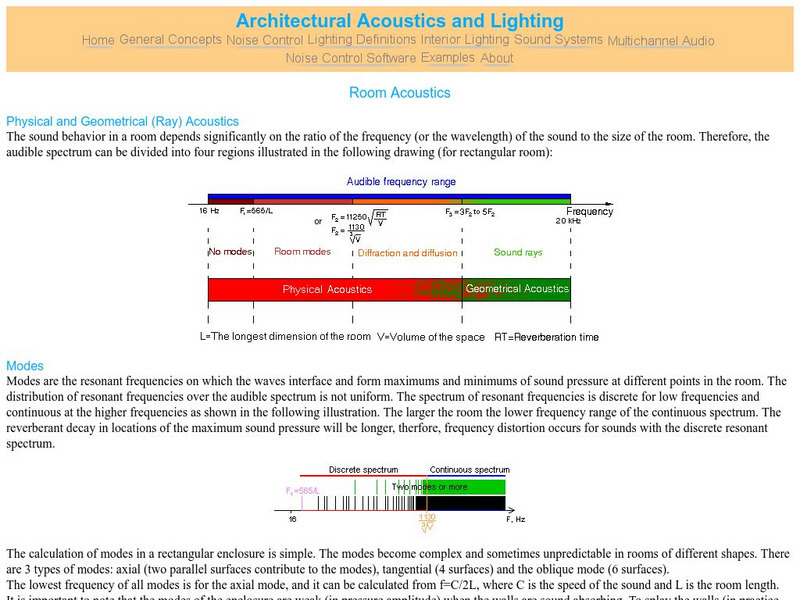
Other
Architectural Acoustics and Lighting: Room Acoustics
This site from Architectural Acoustics and Lighting provides a discussion of various factors affecting the acoustics of a given room. Room dimensions, the wavelength of the sound wave, the physical characteristics of the walls, the...
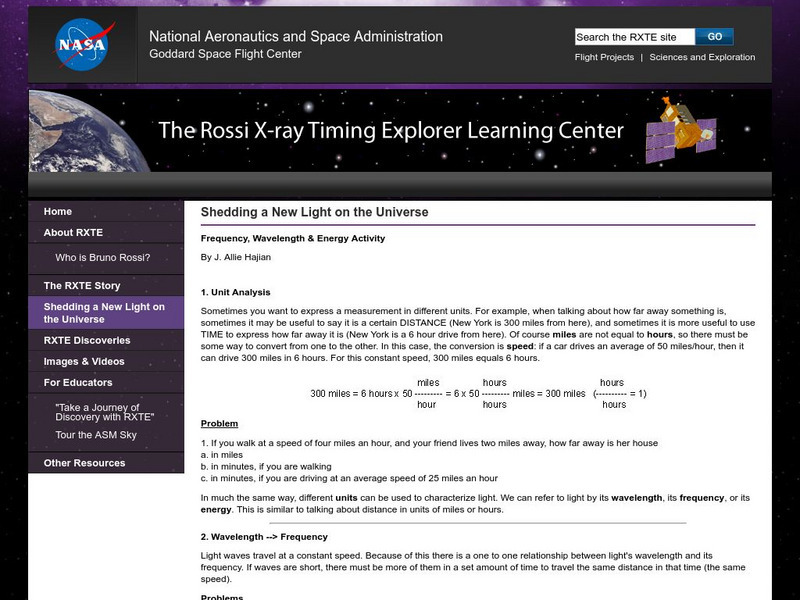
NASA
Rxte Learning Center: Frequency, Wave Length, and Energy Activity
Resource focuses on the relationship between the frequency, wavelength and speed of light. Has a link to an interactive activity relating frequency, wavelength, and energy.
CK-12 Foundation
Ck 12: Light
[Free Registration/Login may be required to access all resource tools.] In the following tutorial students will describe the relationships between speed, wavelength, and frequency of light. They will understand the photoelectric effect...
Physics Classroom
The Physics Classroom: Formation of Standing Waves
How are standing wave formations formed? Why are they only formed when the medium is vibrated at specific frequencies? What makes these so-called frequencies so special and magical? These questions are answered in this exploration of...
TeachEngineering
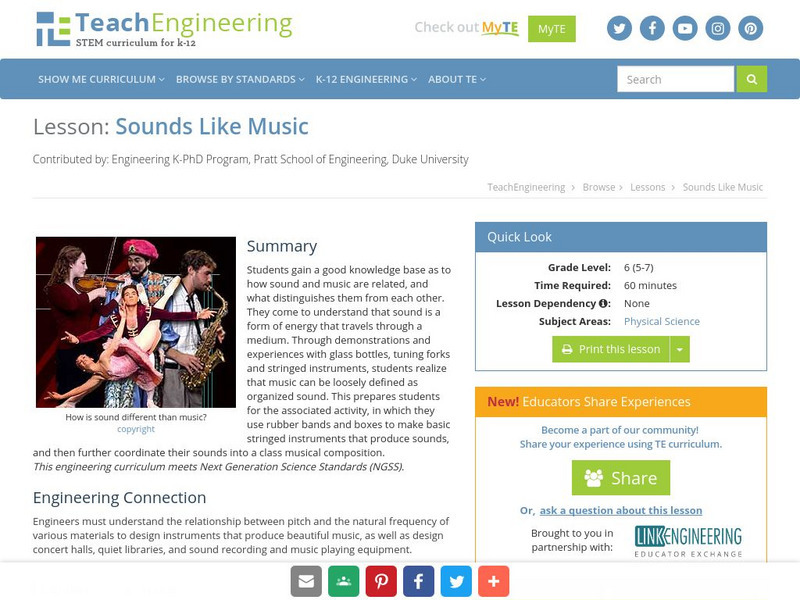
Teach Engineering: Sounds Like Music
Music can loosely be defined as organized sound. The lesson objectives, understanding sound is a form of energy, understanding pitch, understanding sound traveling through a medium, and being able to separate music from sound, can...
Physics Classroom
The Physics Classroom: Behavior of Waves
Boundary behavior, incident pulse, reflected pulse,and transmitted pulse are explained in this thorough tutorial. Animation and drawings are used to clarify the concepts.

Texas Education Agency
Texas Gateway: Physics of Hearing: Conceptual Questions
This is a list of 15 questions based on the major concepts presented in Chapter 17: Physics of Hearing from the AP Physics online text.
Georgia State University
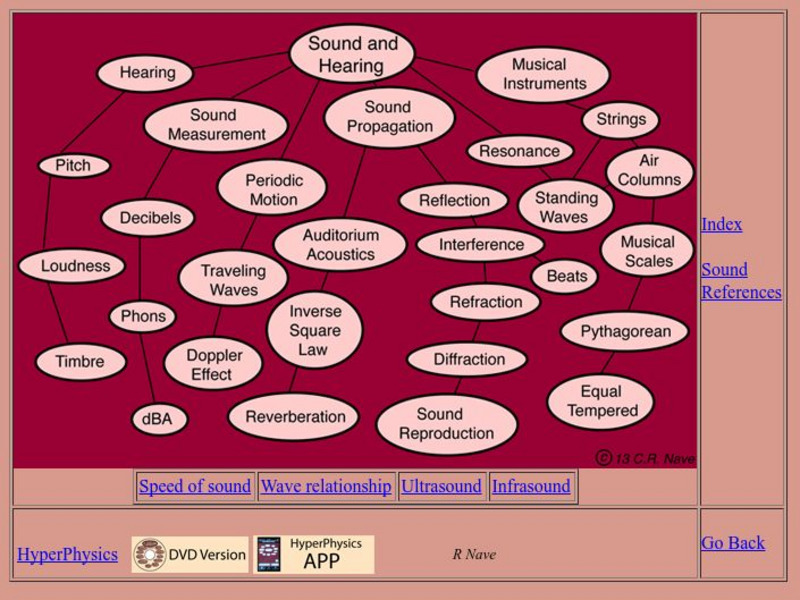
Georgia State University: Hyper Physics: Sound and Hearing
Home page for a hypertext course on physics. Accesses a range of topics from hearing to sound measurement to sound propoation to musical instruments.
Georgia State University
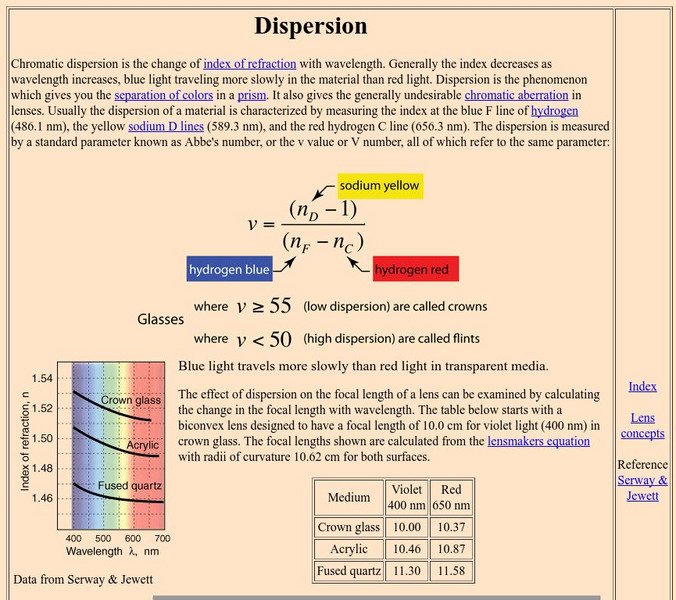
Georgia State University: Hyper Physics: Dispersion
The phenomenon of light dispersion is explained with a formula and a practice form for calculating Abbe's number.