Hi, what do you want to do?





University of Maryland
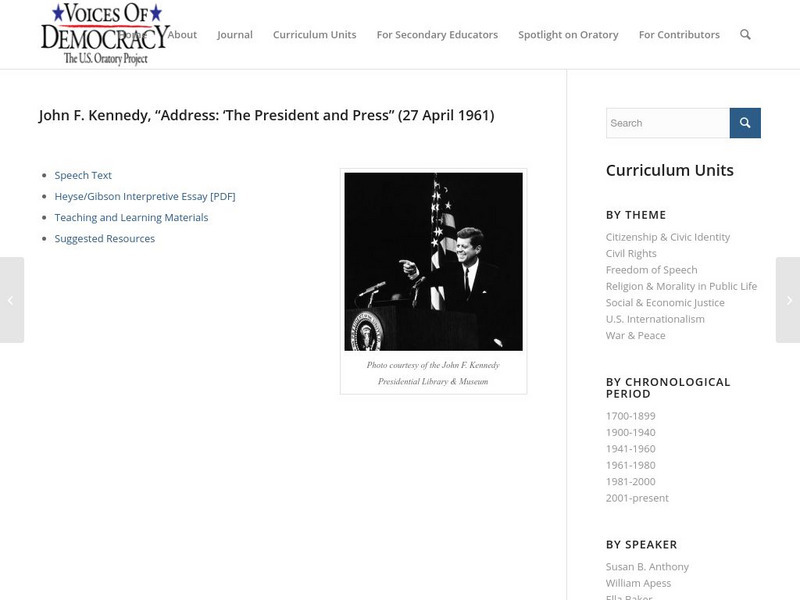
Voices of Democracy: John F. Kennedy, "Address: "The President and Press" 1961
Read President John F. Kennedy's speech, "The President and the Press," which he delivered before the American Newspaper Publishers Association (ANPA) on April 27, 1961. In this speech, he attempted to explain and justify the Bay of Pigs...
Bill of Rights Institute
Bill of Rights Institute: Life Without the Bill of Rights?
This a click-and-explore activity that puts you in control and ask you to consider how life would change without some of our most cherished freedoms. Life Without the Bill of Rights? invites you to understand the significance of your...

BBC
Bbc News: Ghana Celebrates First 50 Years
Ghana's celebration of fifty years of freedom from colonial rule is the focus of this BBC feature. Richly supplemented with photos, audio slideshows, speeches and background articles, the article provides lots of information on Ghana's...

Other
Freedom Forum: Lesson Plans for the First Amendment
These lessons address constitutional principles and contemporary issues involving the First Amendment. They intend to have explore how freedoms began and how they operate in today's world. Students will discuss just how far individual...
Library of Virginia
Virginia Memory: Constitution Day Activities: Middle and High 2
What would life be like without the freedoms of speech, press, religion, assembly, and the right to petition?
Reporters Committee for Freedom of the Press
Rcfp: The Reporters Committee for Freedom of the Press
This non-profit organization collects instances of First Amendment and Freedom of Information cases throughout the United States and reports on the facts and outcomes. An interesting cross section from this section of our law.
Thomson Reuters
Find Law: u.s. Constitution: First Amendment Protections
This resource contains an annotated look at the different topics covered within the First Amendment of the U.S. Constitution. Click on any subtopic link for in-depth information about that part of the First Amendment.
US National Archives
Our Documents: The Alien and Sedition Acts (1798)
The Alien and Sedition Acts were passed by Congress in 1798 because of feared war with France. This engaging page gives you the opportunity to see a complete copy of the original document and also gives links to a typed transcript,...
PBS
Pbs Online News Hour: Virtual Victory?
Discussion of the implications of the Supreme Court ruling against the constitutionality of the Communications Decency Act, including give and take on the meaning of the decision for children. Includes transcript of discussion, and link...
Yale University
Avalon Project: Alien and Sedition Acts
This timeline provides links to the texts of the Alien and Sedition Acts, and the Kentucky and Virginia Resolutions that protested them.
University of Groningen
American History: Documents: The Kentucky Resolution of 1799
The full text of the Kentucky Resolution of 1799, in which the General Assembly of the Commonwealth of Kentucky declares its opposition to the Alien and Sedition Acts of 1798.
Penguin Publishing
Penguin Random House: "Censorship: An Educator's Guide"
Activities, writing prompts, points of discussion and some additional resources are offered here to help with teaching about free speech and censorship.
Library of Congress
Loc: America's Story: Bill of Rights
The Bill of Rights was adopted to protect each United States citizen's rights. Learn about how the Bill of Rights was formed and the protections it guarantees to Americans.
Other
First Amendment Center
This First Amendment site, partly news and partly background, contains information related to all the aspects of the freedoms outlined in the First Amendment.
Independence Hall Association
U.s. History: Alien and Sedition Acts
A great description of the Alien and Sedition Acts, passed by the Federalist Congress in 1798. See how the Federalists tried to hang on to power by restricting voting privileges and infringing on free speech and freedom of the press.
Social Studies Help Center
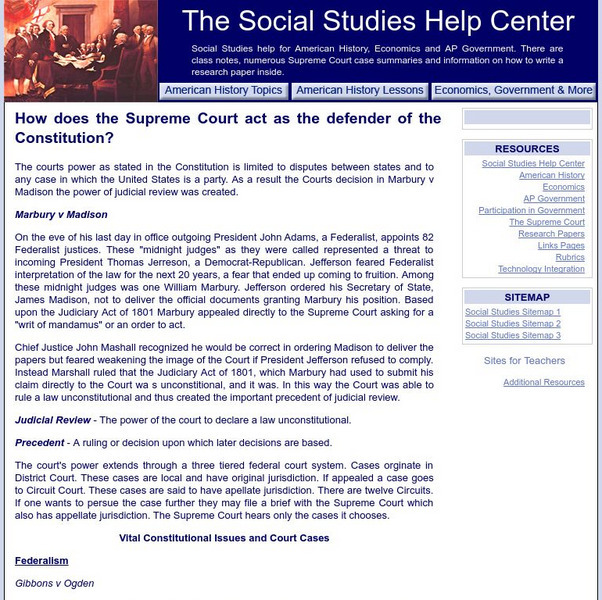
Social Studies Help Center: The Supreme Court as Defender of the Constitution
This site gives you examples of court cases demonstrating how the Supreme Court upholds the constituion. It also includes links to further information.
Read Works
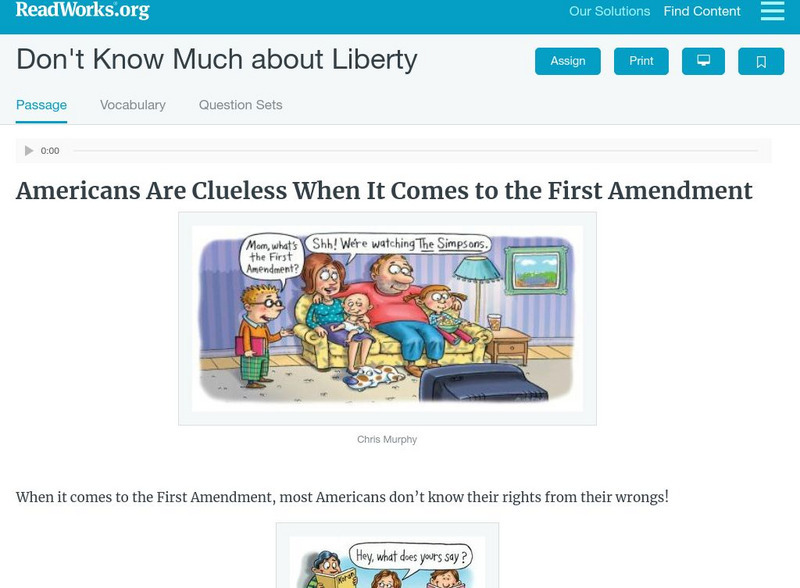
Read Works: Don't Know Much About Liberty
[Free Registration/Login Required] Students read about the freedoms guaranteed by the First Amendment to the Constitution. A question sheet is available to help students build skills in classifying and categorizing.
Annenberg Foundation
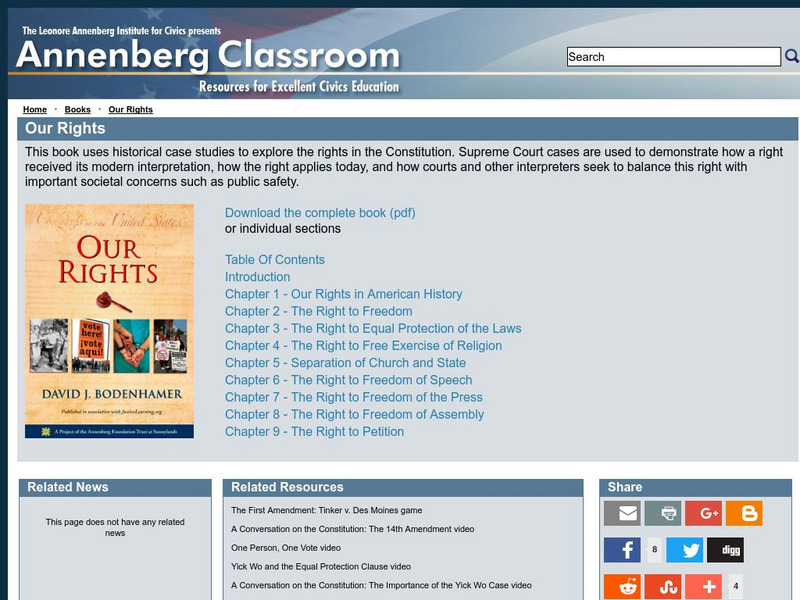
Annenberg Classroom: Our Rights
This book uses historical case studies to explore the rights in the Constitution. Supreme Court cases are used to demonstrate how a right received its modern interpretation, how the right applies today, and how courts and other...
Illinois Institute of Technology
Oyez: Gitlow v. New York
Brief resource presents the facts of the case, questions presented, and the conclusion of the Gitlow v. New York United States Supreme Court case.
Digital History
Digital History: Religion and the u.s. Constitution
A very brief explanation of the three-pronged test the Supreme Court uses to determine the constitutionality of a governmental poiicy to ensure it doesn't advocate the establishing of religion.