Hi, what do you want to do?






Teach Engineering
What a Drag!
Stop and drop what is in your hand! Pupils investigate how form effects drag in the 12th part of a 22-part unit on aviation. Groups create equally weighted objects and determine which one falls the fastest by collecting data.

Exploratorium
Eddy Currents
Make electromagnetic eddy currents evident with this demonstration. You will need to gather a few materials from the local hardware store and a strong neodymium magnet, but the visual value is well worthwhile.
Texas Instruments
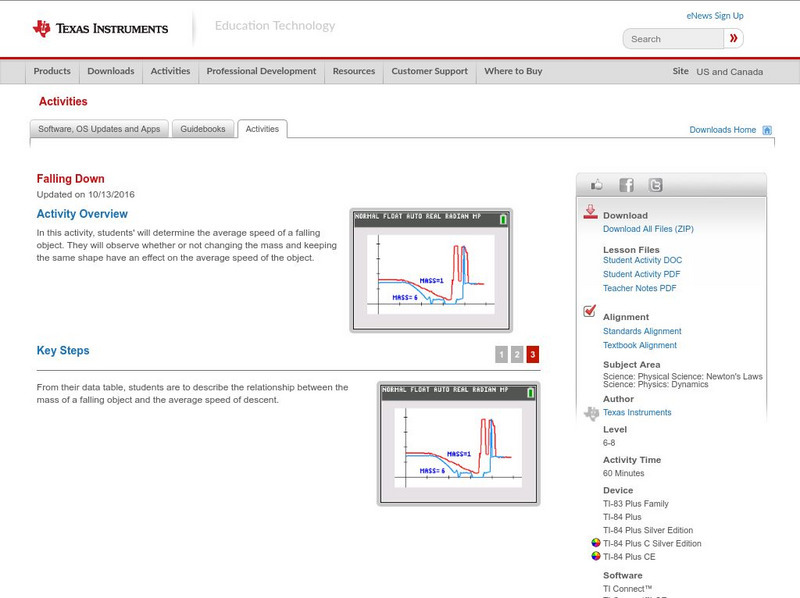
Texas Instruments: Falling Down
In this activity, students will determine the average speed of a falling object. They will observe whether or not changing the mass and keeping the same shape have an effect on the average speed of the object.
Texas Instruments
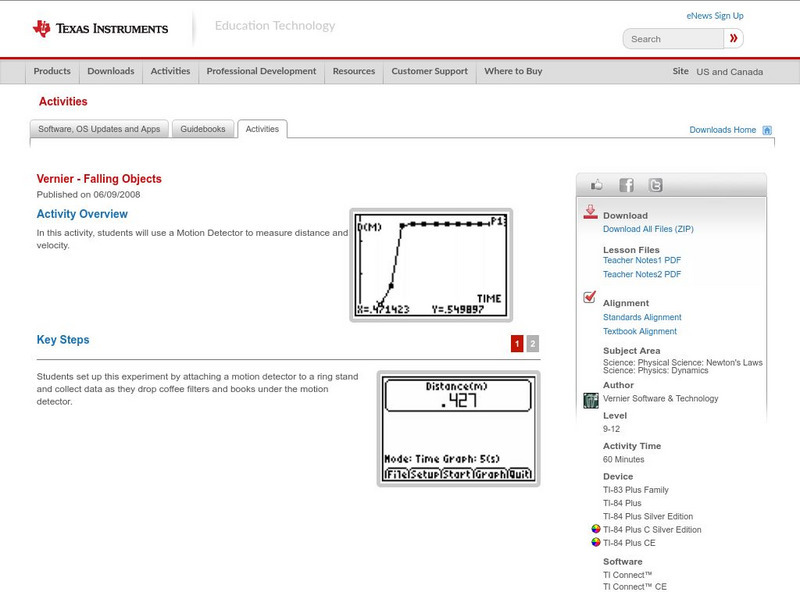
Texas Instruments: Falling Objects
In this activity, Students can use a Motion Detector to measure distance and velocity.
TeachEngineering
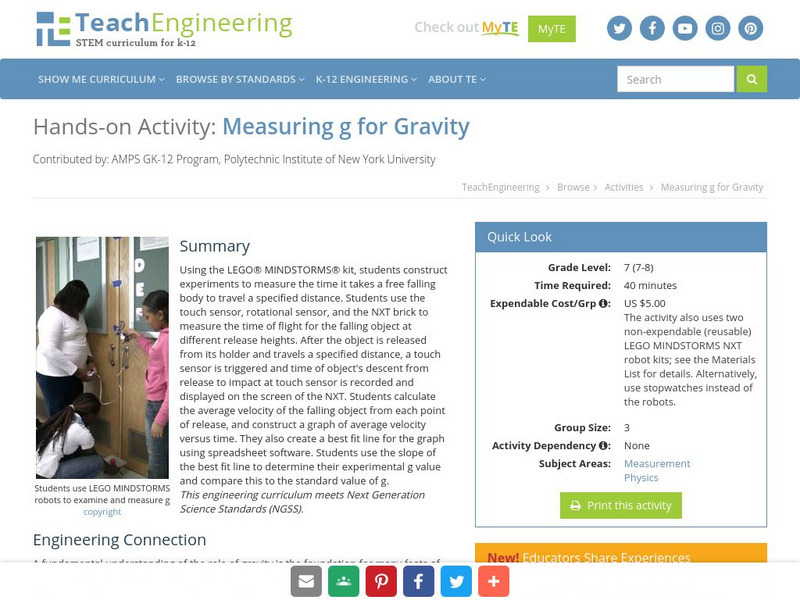
Teach Engineering: Measuring G
Using the LEGO MINDSTORMS NXT kit, students construct experiments to measure the time it takes a free falling body to travel a specified distance. Students use the touch sensor, rotational sensor, and the NXT brick to measure the time of...
Texas Instruments
Texas Instruments: Air Resistance
Use the TI-89 to investigate the effect of air resistance on a free-falling object. Examples in the activity use calculator screenprints and keystroke instructions to demonstrate the use of the calculator to solve these problems....

Physics World
Physics World: Contextual Physics in Ocean Park
After downloading the "Motion Video Analysis" software, users can collect data about moving object's position from digital movie clips. This collection of data will allow them to plot motion graphs and draw conclusions about physics in...