Hi, what do you want to do?






Curated OER
Jupiter's "Monstrous" Magnetosphere
Students explore Jupiter's magnetosphere. In this Jupiter lesson plan, students examine a diagram of the magnetic field that surrounds Jupiter.

Curated OER
Air can do work.
Pupils replicate the teacher demonstrations by changing the variables and predicting the outcomes.

Curated OER
Air Expansion and Contraction
Young scholars observe that air exerts pressure, that heated air expands and that cooled air contracts. After the demonstration, students engage in a question and answer session about what they saw.

Curated OER
Drops on a Penny
Eighth graders experiment to determine the number of drops of water a heads up penny hold. They create a stem and leaf graph of the class results and use the data for further experimentation on a tails up penny.

Curated OER
Rocket Pinwheel
Learners observe a balloon-powered pinwheel to study the principles of rocketry. They study Newton's Third Law of Motion.

Curated OER
Heritage: What Would YOU Take?
Fifth graders classify goods based on their value and decide what they would take with them if they were resettling to a new land. They write an essay defending their choices.

Curated OER
Branches of Government Graphic
Young scholars explore the three branches of government. They create a graphic diagram to show each branch of government. Students include the qualifications for service and duties of each branch of government in their graphic diagram.

Curated OER
Friction- What a Drag
Students explore friction. In this friction lesson, students investigate that weight and surface type affect friction.
University of Colorado
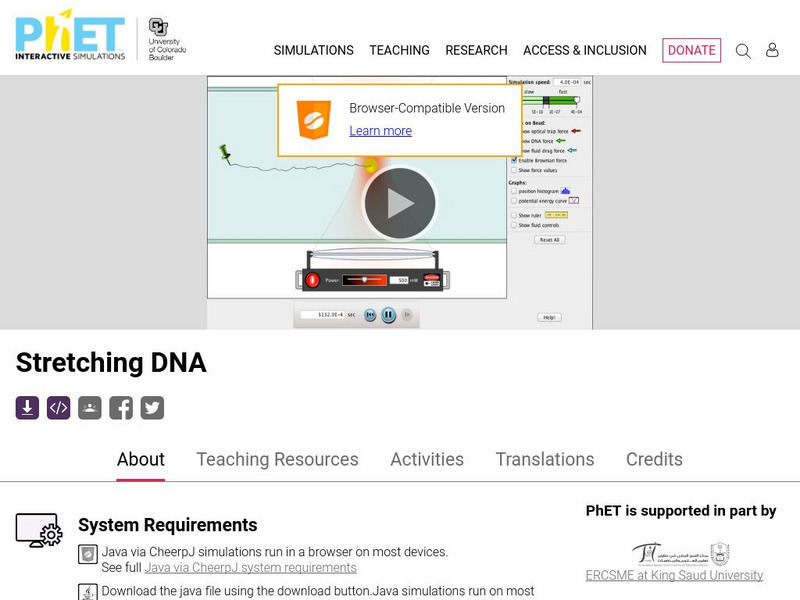
University of Colorado: Ph Et Interactive Simulations: Stretching Dna
Explore stretching just a single strand of DNA using optical tweezers or fluid flow. Experiment with the forces involved and measure the relationship between the stretched DNA length and the force required to keep it stretched.
University of Colorado
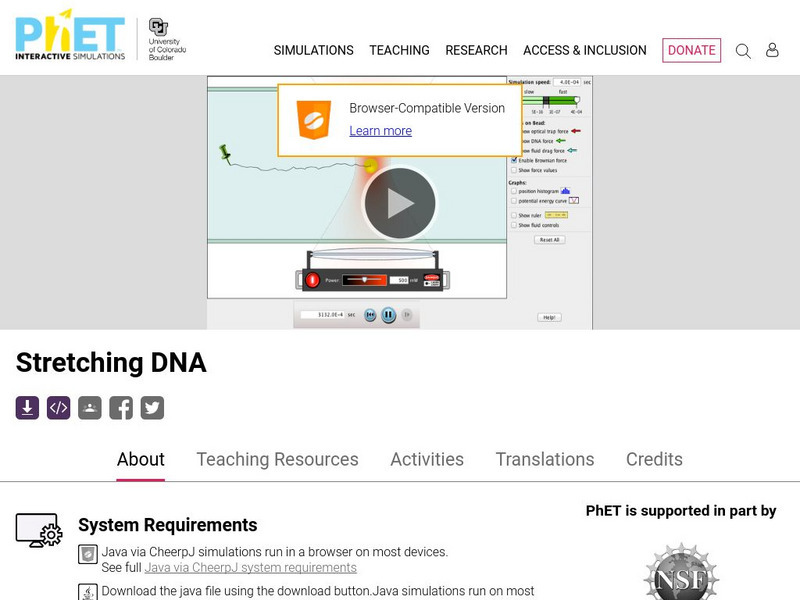
University of Colorado: Ph Et Interactive Simulations: Stretching Dna
Explore stretching just a single strand of DNA using optical tweezers or fluid flow. Experiment with the forces involved and measure the relationship between the stretched DNA length and the force required to keep it stretched. Is DNA...
Texas Instruments
Texas Instruments: The Linear Force Relation for a Rubber Band
In this activity, students' will use a force sensor and a motion detector to study the relationship between the force applied to a rubber band and the distance to which it stretches. They will then model force versus strech data with a...

Physics Aviary
Physics Aviary: Practice Problems: Spring Stretch on Other Planet
Students must find the value of the amount of stretch that will occur to a spring on another planet.
Physics Aviary
Physics Aviary: Practice Problems: Spring Constant From Force Data
Students must find the value of the spring constant and the original length of a spring based on data that was collected from stretching a spring different amounts using a force probe.
TeachEngineering
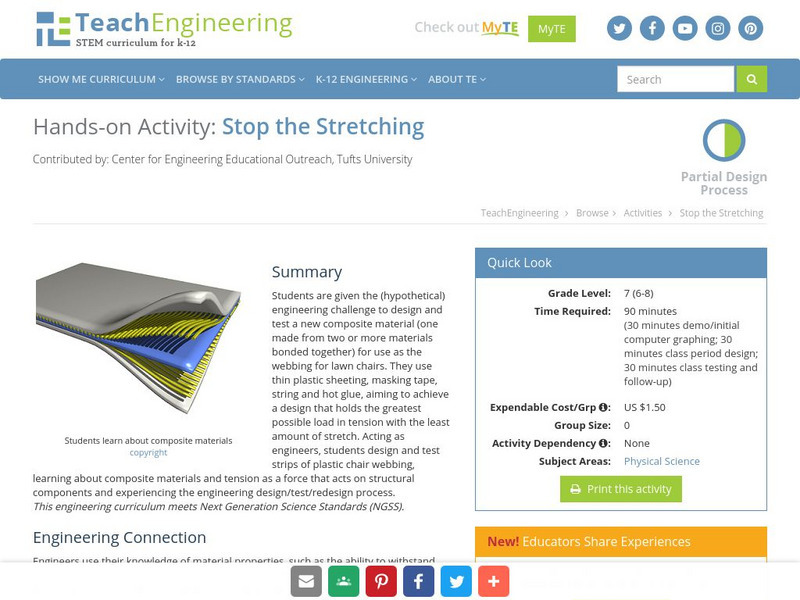
Teach Engineering: Stop the Stretching
Students will learn about composite materials, tension as a force and how they act on structural components through the design and testing of a strip of plastic chair webbing.
Physics Aviary
Physics Aviary: Work to P Ee Lab
This lab is designed to have students discover the relationship between the work that is done and the stretch of a spring. Students will get the area under a Force/Stretch graph to find the work given to a spring for a given situation....
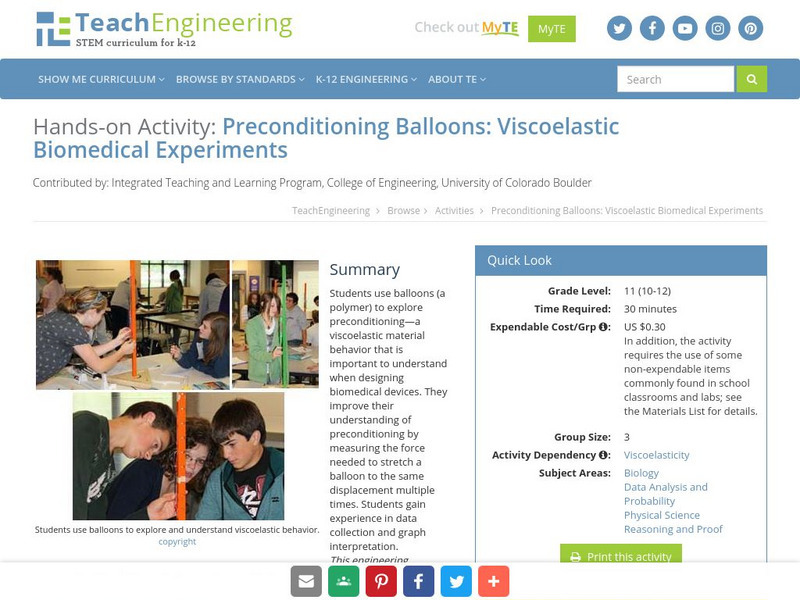
TeachEngineering
Teach Engineering: Preconditioning Balloons
Students use balloons (a polymer) to explore preconditioning a viscoelastic material behavior that is important to understand when designing biomedical devices. They improve their understanding of preconditioning by measuring the force...

University of Colorado
University of Colorado: Ph Et Interactive Simulations: Hooke's Law
An interactive simulation that teaches about force and potential energy by changing variables to stretch and compress springs. This simulation can either be downloaded or played online and includes handouts, lesson plans, and additional...
University of Colorado
University of Colorado: Ph Et Interactive Simulations: Hooke's Law
Stretch and compress springs to explore the relationships between force, spring constant, displacement, and potential energy. Investigate what happens when two springs are connected in series and parallel.

ClassFlow
Class Flow: Magnets and Springs
[Free Registration/Login Required] This unit gives children experience of forces including attraction and repulsion between magnets, compression and stretching of springs, and stretching of elastic bands. They learn that these forces...
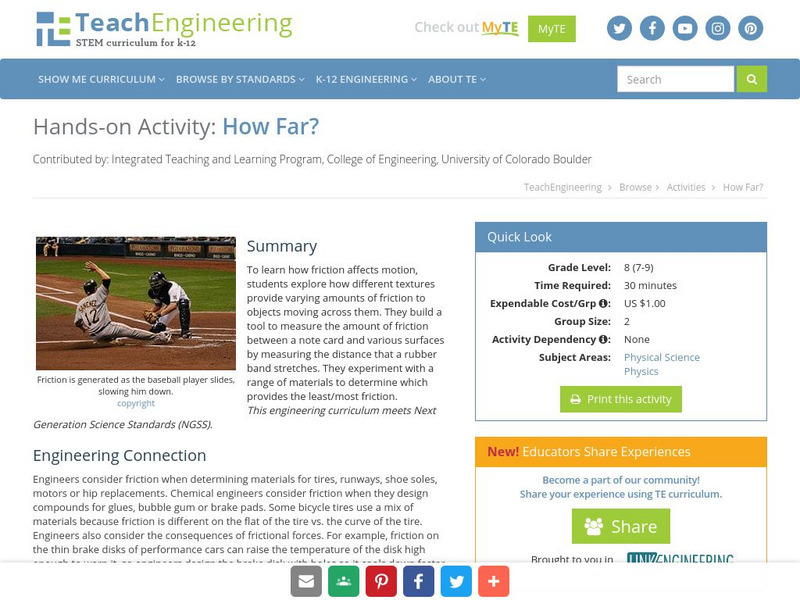
TeachEngineering
Teach Engineering: How Far?
To learn how friction affects motion, students explore how different textures provide varying amounts of friction to objects moving across them. They build a tool to measure the amount of friction between a note card and various surfaces...
Science Buddies
Science Buddies: Applying Hooke's Law: Make Your Own Spring Scale
Hooke's law says that the opposing force of a spring is directly proportional to the amount by which the spring is stretched. How accurately Hooke's law describe the behavior of real springs? Can springs be used to make accurate scales...
Texas Instruments
Texas Instruments: Hooke's Law
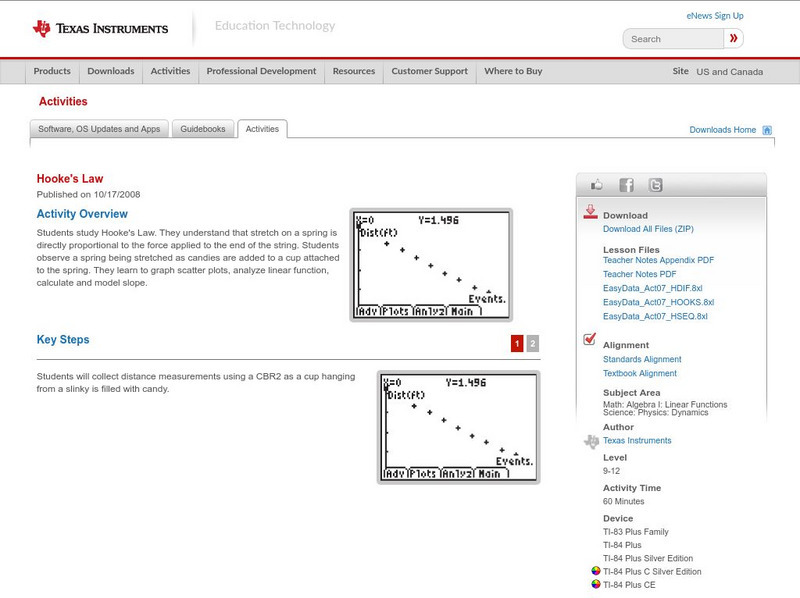
In this activity, students study Hooke's Law. They understand that stretch on a spring is directly proportional to the force applied to the end of the string. Students observe a spring being stretched as candies are added to a cup...
Concord Consortium
Concord Consortium What Is Happening When a Spark Occurs?
Activity 1 of this module investigates: How does potential energy change when things are pushed or pulled? Exploring how force is related to potential energy, this activity investigates how potential energy is changed when a spring is...
New York University
Nyu: Math Mol: Motion of Molecules
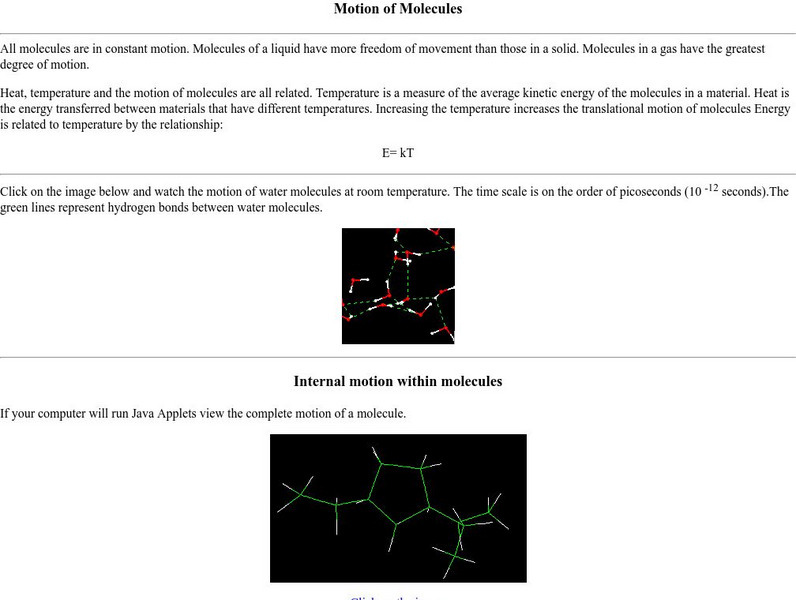
Examine the link between molecular motion and energy. Observe the movement of a molecule at room temperature. Learn about the different types of molecular motion.