Hi, what do you want to do?






Curated OER
Science Kids: Science Images: Forces of Lift
This diagram shows the forces of lift that affect the wing of an aircraft. Lift, thrust, weight and drag all affect the flight of the aircraft as well as the angle of attack.
Other
E Gfi: Lesson: Get a Lift
In this instructional activity, students are introduced to the four forces of flight-drag, lift, thrust, and weight-through a variety of fun-filled flight experiments. Students will "fly" for short periods and then evaluate factors that...
Science Education Resource Center at Carleton College
Serc: Vectors: Lifting a Bowling Ball
Students experience and analyze two different methods of lifting a bowling ball. By using and understanding vectors, they create a useful free body diagram to explain why one person can lift the bowling ball easier than two people

NASA
Nasa: What Is Lift?
A description of how lift is a mechanical force that requires a fluid moving through a solid object and a change in velocity.
NASA
Glenn Research Center: Newton's Laws of Motion
NASA presents a concise explanation of Newton's three laws of motion. Click on the highlighted vocabulary to find more detailed and illustrated descriptions. Included is a link to a movie that shows how the laws of motion described the...
TeachEngineering
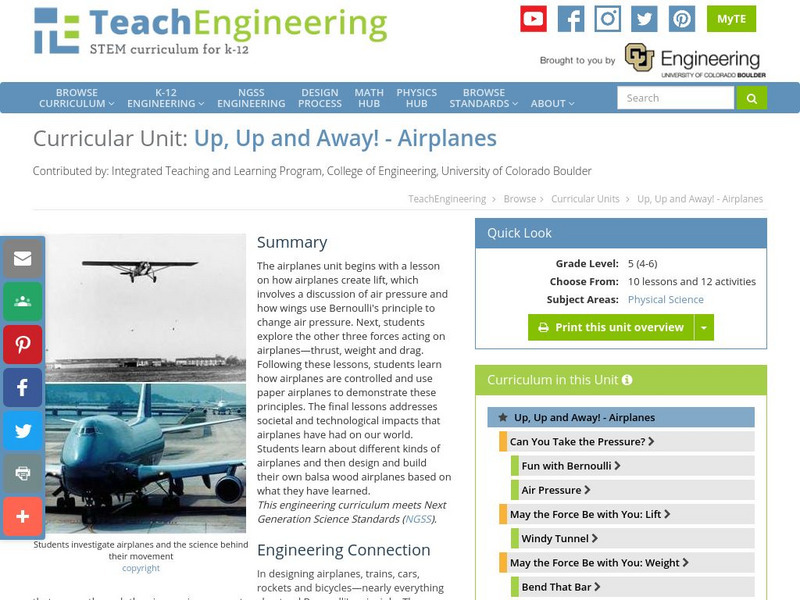
Teach Engineering: Up, Up and Away! Airplanes
The airplanes unit begins with a lesson on how airplanes create lift, which involves a discussion of air pressure and how wings use Bernoulli's Principle to change air pressure. Following the lessons on lift, students explore the other...
NASA
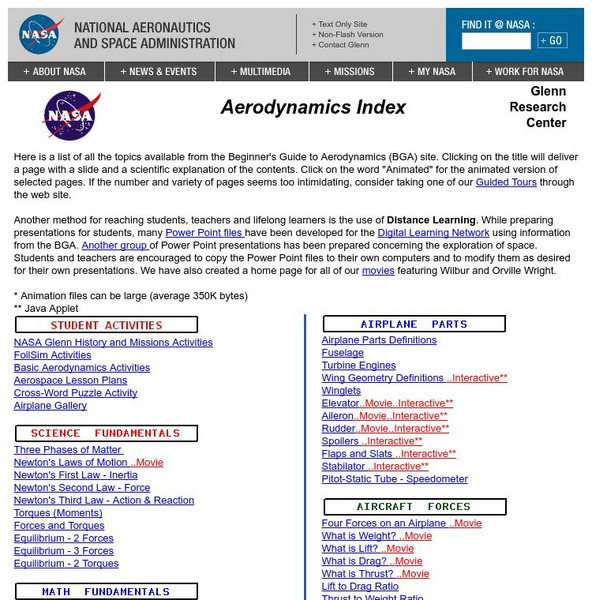
Nasa: Aerodynamics Index
Are you studying or teaching Aerodynamics? This page acts as an index to all the terminology related to this topic. Clicking on any title will open a page with a colored slide and a scientific explanation of the contents. Animated,...
TeachEngineering
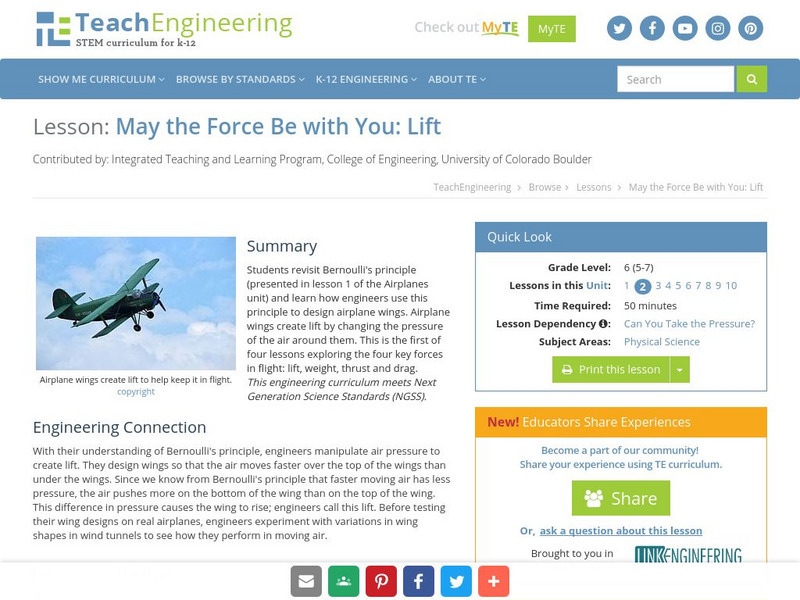
Teach Engineering: May the Force Be With You: Lift
Students revisit Bernoulli's Principle (Lesson 1 of the Airplanes unit) and learn how engineers use this principle to design airplane wings. Airplane wings create lift by changing the pressure of the air around it. This is the first of...
TryEngineering
Try Engineering: Chair Lift Challenge
Lesson investigates how engineers develop safe transportation systems to operate in a variety of climates and environments. Teams of students work together to construct a "chair lift" made from everyday materials as a test of this...

TeachEngineering
Teach Engineering: The Claw
Students learn about gear ratios and power by operating toy mechanical cranes of differing gear ratios. They attempt to pick up objects with various masses to witness how much power must be applied to the system to oppose the force of...
Other
Aviation Internet Group: Aviation Theory
Collection of articles ranging from basic to advanced on aerodynamics theory.
Smithsonian Institution
Smithsonian Learning Lab: How Things Fly: Activities for Teaching Flight
Through this series of three lessons, students will gain an understanding of the basics of flight. They will learn about the four forces of flight and practice their observation skills through a number of fun experiments. In addition,...
Science Buddies
Science Buddies: Efficient Propeller Design
There's a lot to understand about the simple propeller to see how it affects lift and thrust in an airplane or helicopter. This Science Buddies project gives you lots of ideas on how to change the design of the propeller to achieve...
TeachEngineering
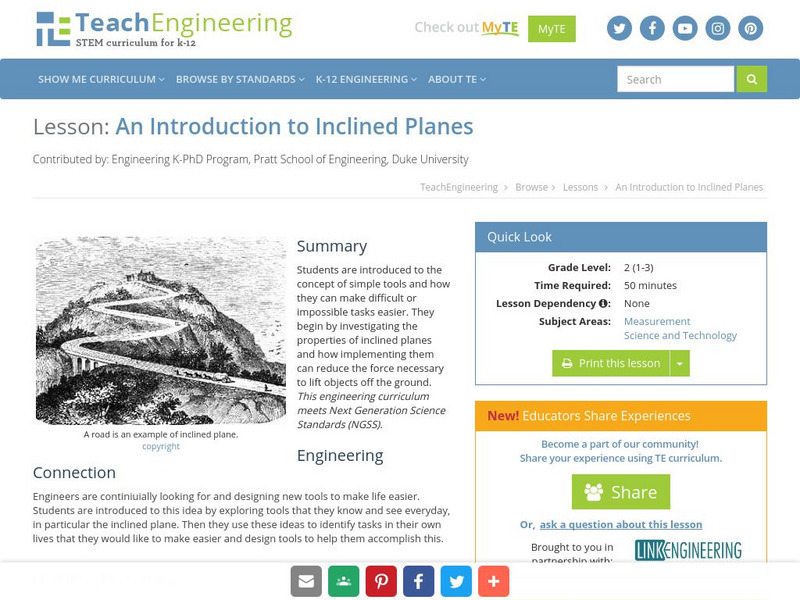
Teach Engineering: An Introduction to Inclined Planes
Learners are introduced to the concept of simple tools and how they can make difficult or impossible tasks easier. They begin by investigating the properties of inclined planes and how implementing them can reduce the force necessary to...
University of Minnesota
The Physics of Flight: Bernoulli's Principle
Discusses air flow around the wing of a plane and its effect upon the lift and drag forces. Focuses on the application of Bernoulli's principle to wing design and the subsequent airfoil shapes.
TeachEngineering
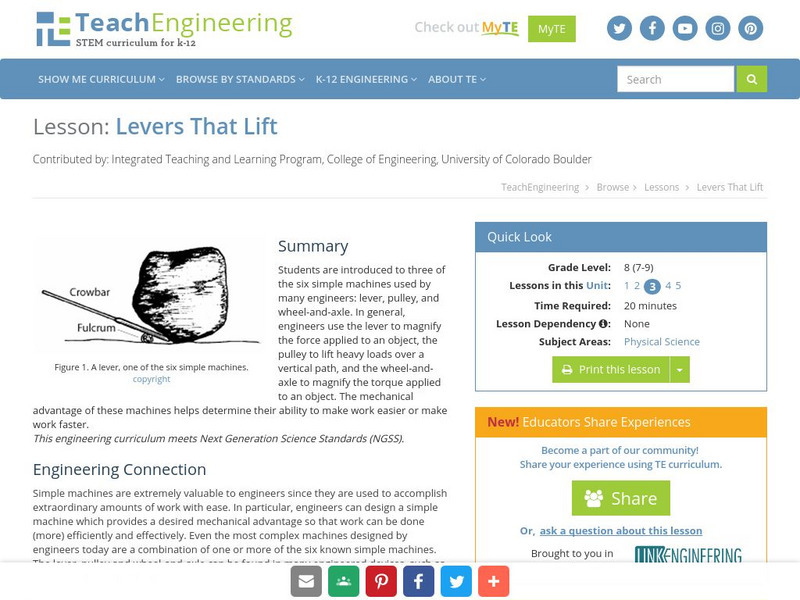
Teach Engineering: Levers That Lift
This lesson introduces young scholars to three of the six simple machines used by many engineers: the lever, the pulley, and the wheel-and-axle. In general, engineers use the lever to magnify the force applied to an object, the pulley to...
PBS
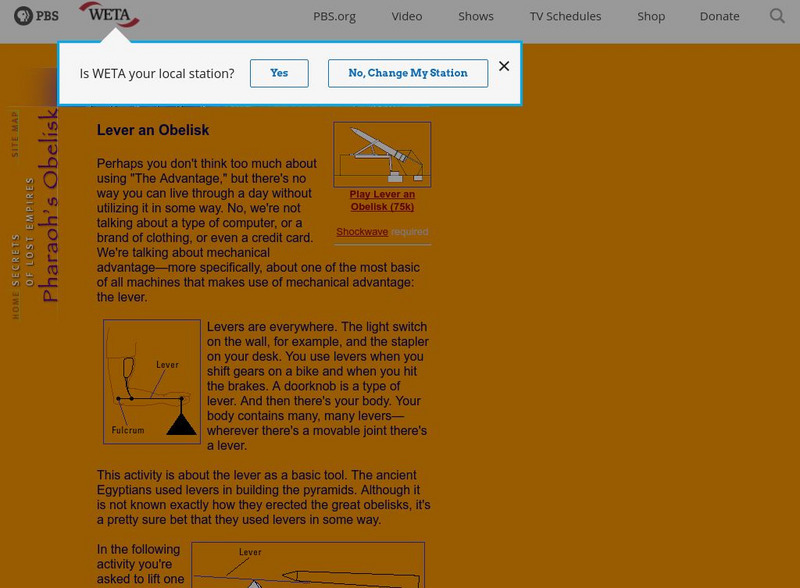
Pbs Teachers: Secrets of Lost Empires Ii: Lever an Obelisk
Utilize an understanding of how a lever works to lift an obelisk, using as few of the weights and support stones as possible in this online interactive activity.
NASA
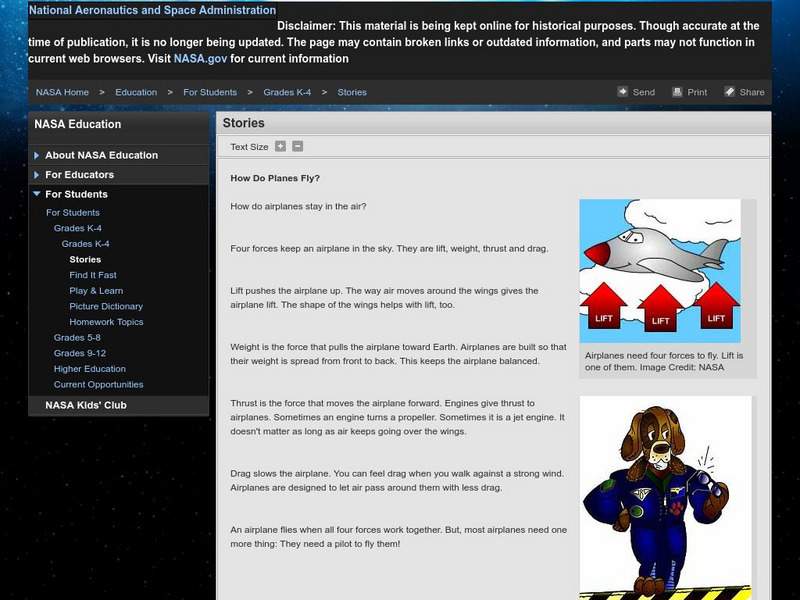
Nasa: How Things Fly
Easy to read guide from NASA on the basics of flight. Great graphics and some simulations are included.

NASA
Nasa: Beginner's Guide to Aerodynamics
Includes exhaustive information and a wealth of activities pertaining to aerodynamics and the physics of flight.
Physics Aviary
Physics Aviary: Pulley Lab
This lab is designed to have students find the relationship between the number of pulleys used and the force required to lift a mass. Students will see that it is not actually the number of pulleys that matter, but the number of strings...
PBS
Pbs Nova: Pilot the Wright Brothers' Flyer
In this interactive, find out how the Wright brothers' design of the first flyer provided lift and speed, and allowed the pilot to make adjustments in response to changes in wind speed and direction.

PBS
Pbs Teachers:dragonfly Tv Cup
Apply knowledge of motion, forces and lift while sailing a boat around a race course.

Exploratorium
Exploratorium: Science Snacks: Balancing Ball: Suspend a Ball in a Stream of Air
In this lesson plan students learn about air flow using a suspended ball in an air stream.
TeachEngineering
Teach Engineering: Heave Ho!
Students will discover the scientific basis for the use of inclined planes. They will explore, using a spring scale, a bag of rocks and an inclined plane, how dragging objects up a slope is easier than lifting them straight up into the...