Hi, what do you want to do?






Smithsonian Institution
Smithsonian Learning Lab: How Things Fly: Activities for Teaching Flight
Through this series of three lessons, students will gain an understanding of the basics of flight. They will learn about the four forces of flight and practice their observation skills through a number of fun experiments. In addition,...
PBS
Pbs Learning Media: Centripetal Force: Pulling Cs and Gs
In this interactive activity from NOVA, discover how centripetal force can affect you when riding in a car or flying at high speeds in a fighter jet.
TeachEngineering
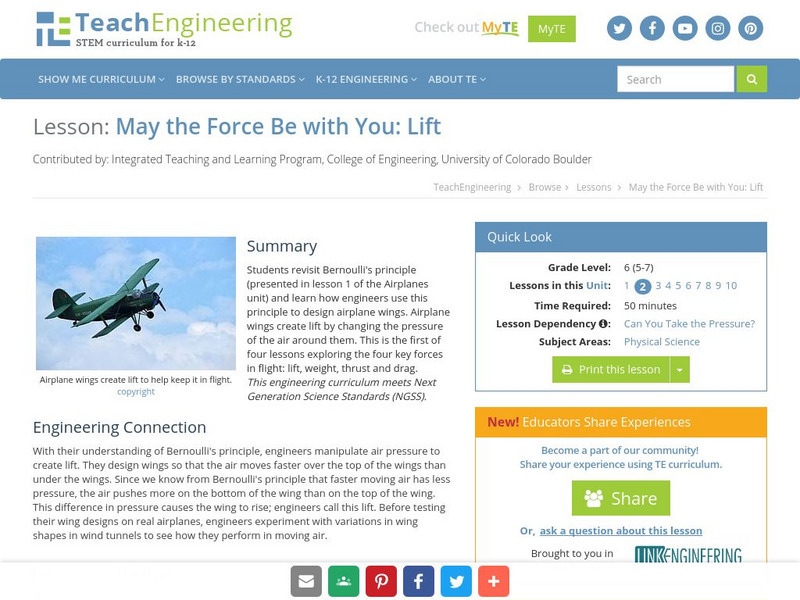
Teach Engineering: May the Force Be With You: Lift
Students revisit Bernoulli's Principle (Lesson 1 of the Airplanes unit) and learn how engineers use this principle to design airplane wings. Airplane wings create lift by changing the pressure of the air around it. This is the first of...
TeachEngineering
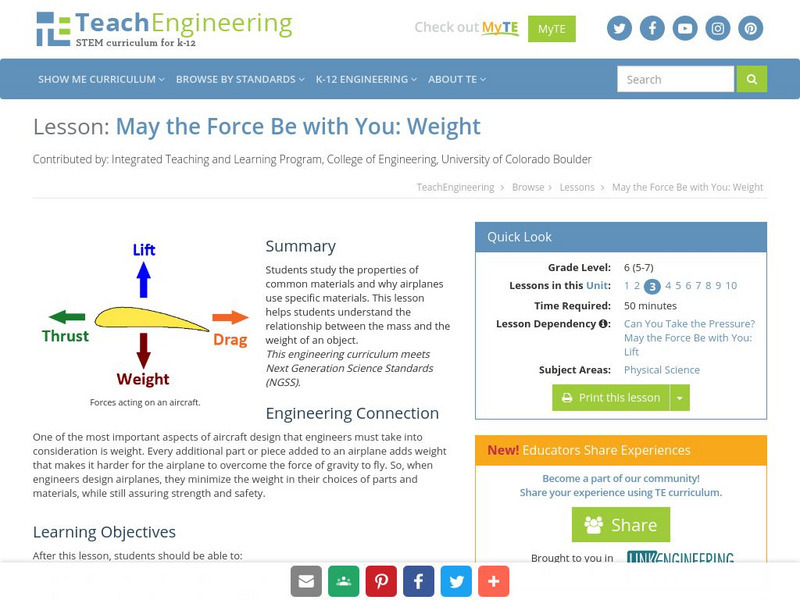
Teach Engineering: May the Force Be With You: Weight
The purpose of this lesson is to help students understand the relationship between the mass and the weight of an object. Students will study the properties of common materials and why airplanes use specific materials.
NASA
Glenn Research Center: Newton's Laws of Motion
NASA presents a concise explanation of Newton's three laws of motion. Click on the highlighted vocabulary to find more detailed and illustrated descriptions. Included is a link to a movie that shows how the laws of motion described the...
TeachEngineering
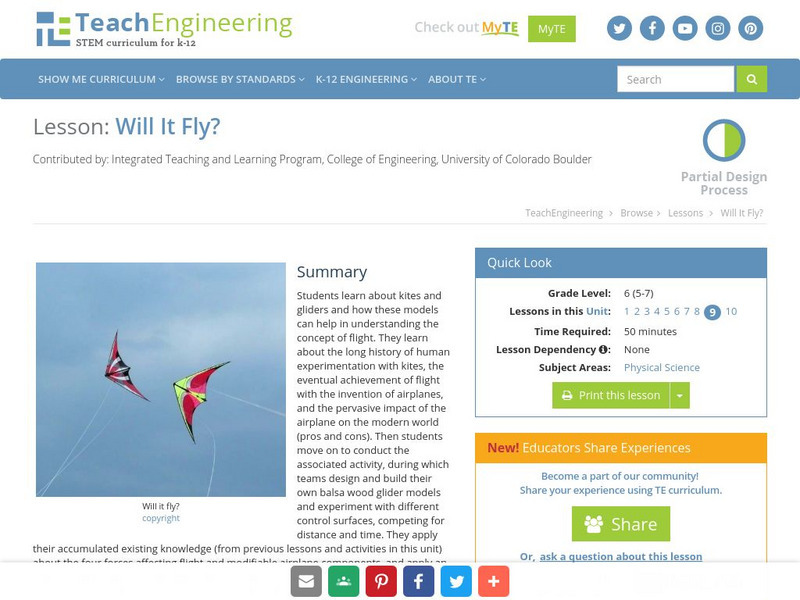
Teach Engineering: Will It Fly?
In this lesson, students will learn about kites and gliders and how these models can help in understanding the concept of flight. Students will design and build their own balsa wood models and experiment with different control surfaces....
TeachEngineering
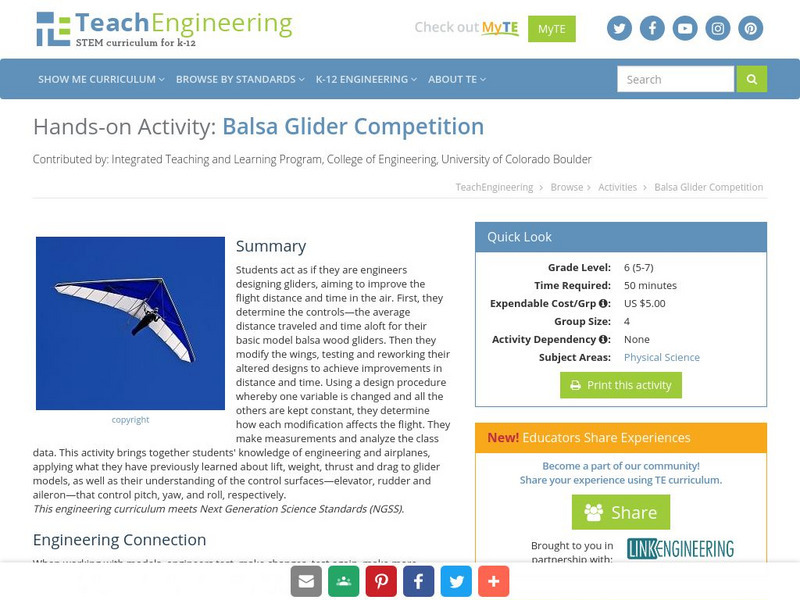
Teach Engineering: Balsa Glider Competition
The purpose of this activity is to bring together the students' knowledge of engineering and airplanes and the creation of a glider model to determine how each modification affects the flight. The students will use a design procedure...
TryEngineering
Try Engineering: Designing Drones
This lesson focuses on helicopters and drones, how they fly, how they are used in different ways that help people and the environment. Teams of students explore helicopter flight; and design, build, and test their own simple rotor out of...
TeachEngineering
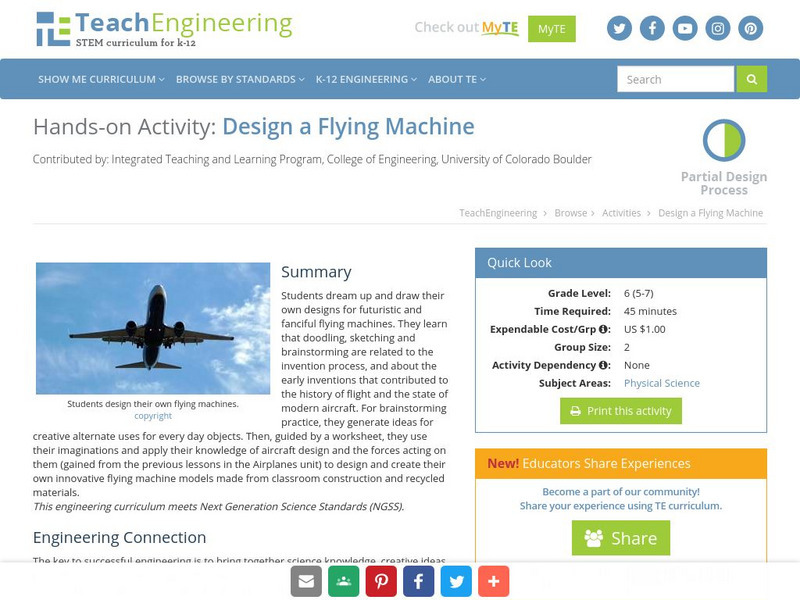
Teach Engineering: Design a Flying Machine
The purpose of this activity is for the students to draw a design for their own flying machine. They will apply their knowledge of aircraft design and the forces acting on them. The students will start with a brainstorming activity where...
TeachEngineering
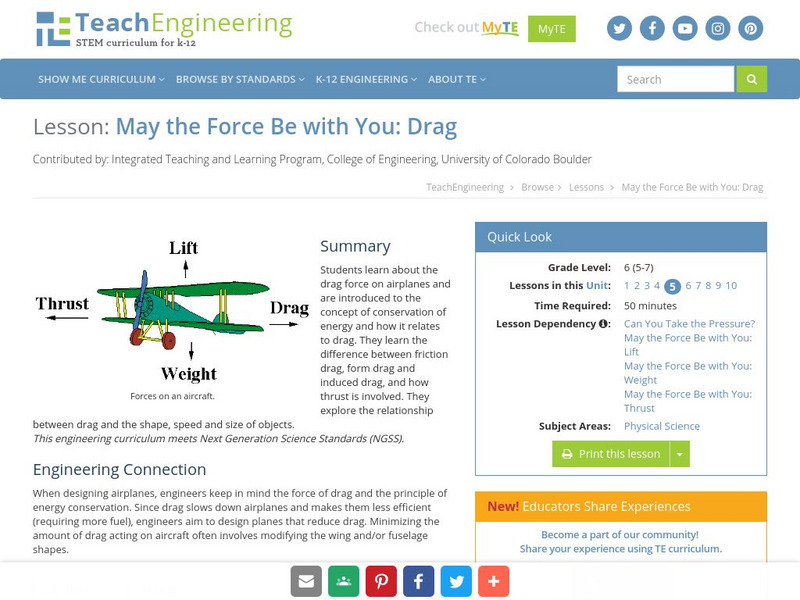
Teach Engineering: May the Force Be With You: Drag
This lesson plan explores the drag force on airplanes. The students will be introduced to the concept of conservation of energy and how it relates to drag. Students will explore the relationship between drag and the shape, speed and size...
Other
Personal: The Laws of Motion
This personal site explains the physics of angular momentum and their application to flight. Part of a much larger site on the procedures, principles, and perceptions of flight.
A&E Television
History.com: Miracle of the Andes: How Survivors of the Flight Disaster Struggled to Stay Alive
When an Uruguayan rugby team crashed in the Andes on Friday, October 13, 1972, cannibalism helped some survive two months in harsh conditions. The Uruguayan Air Force Fairchild F-227 had crashed into a glacial valley high in the Andes....
Science Buddies
Science Buddies: Two Stage Balloon Rocket
Learners will build a multi-stage balloon rocket that they can launch across the classroom while learning about real space flight and Newton's laws of motion.

Alabama Learning Exchange
Alex: Building a Paper Airplane Using Bernoulli's Principle
This is a culmination activity used after students have studied Bernoulli's Principle as part of a unit on forces and fluids. Students will use the Internet, textbooks, library resources and their cooperative learning group to design...
Other
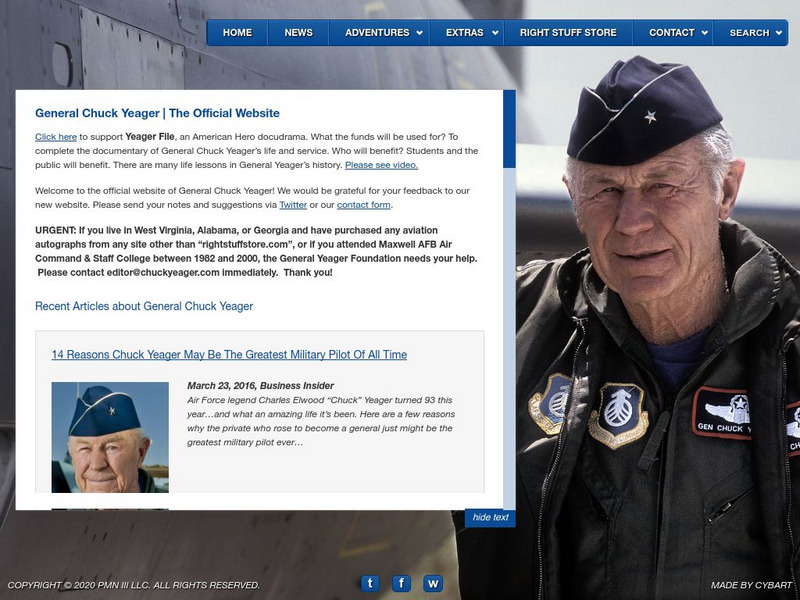
Chuck Yeager
"The fastest man alive," "The guy with the right stuff," "Mr. Supersonic," read about this true American on his own personal website. Filled with fact filled information.
TeachEngineering
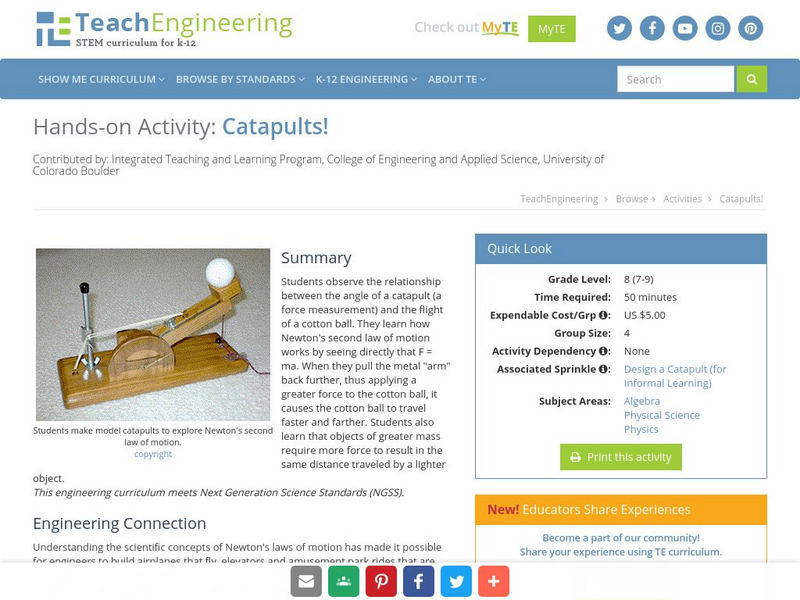
Teach Engineering: Catapults!
Students observe the relationship between the angle of a catapult (a force measurement) and the flight of a cotton ball. They learn how Newton's second law of motion works by seeing directly that F = ma. When they pull the metal "arm"...
Science Buddies
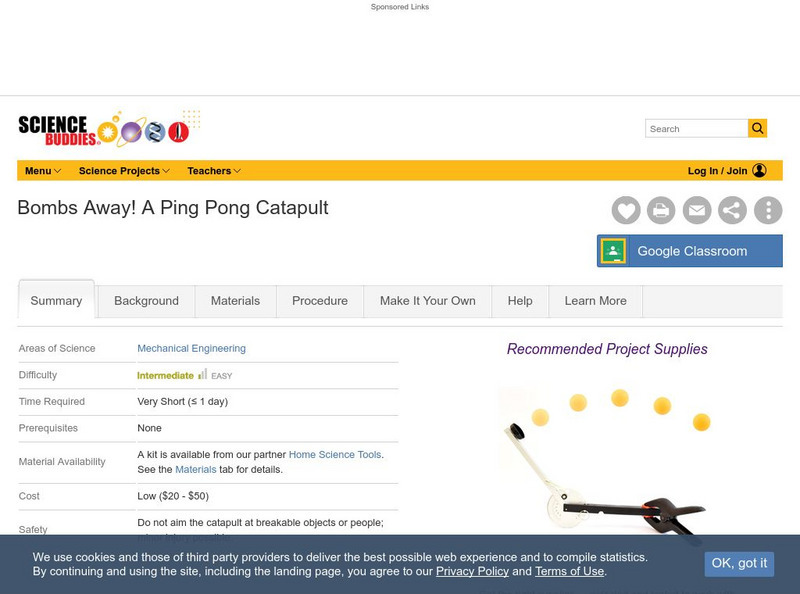
Science Buddies: Bomb's Away! A Ping Pong Catapult
With this project you'll send ping pong balls flying through the air with a rubber-band powered catapult. This catapult makes it easy to reproduce the launch angle, and to measure the amount of force applied to the projectile. Armed with...