Hi, what do you want to do?






Curated OER
Motion Through the Ages
Eighth graders conduct internet research to produce a timeline of man's growth in understanding of concepts of motion and planetary motion through history.

Curated OER
How We See Things
Students investigate how mirrors reflect light. In this reflection lesson, students draw the path of the light reflected from a mirror. Students construct a list of objects that are light sources.

DiscoverE
Touch Down
Protect the marshmallows! Groups create contraptions that will keep marshmallows in a cup, even after dropping them from a certain height. This is a fun way to model the shock-absorbing capabilities of spacecraft.

Curated OER
Brain POP - Properties of Matter
In this properties of matter worksheet, students complete 18 fill in the blank questions about mass, density, volume or weight.

Curated OER
Brain POP- Properties of Matter
In this properties of matter worksheet, middle schoolers answer 18 questions about mass, density, volume or weight. All of the questions are multiple choice.

Curated OER
Using Electricity
Students name appliances that use electricity. They construct a simple electrical circuit. They predict whether a circuit work. They name components of an electrical circuit.

Curated OER
Changing circuits
Young scholars identify that there are conventional symbols to represent the components in circuits. Students use these symbols to draw diagrams of circuits. They are reminded that electric circuits can be drawn in diagrams using...

Curated OER
Changing Circuits
Students observe an on-line activity to review the basics of electrical circuitry, then research answers to related questions on-line.In this lesson on changing components in a series circuit, students discover how different components...

Curated OER
How We See Things
Students explain that when a beam of light is reflected from its surface, it changes direction. In this virtual science experiment lesson plan, students complete an activity that requires them to investigate how flat mirrors reflect...

Curated OER
Knowledge Quiz
In this oceans quiz worksheet, students complete a 10 question multiple choice quiz covering a variety of concepts related to the ocean.

Curated OER
Influential Scientists Vocabulary Multiple Choice Worksheet
In this influential scientists worksheet, students read the definitions of 19 science professions. From 4 choices, students choose the correct name of the job that fits the definition. Example: studies birds (ornithologist).

Curated OER
Air Pressure
Fourth graders observe a demonstration experiment showing air pressure. They explain air pressure by completing the worksheet.

Curated OER
Micro-organisms
Students examine how micro-organisms are living organisms that are often too small to be seen. They explain that micro-organisms may be beneficial or harmful.

Curated OER
How We See Things
Students explain that mirrors reflect light. They examine how when a beam of light is reflected from a surface, its direction changes.

Curated OER
Changing Circuits
Students participate in an online lesson to explain how to make bulbs brighter or dimmer in a series circuit by changing the number or type of components.

Curated OER
Science: Space Quiz
In this science: space quiz worksheet, students answer twenty questions, not interactively, about outer space, then scroll down to find the answers.

Curated OER
Magnetism: Knowledge Quiz
In this magnetism quiz instructional activity, students complete a set of 10 multiple choice questions covering a variety of concepts about magnetism.

Curated OER
Physics Post-Lab
Students explore physics. In this science lesson, students discuss physics in their everyday lives. Students complete a physics worksheet.

Curated OER
Watershed Management
Students investigate the concept of a watershed. They conduct research into the concept using a variety of resources. Students take a field trip to a local watershed to make observations. The outcome is a report concerning the outside...
Nine Planets
The Nine Planets: The Moon
Explore the mythology, structure, observational history, gravitational force, and orbit of Earth's Moon.

PBS
Pbs Learning Media: Why Doesn't the Moon Fall Down?
In this animated video segment adapted from NASA, astronomer Doris Daou explains how the forces of speed and gravity keep the moon in a constant orbit around Earth. [1:36]

University of Colorado
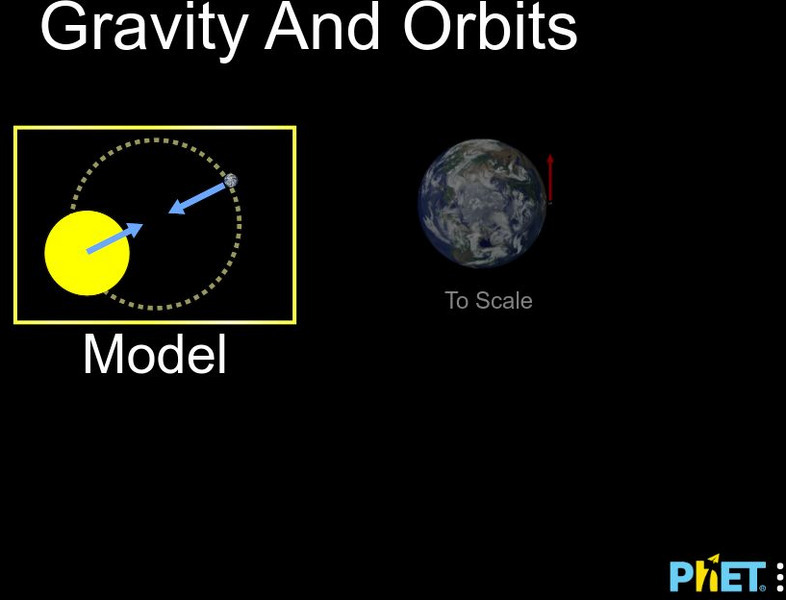
University of Colorado: Ph Et Interactive Simulations: Gravity and Orbits
An interactive simulation that teaches about gravitational force, circular motion, and astronomy by manipulating the sun, earth, moon, and a space station to observe the effects of gravity and orbital paths. This simulation can either be...
University of Colorado
University of Colorado: Ph Et Interactive Simulations: Gravity and Orbits
Move the sun, earth, moon, and space station to see how it affects their gravitational forces and orbital paths. Visualize the sizes and distances between different heavenly bodies, and turn off gravity to see what would happen without it.
E-learning for Kids
E Learning for Kids: Antarctica Penguins: How Does the Moon Influence the Tide?
This lesson explains how the moon affects tides on Earth and about the different types of tides.