Hi, what do you want to do?






Discovery Education
Discovery Education: Rules of Forces and Motion
With this hands-on lesson, help learners understand force, gravity, friction, and speed. Students will also learn how each of these concepts affects the another.
eSchool Today
E School Today: All About Forces
Forces are everywhere. Learn what they are, the characteristics of forces, different kinds of forces, and factors that affect them.

Science Struck
Science Struck: A Comprehensive List of All the Physics Formulas
Provides a long list of physics formulas for easy reference.
TeachEngineering
Teach Engineering: What a Drag
Young scholars learn about friction and drag - two different forces that convert energy of motion to heat. Both forces can act on a moving object and decrease its velocity. Students learn examples of friction and drag, and suggest ways...
Texas Education Agency
Texas Gateway: Effects of Force
Explore the effects of forces around us in the world.
Science4Fun
Science4 Fun: What Is Friction
What is friction? Illustrated discussion of friction including the three types, its importance, and why it is avoided.
Other
Easyphysics: Chapter 4 Forces
Learners investigate forces and Newton's laws. Some topics examined are mass, friction, and Newton?s laws of motion. The resource includes example problems with solutions and a chapter quiz.
Famous Scientists
Famous Scientists: Charles Augustin De Coulomb
A short biography about Charles Coulomb, known for developing Coulomb's law, the definition of the electrostatic force of attraction and repulsion.
Science4Fun
Science4 Fun: Force
What is force? Illustrated discussion of how force is calculated and three familiar types.
TeachEngineering
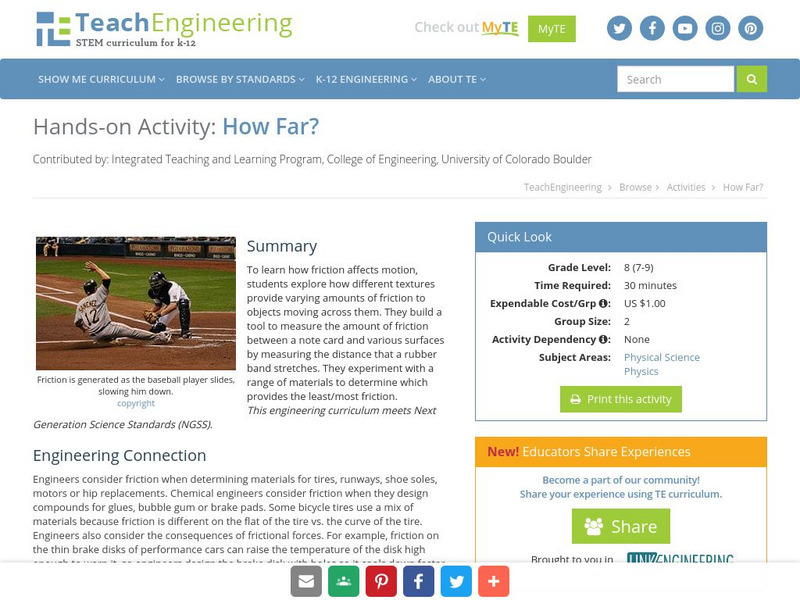
Teach Engineering: How Far?
To learn how friction affects motion, students explore how different textures provide varying amounts of friction to objects moving across them. They build a tool to measure the amount of friction between a note card and various surfaces...

PBS
Pbs Teachers: Tower of Coins Experiment
Demonstrate inertia by pushing a nickel out of the bottom of a stack without disturbing the rest of the stack.
University of Oregon
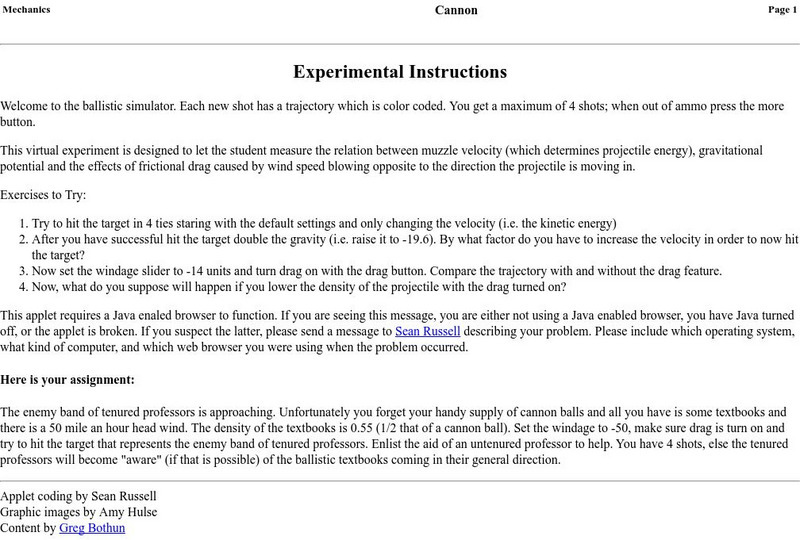
Uo: Cannon Simulator: Experimental Instructions
This virtual experiment is designed to let the student measure the relation between muzzle velocity (which determines projectile energy), gravitational potential and the effects of frictional drag caused by wind speed blowing opposite to...
Science and Mathematics Initiative for Learning Enhancement (SMILE)
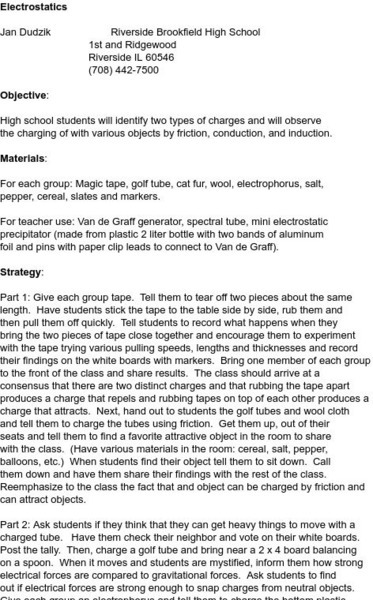
Smile: Electrostatics
A teacher lesson plan which includes activities pertaining to common methods of charging objects - induction, conduction, and friction.