Hi, what do you want to do?





Science Buddies
Science Buddies: Explore the Forces of Friction
We all recognize what friction is, but do you really understand what causes it? This project focuses on friction, its causes and forces and specifically how it affects how fast you can slip down slides.
OpenStax
Open Stax: Physics: Centripetal Force
In the following interactive students will begin to calculate coefficient of friction on a car tire. They will also calculate ideal speed and angle of a car on a turn.
TeachEngineering
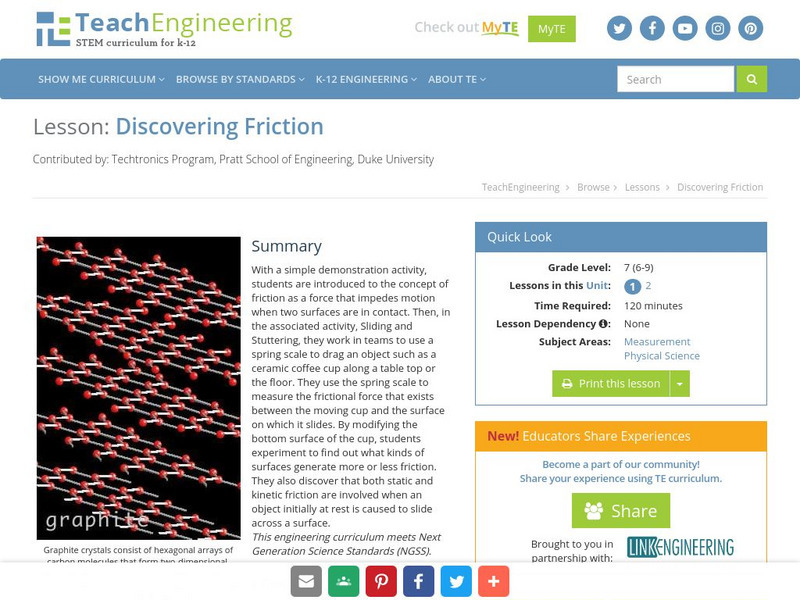
Teach Engineering: Discovering Friction
With a simple demonstration activity, students are introduced to the concept of friction as a force that impedes motion when two surfaces are in contact. Then, in the Associated Activity (Sliding and Stuttering), they work in teams to...
TeachEngineering
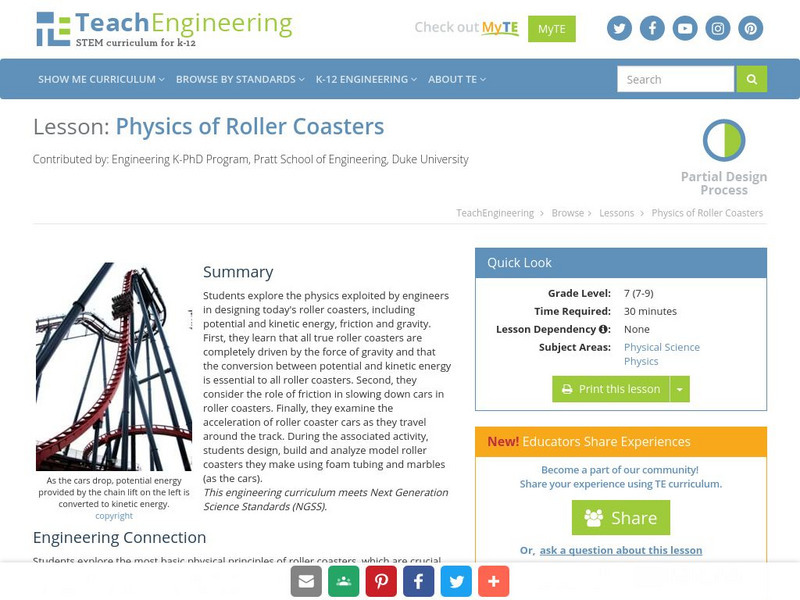
Teach Engineering: Physics of Roller Coasters
Students explore the physics utilized by engineers in designing today's roller coasters, including potential and kinetic energy, friction, and gravity. First, students learn that all true roller coasters are completely driven by the...

Discovery Education
Discovery Education: Friction in Our Lives
Students observe objects in motion down a ramp to discover how the force of friction affects an object's motion. Includes the lesson plan, vocabulary list, and extensions for students.
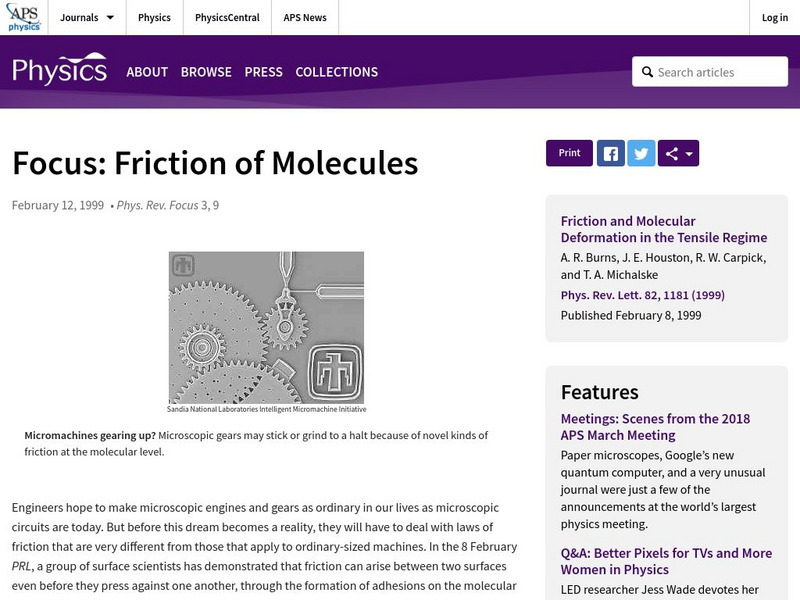
Other
Focus Physical Review: Friction of Molecules
This is an article published by the American Physical Society on friction in microscopic gears that results from the adhesion of molecules. A great exploration of this new obstacle in science.
Oklahoma Mesonet
University of Oklahoma: High and Low Pressure
This University of Oklahoma meteorology tutorial explores both high and low pressure systems--how they form and the different forms they take.

Other
Mechanical Systems
A collection of resources on how humans use machines and tools to meet their needs. Covers simple and complex machines, subsystems that transfer forces, mechanical advantage, speed ratio, the effect of friction, efficiency, the science...
Texas Education Agency
Texas Gateway: 5.2 Further Applications of Newton's Laws: Drag Forces
By the end of this section, you will be able to define drag force and model it mathematically, discuss the applications of drag force, define terminal velocity, and perform calculations to find terminal velocity.
Science Struck
Science Struck: Static Friction vs. Kinetic Friction: The Differences
Teaches what friction force is, the difference between static and kinetic friction, and how friction force is calculated.
Texas Education Agency
Texas Gateway: Further Applications of Newton's: Elasticity: Stress and Strain
By the end of this section, you will be able to state Hooke's law; explain Hook's law using graphical representations between deformation and applied force; discuss the three types of deformations: changes in length, sideways shear, and...
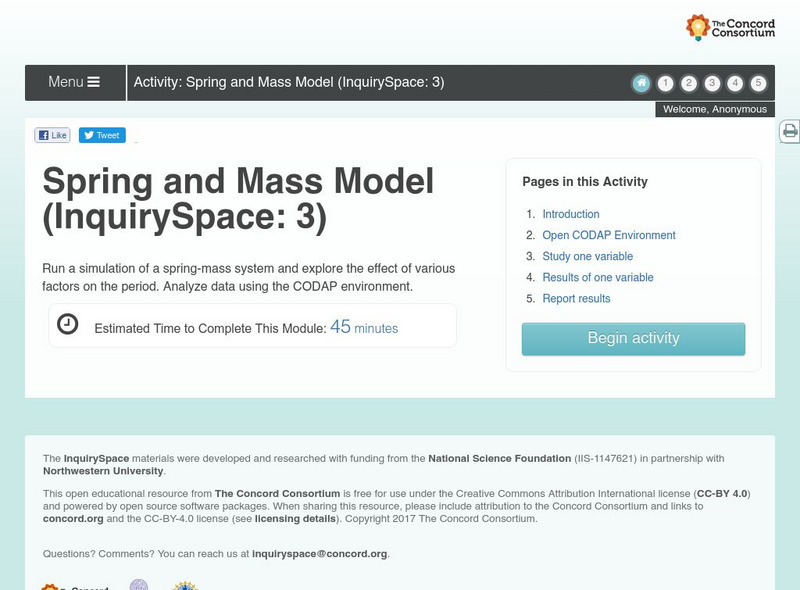
Concord Consortium
Concord Consortium: Spring and Mass Model
An interactive tool where students can explore how a spring behaves, and how changing the elasticity, mass, push/pull force, and friction affect its motion or period. As the spring moves, its motion is shown on a distance-time graph.
Physics Classroom
The Physics Classroom: Energy Conservation on an Incline
This site is a discussion and animation about whether the total mechanical energy of a cart rolling down an incline is conserved, which can be determined if there are any external forces acting upon it.
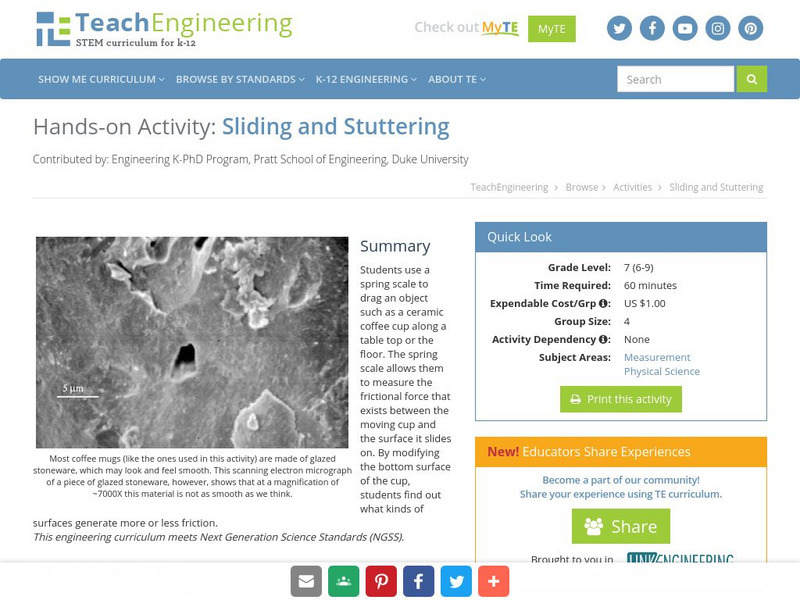
TeachEngineering
Teach Engineering: Sliding and Stuttering
Students use a spring scale to drag an object such as a ceramic coffee cup along a table top or the floor. The spring scale allows them to measure the frictional force that exists between the moving cup and the surface it slides on. By...
Science Struck
Science Struck: Guide to Free Body Diagrams in Physics
A detailed explanation of the different types of forces that can be applied to an object and how to represent them in a free body diagram. Includes examples and some practice problems to try, with solutions provided.
TryEngineering
Try Engineering: Give Me a Brake
Activity investigates the concept of how bicycle brakes use force and friction to stop or slow mechanical motion. Young scholars work in teams to devise a simple braking system while suggesting improvements to current bicycle brake design.
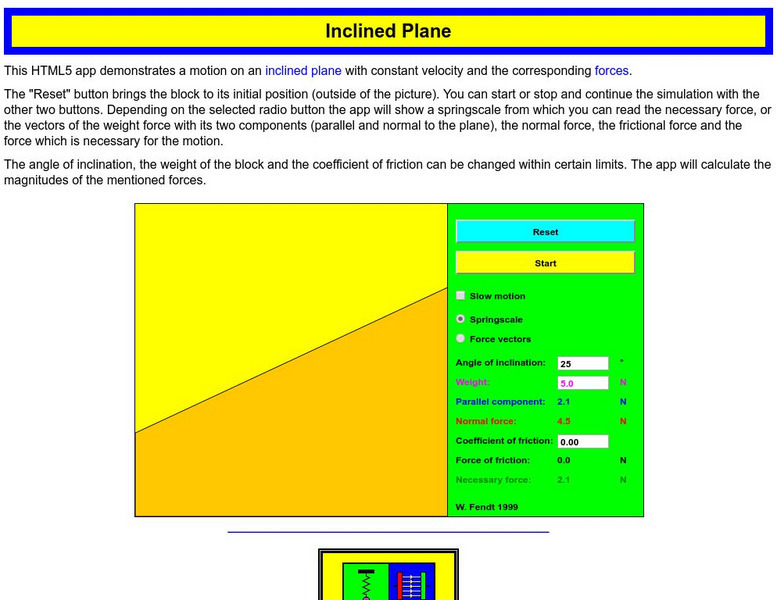
Walter Fendt
Walter Fendt: Inclined Plane
This site is an interactive app of an inclined plane showing the effect of the angle, the weight of the block, and the friction as a block is pulled up an incline.
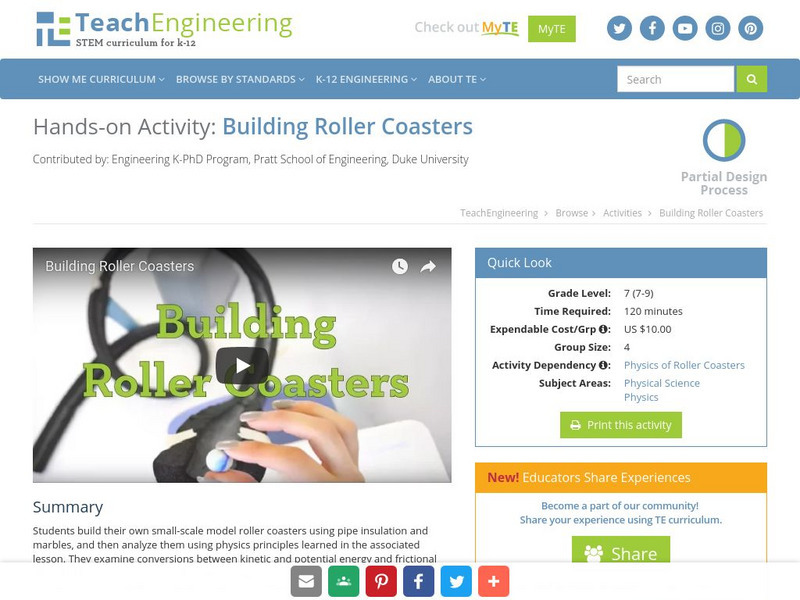
TeachEngineering
Teach Engineering: Building Roller Coasters
In this hands-on activity students learn about the laws of physics by creating a marble roller coaster.

Discovery Education
Discovery Education: Physical Science: Gravity Gets You Down
In this lesson, students make predictions about falling objects of different sizes and masses to learn about gravity and air resistance. Includes audio vocabulary list and extension activities.
CK-12 Foundation
Ck 12: Physics: Newton's Laws Study Guide
This study guide on Newton's Laws covers key terms, the three laws, free body diagrams, friction coefficients and tension. Includes equations and an example problem with solution. It is available for download with free registration.

Incorporated Research Institutions for Seismology
Iris: Earthquake Machine: Basic One Block & Simple Graph Animated
Animation of the single-block "Earthquake Machine" model shows how "Forces, Faults, and Friction" interact. [0:16]