Hi, what do you want to do?






Science Education Resource Center at Carleton College
Serc: Exploring Acceleration Through Vectors
The goal of this activity is to get students to think about what is happening when velocity and acceleration vectors point in different directions. The pictures, sentences, and cars used allow the students to picture each situation in...

Physics Classroom
The Physics Classroom: Circular and Satellite Motion: Principles for Satellites
Students explore how a satellite's motion is governed by the same physics principles and described by the same mathematical equations.

University of Colorado
University of Colorado: Ph Et Interactive Simulations: Hooke's Law
An interactive simulation that teaches about force and potential energy by changing variables to stretch and compress springs. This simulation can either be downloaded or played online and includes handouts, lesson plans, and additional...
Science Struck
Science Struck: Guide to Free Body Diagrams in Physics
A detailed explanation of the different types of forces that can be applied to an object and how to represent them in a free body diagram. Includes examples and some practice problems to try, with solutions provided.
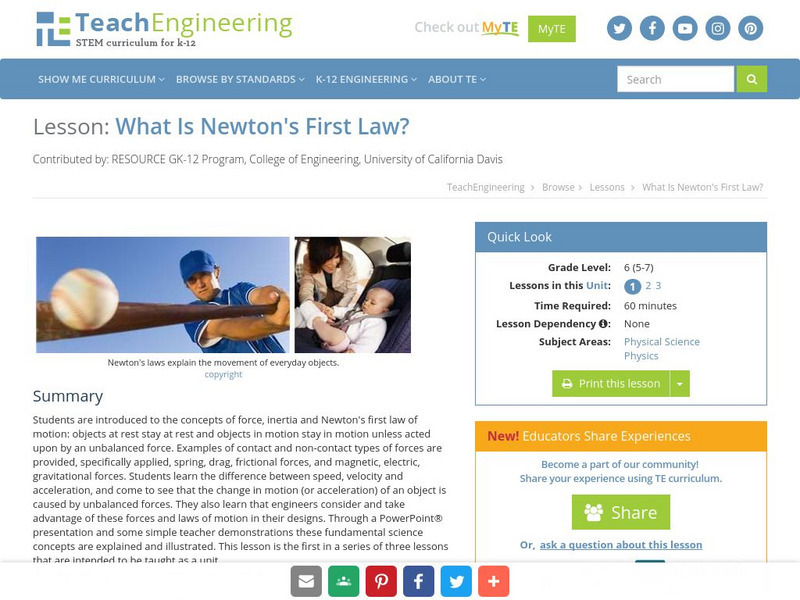
TeachEngineering
Teach Engineering: What Is Newton's First Law?
Learners are introduced to the concepts of force, inertia, and Newton's first law of motion: objects at rest stay at rest and objects in motion stay in motion unless acted upon by an unbalanced force.This lesson is the first in a series...
PBS
Pbs Learning Media: To Survive at High Velocity
This video segment adapted from NOVA looks at speed, velocity, and centripetal force on the racetrack. [6:28]
NASA
Nasa E Clips: Nasa's Launchpad: The Great Boomerang Challenge [Pdf]
Students use the principles of technological and engineering design to research and explain how airfoil shape affects flight characteristics and how it applies to boomerang flight.. They will work in teams to design, build, test, and...
University of Colorado
University of Colorado: Ph Et Interactive Simulations: Projectile Motion
An interactive simulation that teaches about kinematics, air resistance, and parabolic curve by shooting a car out of a cannon while trying to hit a target. Observe how changes in angle, initial speed, mass, air resistance, and drag...
Physics Classroom
The Physics Classroom: Resultants
A tutorial that describes what a resultant is and how a resultant is determined.
Physics Classroom
The Physics Classroom: Horizontally Launched Projectile Problems
In the case of projectiles, students use information about the initial velocity and position of a projectile to predict such things as how much time the projectile is in the air and how far the projectile will go. They do this to make...
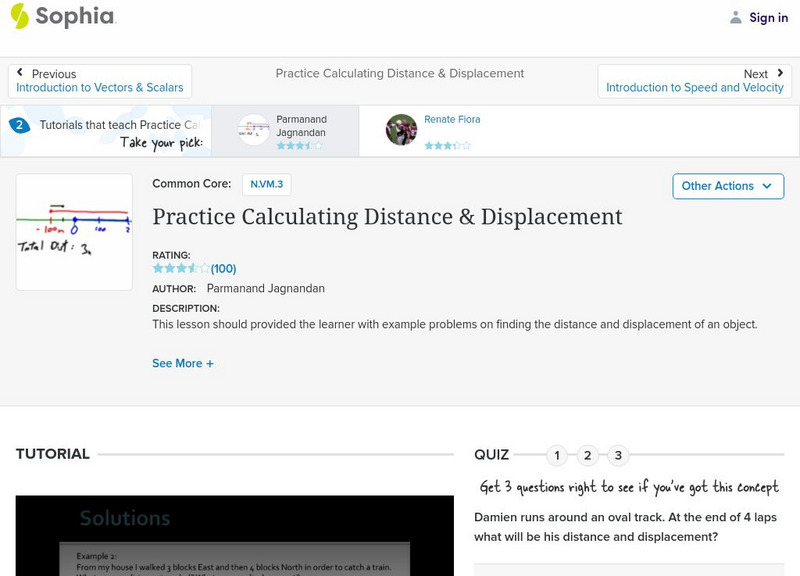
Sophia Learning
Sophia: Practice Calculating Distance & Displacement: Lesson 1
This lesson should provided the learner with example problems on finding the distance and displacement of an object. It is 1 of 2 in the series titled "Practice Calculating Distance & Displacement."
Physics4kids
Physics 4 Kids: Motion/mechanics Overview Quiz
Take this ten question multiple choice quiz on motion and mechanics.

University of Guelph
University of Guelph: Physics Tutorials: What Is Torque?
This site provides an introductory look at torque, the measure of how much a force acting on an object causes that object to rotate. Provides a definition of torque, illustrations, and also a formula to define torque.
Math Graphs
Houghton Mifflin: Math Graphs: Force Field [Pdf]
The practice exercise investigates force fields, closed curves, and work. The resource consists of an enlarged printable version of a force field available in PDF format.

Other
Math Help: Trying to Pull a Boulder Up a Hill
A practical application of the use of the components of vectors with force. Example and general form are both given.
Walter Fendt
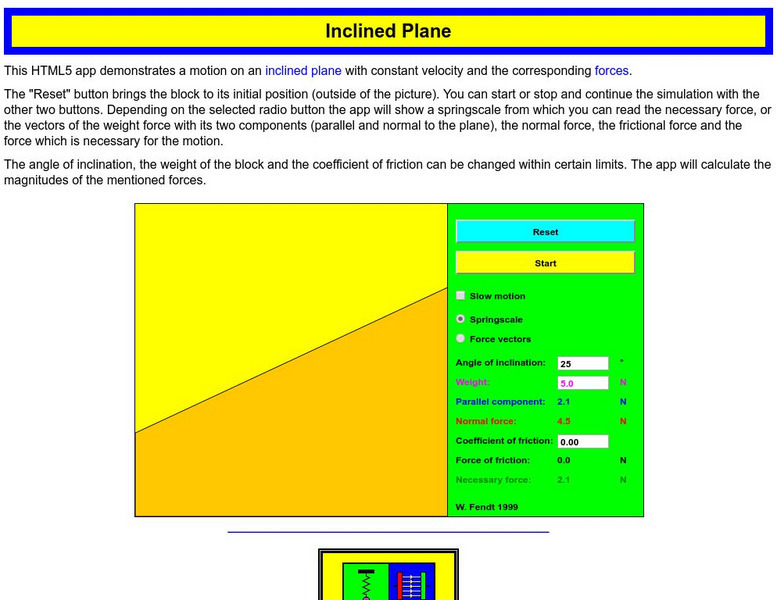
Walter Fendt: Inclined Plane
This site is an interactive app of an inclined plane showing the effect of the angle, the weight of the block, and the friction as a block is pulled up an incline.

Khan Academy
Khan Academy: Applying Gravity to a Particle
Next, let's apply all these ideas to the case where a particle is being acted on by both gravity and air resistance using this 5-question quiz/practice. The gravity force vector points downward, and the air resistance force opposes it.
Physics Classroom
The Physics Classroom: Newton's Laws: Drawing Free Body Diagrams
Students practice reading situations where forces are acting upon objects in all directions and magnitudes, and then draw free-body diagrams to represent the forces. Each problem has a self-checking key linked right on the page.

Khan Academy
Khan Academy: Start: How Do Computers Simulate the Motion of Virtual Particles?
In this lesson we'll explore how we use fairly simple physics to draw particles which move according to the forces we feel in the real world (such as wind & gravity).
MadSci Network
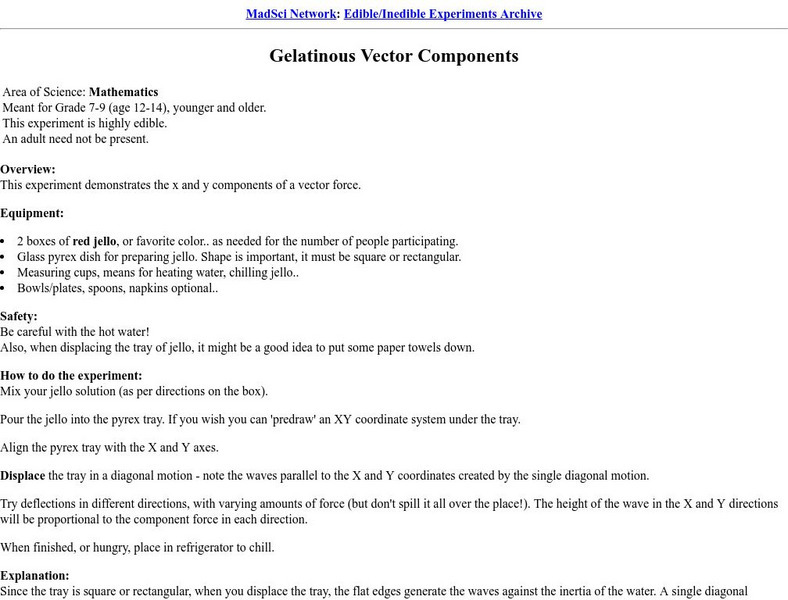
Mad Sci Network: Gelatinous Vector Components
An edible lab activity utilizing Jello to demonstrate the x and y components of vectors.
University of Colorado
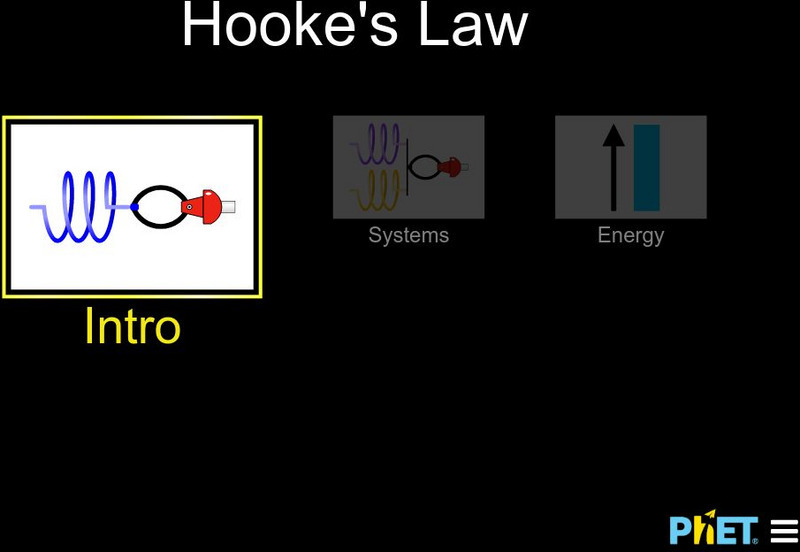
University of Colorado: Ph Et Interactive Simulations: Hooke's Law
Stretch and compress springs to explore the relationships between force, spring constant, displacement, and potential energy. Investigate what happens when two springs are connected in series and parallel.
TeachEngineering
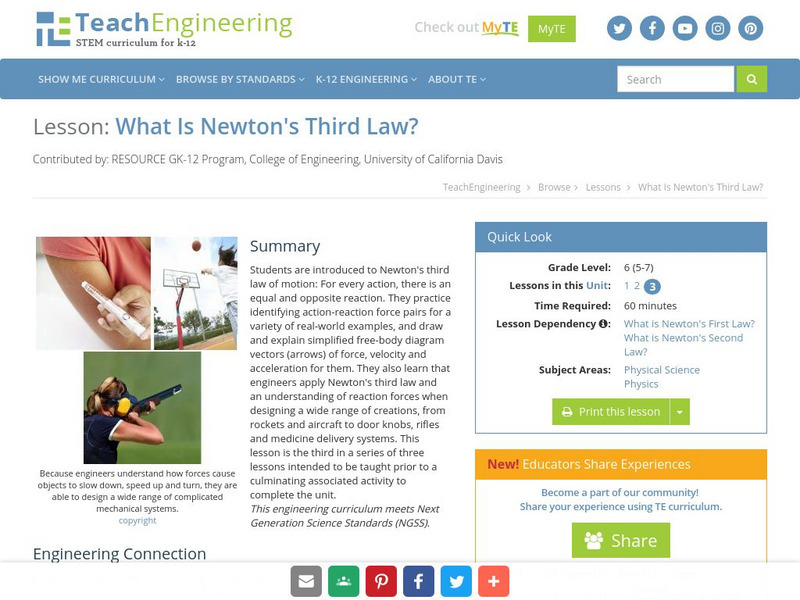
Teach Engineering: What Is Newton's Third Law?
Students are introduced to Newton's third law of motion, and then learn that engineers apply Newton's third law and an understanding of reaction forces when designing a wide range of creations, from rockets and aircraft to door knobs,...
Physics Classroom
The Physics Classroom: Satellite Motion
An animation depicting the path of projectiles launched at various launch speeds from the fictional Newton's Mountain. Accompanying text discusses satellite motion and the requirements of orbital motion. Links to further information is...
Concord Consortium
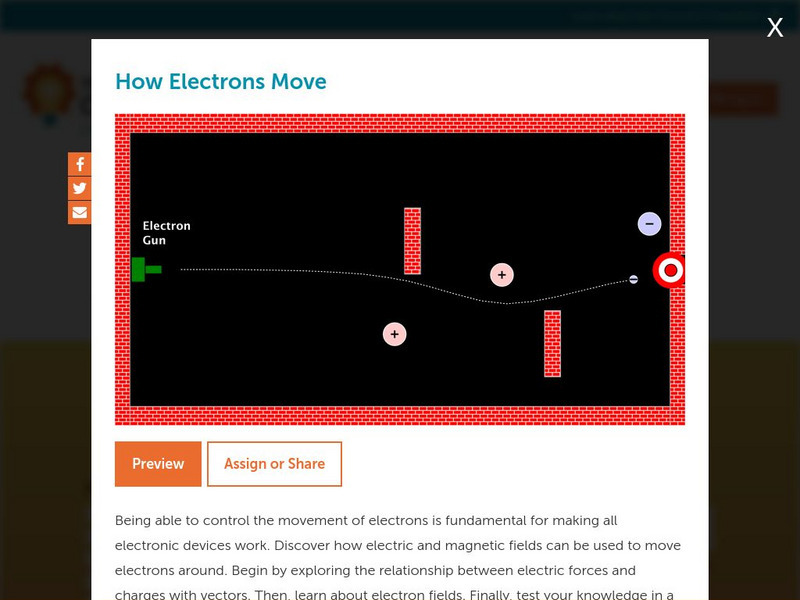
Concord Consortium: How Electrons Move
Being able to control the movement of electrons is fundamental for making all electronic devices work. Discover how electric and magnetic fields can be used to move electrons around. Begin by exploring the relationship between electric...