Hi, what do you want to do?





University of Colorado
University of Colorado: Ph Et Interactive Simulations: Gravity Force Lab
An interactive simulation that teaches about gravitational force, Newton's Third Law, and force pairs by varying properties affect the gravitational force exerted between two objects. This simulation can either be downloaded or played...

University of Colorado
University of Colorado: Ph Et Interactive Simulations: Gravity and Orbits
An interactive simulation that teaches about gravitational force, circular motion, and astronomy by manipulating the sun, earth, moon, and a space station to observe the effects of gravity and orbital paths. This simulation can either be...

Texas Education Agency
Texas Gateway: 4.8 Extended Topic: The Four Basic Forces: An Introduction
By the end of this section, you will be able to understand the four basic forces that underlie the processes in nature: gravitational, electromagnetic, weak nuclear, strong nuclear forces.
Curated OER
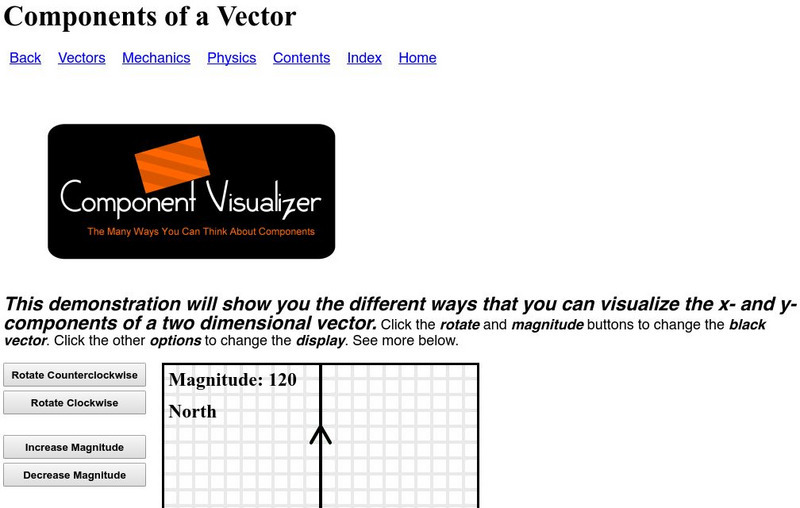
Zona Land: Components of a Vector
An interactive Java applet where users can rotate a vector about its tail and view the components of that vector. Magnitude of the components is updated on screen as the vector is dragged.
Wikimedia
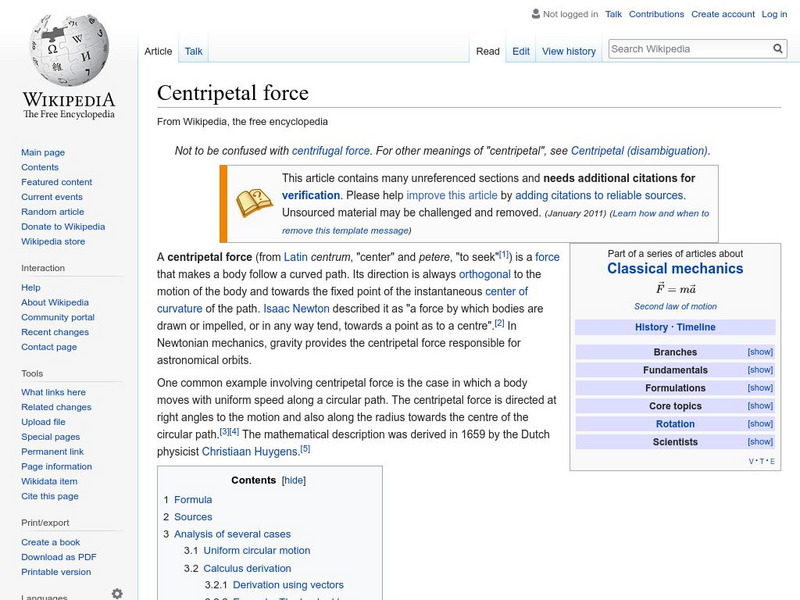
Wikipedia: Centripetal Force
Wikipedia's site on centripetal force provides a section explaining the difference between centripetal force and centrifugal force. Includes formulas and hyperlinked terms.
University of Minnesota
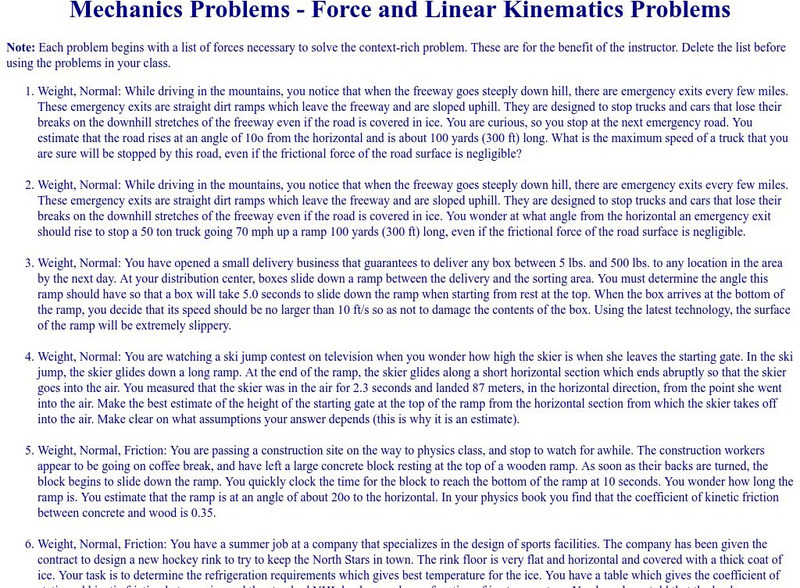
University of Minnesota: Mechanics Problems: Force and Linear Kinematics Problem
This University of Minnesota site provides a series of contextually rich problems pertaining to force, Newton's second law of motion, and linear kinematics.

Georgia Department of Education
Ga Virtual Learning: Ap Physics 1: Work, Energy, and Power
The mathematical model for the relationships between work and energy serves to model physical problems and, more importantly, predict natural and man-made phenomena. Students discover the relationships which serve as a powerful...
Science Education Resource Center at Carleton College
Serc: Hand Towing a Car: Critical Thinking, Problem Solving and Analysis
In this active learning activity, students will find a technique to move a car with one hand. Students are given only a tow strap, so the students must apply angular force to successfully move the car with one hand.
Physics Classroom
The Physics Classroom: Vectors: Forces in Two Dimensions: Addition of Forces
In this tutorial, examine the effect of forces acting at angles to the horizontal, such that the force has an influence in two dimensions- horizontally and vertically.
Physics Classroom
The Physics Classroom: Vectors: Net Force Problems Revisited
Through interactive examples and practice problems, this tutorial helps students understand net force-acceleration problems in which an applied force is directed at an angle to the horizontal.
NASA
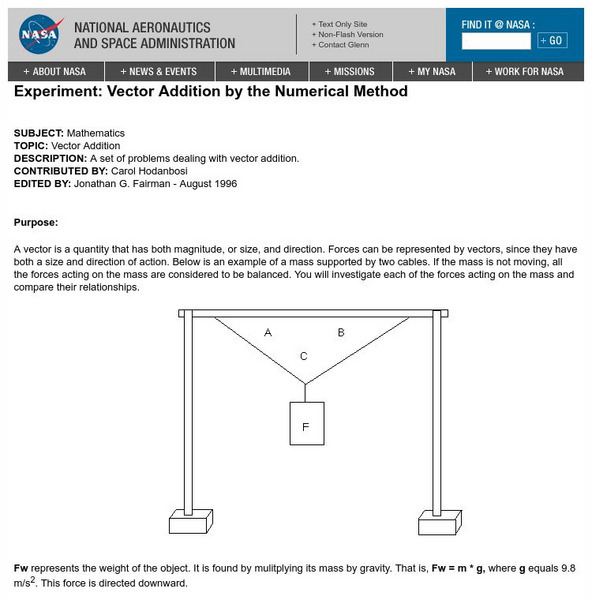
Nasa: Vector Addition by the Numerical Method
A lab experiment involving readily available materials. Students analyze three forces acting upon one point to determine the resultant force. Questions and accompanying answers are provided.
Physics Classroom
The Physics Classroom: Vectors and Projectiles: Vector Addition Interactive
Explore adding vectors by dragging objects on a canvas. Adding vectors can be easy with this Vector Guessing Game Interactive. Students can improve their understanding and skill at adding vectors using the head-to-tail method.
Physics Classroom
The Physics Classroom: Motion and Forces in Two Dimensions: Vectors/direction
The emphasis of this unit is to understand some fundamentals about vectors, and to apply the fundamentals in order to understand motion and forces that occur in two dimensions.
Physics Classroom
The Physics Classroom: Motion and Forces in Two Dimensions: Vector Components
Students examine examples of vectors that are directed in two dimensions- upward and rightward, northward and westward, eastward and southward, etc.
Physics Classroom
The Physics Classroom: Motion and Forces in Two Dimensions: Vector Resolution
In this unit, students learn two basic methods for determining the magnitudes of the components of a vector directed in two dimensions. The two methods of vector resolution students will examine are the parallelogram method the...
Physics Classroom
The Physics Classroom: Motion/forces in Two Dimensions: Perpendicular Components
This physics tutorial provides students illustrated examples and interactive practice problems containing perpendicular components of motion.
Physics Classroom
The Physics Classroom: Motion and Forces in Two Dimensions: Component Addition
In this physics tutorial, students learn how to approach more complex vector addition situations by combining the concept of vector components and the principles of vector resolution with the use of the Pythagorean theorem.
Physics Classroom
The Physics Classroom: Vectors and Projectiles: Name That Vector Interactive
Try these vector addition challenges where twenty-five vectors are displayed on a grid. Each challenge involves adding three of the vectors together to determine the resultant. The emphasis of the activity is on component addition.
Physics Classroom
The Physics Classroom: Vectors & Projectiles: Vector Addition: Does Order Matter
Watch this short demonstration that focuses on a single question: Does the order in which vectors are added together affect the magnitude or the direction of the resultant?
Physics Classroom
The Physics Classroom: Vectors and 2 D Motion Table of Contents
Learners explore vectors, projectile motion, and forces in two-dimension. The tutorial consists of lessons and problems to check for understanding.
Physics Classroom
The Physics Classroom: Vectors and Projectiles: Vector Guessing Game
Try this adding vector challenge. Two random vectors are displayed, and students must quickly decide on the size and direction of the resultant. The challenge is to solve as many correctly as possible in 20 seconds. Repeat, and beat your...
Physics Classroom
The Physics Classroom: Vectors: Non Horizontally Launched Projectile Problems
In this physics tutorial on vectors, the use of kinematic equations to solve non-horizontally launched projectiles is demonstrated.

Sophia Learning
Sophia: Work & Vectors
Watch this video tutorial, and find out why work is not a vector. [4:48]

Open Curriculum
Open Curriculum: Vectors and Motion
Learn more about the properties of velocity, acceleration, and force vectors in this illustrated article.