Hi, what do you want to do?






Physics Classroom
The Physics Classroom: Vectors: Forces in Two Dimensions: Addition of Forces
In this tutorial, examine the effect of forces acting at angles to the horizontal, such that the force has an influence in two dimensions- horizontally and vertically.
Physics Classroom
The Physics Classroom: Circular and Satellite Motion: Principles for Satellites
Students explore how a satellite's motion is governed by the same physics principles and described by the same mathematical equations.
Physics Classroom
The Physics Classroom: Motion and Forces in Two Dimensions: Vector Components
Students examine examples of vectors that are directed in two dimensions- upward and rightward, northward and westward, eastward and southward, etc.
Physics Classroom
The Physics Classroom: Circular and Satellite Motion: Gravity More Than a Name
This tutorial is intended for students to strengthen their understanding of gravitation and understand the nature of this force.
Other
Bscs: Bscs Science Teaching Video Library
Elementary teachers have an urgent need for high-quality science classroom videos. To respond as rapidly as possible, BSCS Science Learning has made some of our best K-12 videos available for free streaming. In this collection, you'll...
Physics Classroom
The Physics Classroom: Work, Energy, and Power: Application/practice Questions
Through illustrated examples and practice problems, students apply the relationship between work and mechanical energy change to a variety of motion scenarios in order to test our understanding.
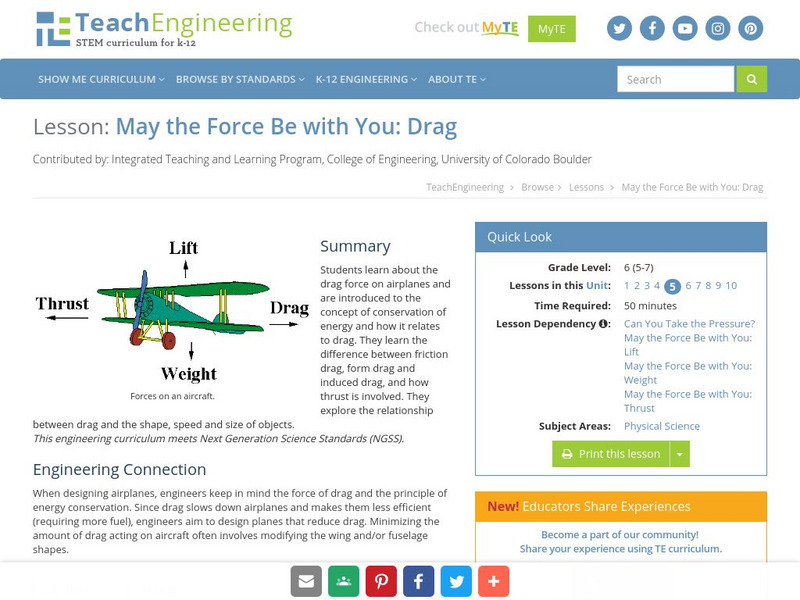
TeachEngineering
Teach Engineering: May the Force Be With You: Drag
This lesson explores the drag force on airplanes. The students will be introduced to the concept of conservation of energy and how it relates to drag. Students will explore the relationship between drag and the shape, speed and size of...
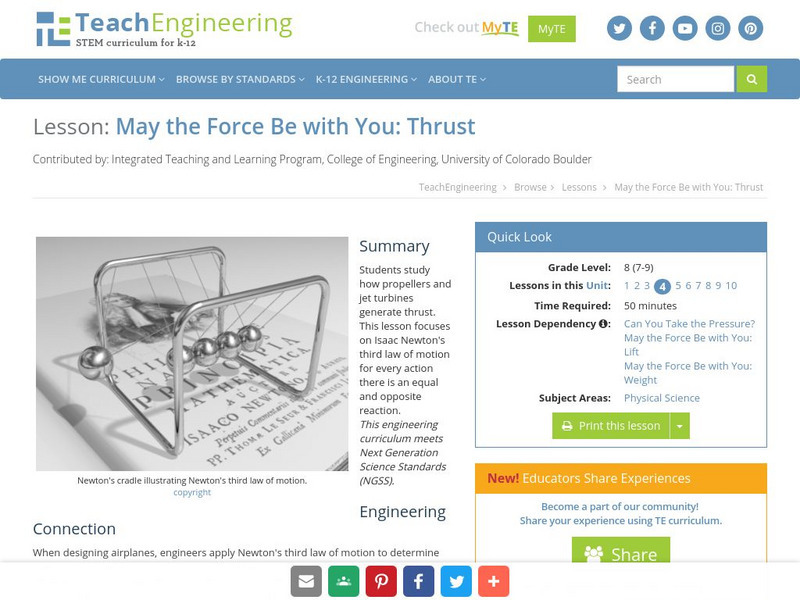
TeachEngineering
Teach Engineering: May the Force Be With You: Thrust
In this lesson plan, young scholars will study how propellers and jet turbines generate thrust. This lesson plan focuses on Isaac Newton's 3rd Law of Motion, which states that for every action there is an equal and opposite reaction.
University of California
Understanding Science: Newton's 2nd Law: Inquiry Approach Lesson
For this lesson, students develop their own scientific experiment to test Newton's hypothesis that the acceleration of an object depends on the net force acting upon it and its mass. After completing their designed experiment, students...
Physics Classroom
The Physics Classroom: Inertia and Mass
This is part of a lesson on Newton's Laws of Motion that focuses on inertia and mass. It restates Newton's first law of motion. The lesson also gives a helpful visual description concerning friction.
BBC
Bbc: Gcse Bitesize: Forces, Acceleration and Newton's Laws Aqa
This lesson focuses on Newton's First Law: an object remains in the same state of motion unless a resultant force acts on it. If the resultant force on an object is zero, this means: a stationary object stays stationary; a moving object...
Physics Classroom
The Physics Classroom: Vectors and 2 D Motion Table of Contents
Learners explore vectors, projectile motion, and forces in two-dimension. The tutorial consists of lessons and problems to check for understanding.

Khan Academy
Khan Academy: Start: How Do Computers Simulate the Motion of Virtual Particles?
For this lesson we'll explore how we use fairly simple physics to draw particles which move according to the forces we feel in the real world (such as wind & gravity).
Science Education Resource Center at Carleton College
Serc: Investigating Projectile Motion: Creating a Catapult
This instructional activity is for 9th grade physical science learners. It begins with an inquiry-based instructional activity using a projectile motion computer simulation. It culminates with students building a catapult; applying and...
Physics Classroom
The Physics Classroom: Free Fall and Air Resistance
This lesson in high school physics on Newton's Second Law of Motion provides a discussion of free fall and air resistance, and answers, "Why do objects which encounter air resistance ultimately reach a terminal velocity?" and "In...
Sophia Learning
Sophia: Friction: Lesson 2
This lesson will introduce the concept of friction and explain how it can affect forces. It is 2 of 5 in the series titled "Friction."
Sophia Learning
Sophia: Friction: Lesson 3
This lesson will introduce the concept of friction and explain how it can affect forces. It is 3 of 5 in the series titled "Friction."
Sophia Learning
Sophia: Practice W/ Systems: Lesson 2
This lesson provides the learner with examples on how to properly define a system, when solving physics problems. It is 2 of 2 in the series titled "Practice w/ Systems."
Sophia Learning
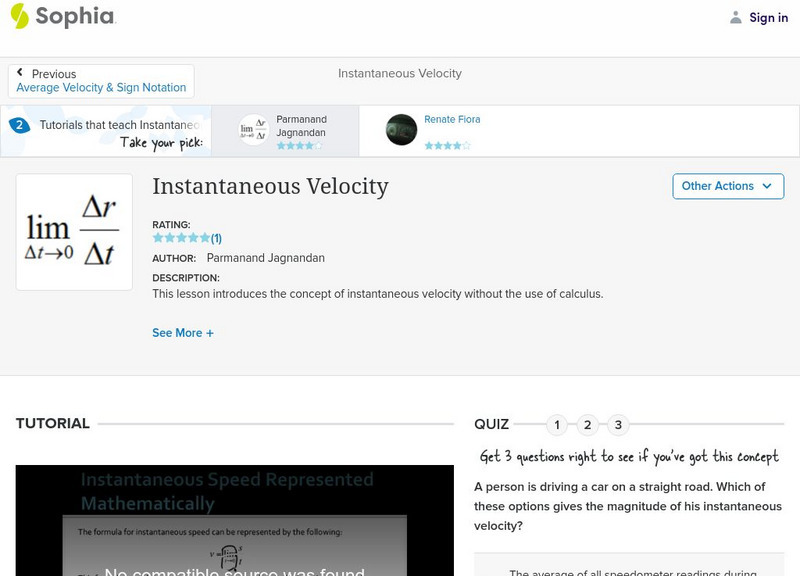
Sophia: Instantaneous Velocity: Lesson 1
This lesson introduces the concept of instantaneous velocity without the use of calculus. It is 1 of 2 in the series titled "Instantaneous Velocity."
Sophia Learning
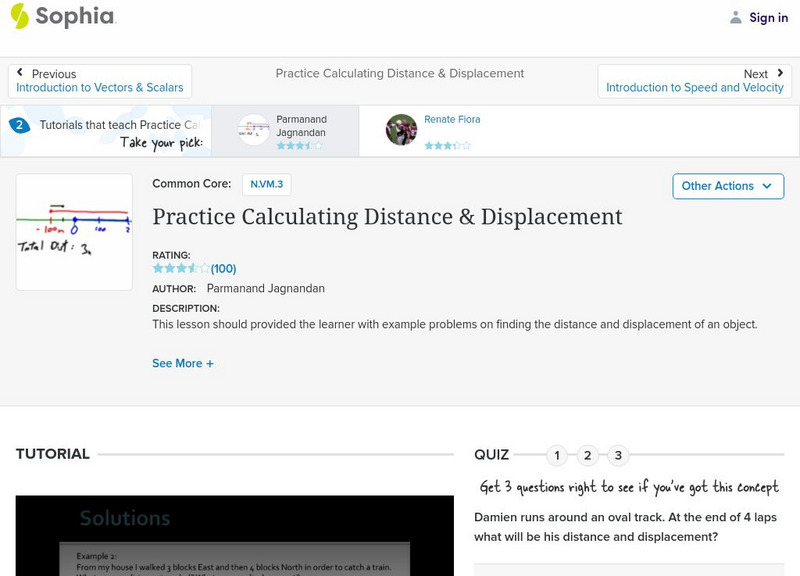
Sophia: Practice Calculating Distance & Displacement: Lesson 1
This lesson should provided the learner with example problems on finding the distance and displacement of an object. It is 1 of 2 in the series titled "Practice Calculating Distance & Displacement."
Science Education Resource Center at Carleton College
Serc: Investigation of Newtonian Forces on Plate Tectonics
An investigation for students to understand plate tectonics by using models to see how motion and forces act on the plates. Students can use these models to see the connection between Newtonian Laws to Earth materials. Lesson plan...
TeachEngineering
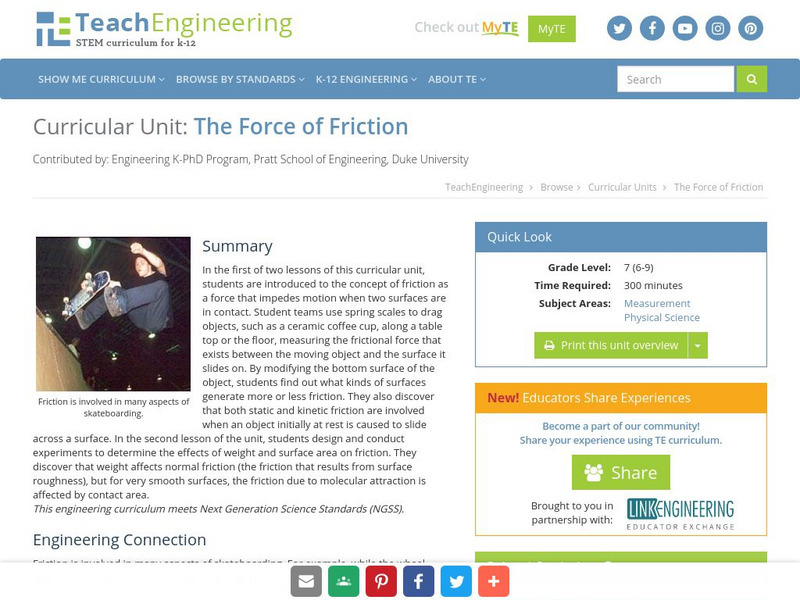
Teach Engineering: The Force of Friction
In the first of two lessons of this curricular unit, students are introduced to the concept of friction as a force that impedes motion when two surfaces are in contact. Student teams use spring scales to drag objects, such as a ceramic...
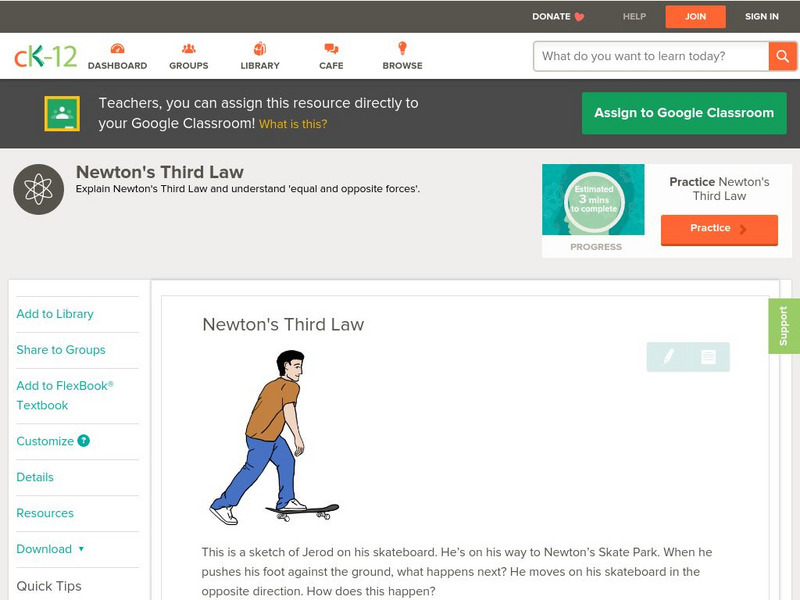
CK-12 Foundation
Ck 12: Physical Science: Newton's Third Law
[Free Registration/Login may be required to access all resource tools.] Newton's Third Law of Motion - action and reaction forces and why they are not balanced forces.
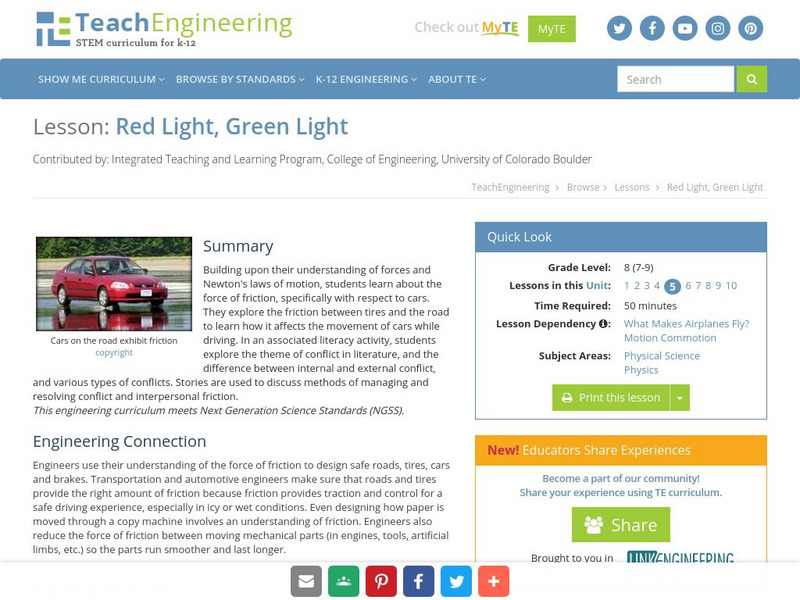
TeachEngineering
Teach Engineering: Red Light, Green Light
Building upon their understanding of forces and Newton's laws of motion, students learn about the force of friction, specifically with respect to cars. They explore the friction between tires and the road to learn how it affects the...