Hi, what do you want to do?





Sophia Learning
Sophia: Practice W/ Gravitational Force: Lesson 1
This lesson provides the learner with example problems on calculating gravitational force. It is 1 of 2 in the series titled "Practice w/ Gravitational Force."

Physics Classroom
The Physics Classroom: Newton's Second Law of Motion
Learn more about finding acceleration through the practices found in this lesson. "The process of determining the acceleration of an object demands that the mass and the net force are known." Check out this comprehensive site.
TeachEngineering
Teach Engineering: What Is Newton's Second Law?
After a review of force, types of forces, and Newton's first law, students are introduced to Newton's second law of motion: force = mass x acceleration.
Physics Classroom
The Physics Classroom: 1 D Kinematics: Ticker Tape Diagrams
Learn how to perform a ticker tape analysis as a way to analyze the motion of an object.
CK-12 Foundation
Ck 12: Physical Science: Velocity Time Graphs
[Free Registration/Login may be required to access all resource tools.] How to draw a velocity-time graph and what it represents.
Science Museum of Minnesota
Science Museum of Minnesota: Motion Machine
A lesson in which students design a machine that makes motion.
Sophia Learning
Sophia: Introduction to a System: Lesson 2
This lesson introduces the concept a systems and explains why it is important to properly define a system. It is 2 of 2 in the series titled "Introduction to a System."
Sophia Learning
Sophia: Free Body Diagram: Lesson 2
This lesson introduces the concept of the free-body diagram. It is 2 of 2 in the series titled "Free-Body Diagram."
Sophia Learning
Sophia: Introduction to a System: Lesson 1
This lesson introduces the concept a systems and explains why it is important to properly define a system. It is 1 of 2 in the series titled "Introduction to a System."
TeachEngineering
Teach Engineering: What Are Newton's Laws?
Through a series of three lessons and one activity, students are introduced to inertia, forces, and Newton's three laws of motion.
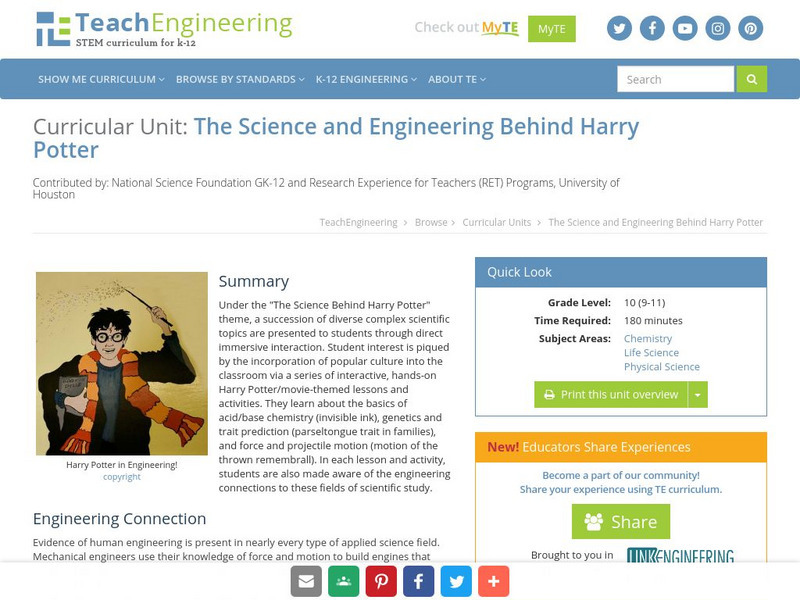
TeachEngineering
Teach Engineering: Engineering Out of Harry Situations
Under the "The Science Behind Harry Potter" theme, a succession of diverse complex scientific topics are presented to students through direct immersive interaction. Student interest is piqued by the incorporation of popular culture into...
Other
Institute of Physics: Practical Physics
Access hundreds of teacher-tested, practical physics lessons on this well-organized, illustrated site. Find just the right demonstration, attention-grabber, or lab for any physics teaching objective at your fingertips.
Other
Ward's Science: Speedy Energy
This is an interactive inquiry where students will investigate the speed of an object and the energy it exerts as it crashes into other objects. Students will understand that the more speed an object has, the more energy it has in a...
Cornell University
Cornell University: Cornell Center for Materials Research: Friction
A collection of experiments where students can learn about how friction works and affects the physical world. At the end, students design a tortoise to win by slowing it down using friction. Lesson includes explanation of the concept of...
Physics Classroom
The Physics Classroom: Circular and Satellite Motion: Centripetal Force
Through illustrated examples and practice problems, students explore the centripetal force requirement. So for an object moving in a circle, there must be an inward force acting upon it in order to cause its inward acceleration.
Physics Classroom
The Physics Classroom: Motion/forces in Two Dimensions: Perpendicular Components
This physics tutorial provides students illustrated examples and interactive practice problems containing perpendicular components of motion.
Physics Classroom
The Physics Classroom: Motion/forces in Two Dimensions: Projectile's Trajectory
This illustrated tutorial discusses the horizontal and vertical components of a projectile's motion; specific attention will be given to the presence/absence of forces, accelerations, and velocity.
Physics Classroom
The Physics Classroom: Motion and Forces in Two Dimensions: What Is a Projectile
Students apply both kinematic principles and Newton's laws of motion to understand and explain the motion of objects moving in two dimensions, more specifically, the motion of projectiles.
Physics Classroom
The Physics Classroom: Circular and Satellite Motion:circular Motion Mathematics
Using the values of speed, acceleration, and force, students explore and analyze the motion of objects in circles.
Physics Classroom
The Physics Classroom: Pendulum Motion
This tutorial investigates pendulum motion and how a variety of quantities change over the course of time. Such quantities will include forces, position, velocity and energy - both kinetic and potential energy. Take the interactive...
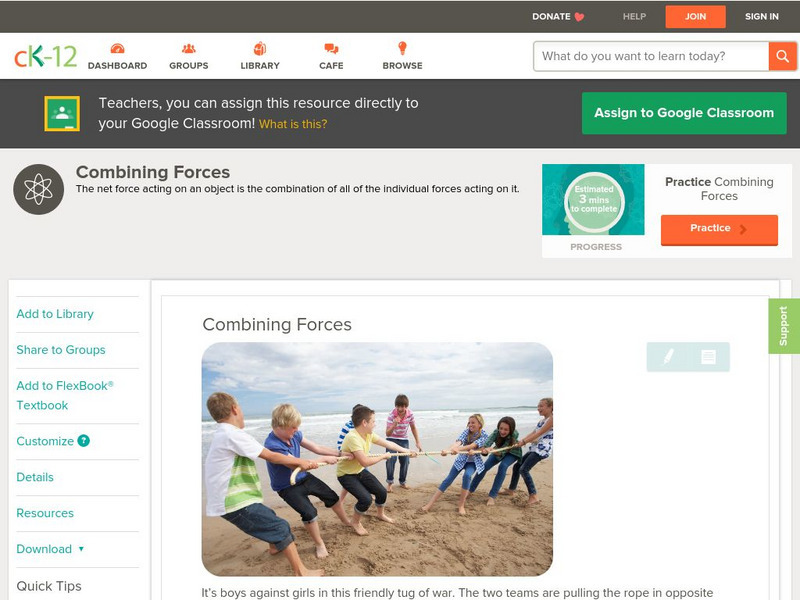
CK-12 Foundation
Ck 12: Physical Science: Combining Forces
[Free Registration/Login may be required to access all resource tools.] Featurea the definition of combining forces: Pulling down and pushing up, forces acting in opposite directions, forces acting in the same direction.
Physics Classroom
The Physics Classroom: Newton's Laws: Finding Individual Forces
Through illustrated examples and interactive practice problems, students find the value of forces acting upon objects using force equations.
Sophia Learning
Sophia: Practice With Free Body Diagrams
Need some practice drawing free-body diagrams? This slideshow lesson gives several examples of different situations and the forces that need to be shown in the free-body diagram.
Physics Classroom
The Physics Classroom: Circular and Satellite Motion: Energy in Satellites
Through interactive practice problems and illustrated examples, students explore energy relationships for satellites.