Hi, what do you want to do?






Curated OER
Measurement of the Depth of the Ocean
Students comprehend the physical properties of pressure and Boyle's Law by designing a depth gauge. They construct a capillary depth gauge and calculate the calibrated depth marks of the capillary tube. They determine the margin of error...

Curated OER
Fun with Balloons
Fifth graders design their own hot air balloon. In this science lesson, 5th graders investigate how factors like weight and sizes affect a balloon's lifting power. They also write math problems based on facts written in the...

Curated OER
Electrical motors
Students investigate and experiement with a 9-volt motor. They will use the connecting wire and battery pack to discover fans.

Curated OER
The Sun
Third graders examine basic information about the sun and its relationship to the solar system. They conduct Internet research and complete a WebQuest about the sun. Students then create a seven question true or false quiz using...

Curated OER
Wandering Wild-oats
Students observe wild-oat seeds. In this biology lesson, students watch how wild-oat seeds react to moisture and draw conclusions and make predictions.

Curated OER
On the Move
Learners see if they can get their perceptions of movement expressed in images.

Curated OER
Cosmic Ray Momentum
Learners describe how cosmic rays achieve high kinetic energy via conservation of momentum.

Curated OER
Simple Machines In Complex Machines
Students brainstorm the concept of a machine. They make lists of the characteristics that all machines share. The teacher uses questioning in order to get students to think more deeply about the subject. They create a lab to demonstrate...

Curated OER
D-Day Message from General Eisenhower to General Marshall
Students use documents in the National Archives of the United States to evaluate the effectiveness of D-Day.

Curated OER
The Unit Circle
Students relate the trigonometric functions to the coordinates of the unit circle with access to explorelearning.com. They determine the signs of trigonometric functions in each quadrant.

Curated OER
Civil Engineering: Designing Bridges
Students examine the bridges of the United States. They discuss the concept of balance. They draw their own design of a suspension bridge.

Curated OER
Looking Blue
Students participate in a research project that is exclusively using the internet. The author states that traditional labs are hard to conduct for a light lab. This one uses the internet with the intention that students can manipulate...

Curated OER
Watch It Slide!
Students work together to examine inclined planes. They create a plan to raise rocks to build pyramids. They discover the changes that occur when the angle is increased or decreased.


Curated OER
Drifting Continents
Students, through teacher-led demonstration, explore the idea of continental drift. They complete a worksheet involving the calculation of continental drift over time.

Curated OER
#22c Airplane flight #22d Airplane flight--How High? How Fast?
Students discuss the application of frames of reference to an airplane flying with a constant velocity v through the air.

Alabama Learning Exchange
Alex: Force and Motion
In this lesson, the learners will work across the curriculum using technology, business education, and mathematics. They will form a company and use the physics of force and motion to build a hovercraft. The students will use this...

Discovery Education
Discovery Education: Rules of Forces and Motion
With this hands-on activity, help students understand force, gravity, friction, and speed. Students will also learn how each of these concepts affects the another.
Better Lesson
Better Lesson: Exploring Force and Motion
Students will explore what they can do with balls, cars, marbles, and ramps and document findings in their science journals. This will engage their curiosity, allow them to make self-discoveries, and explore self-interests.

Center of Science and Industry
Cosi: Force and Motion Teacher Guide
Pick from these hands-on lessons provided by COSI to learn more about Newton's Laws of Motion.
CK-12 Foundation
Ck 12: Physical Science: Calculating Acceleration From Force and Mass
[Free Registration/Login may be required to access all resource tools.] How to calculate acceleration from force and mass, and force from mass and acceleration.
The Wonder of Science
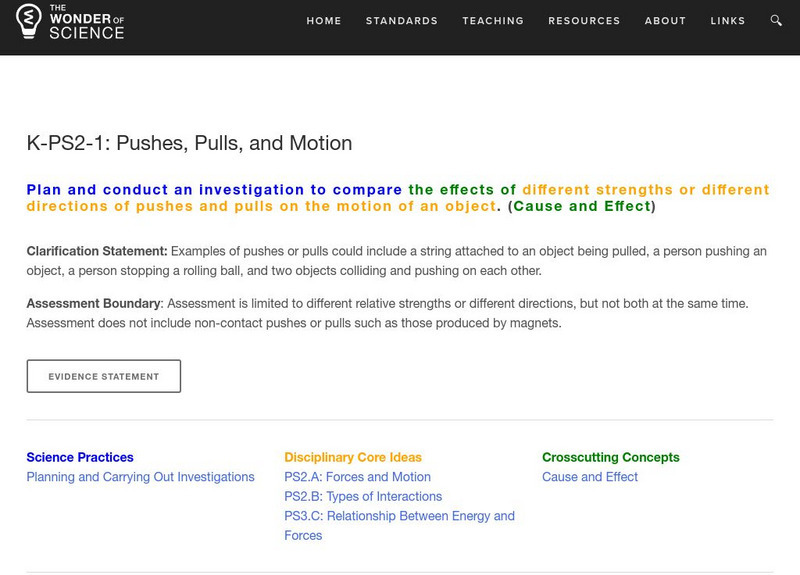
The Wonder of Science: K Ps2 1: Pushes, Pulls, and Motion
Teaching students about pushes, pulls, and motion? Use this site to plan lessons for students to conduct investigations to compare the effects on the motion of an object when pushes or pulls come from different directions or strengths.
Better Lesson
Better Lesson: Force and Motion Investigation
Conduct an investigation collaboratively on the effect of force applied on an object to produce data to serve as the basis for evidence, by using fair tests in which variables are controlled and the number of trials are considered.