Hi, what do you want to do?





Exploratorium
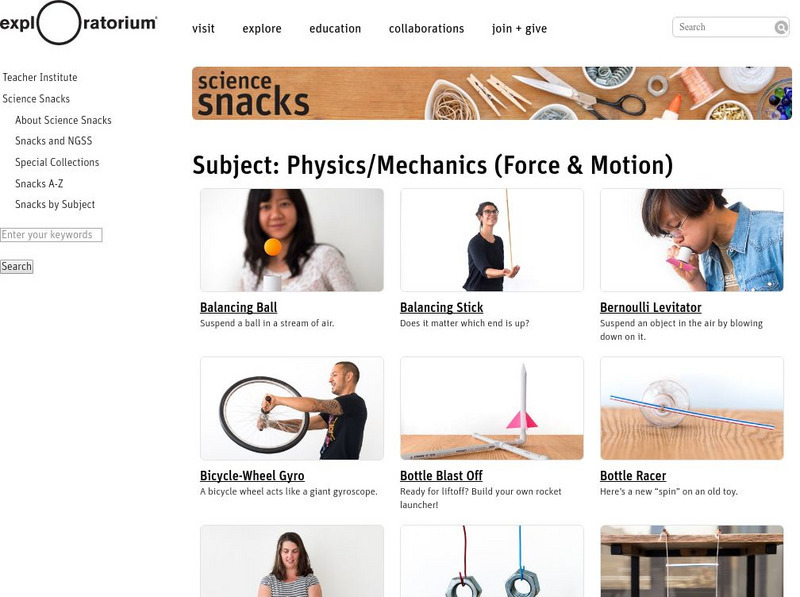
Exploratorium: Science Snacks: Physics/mechanics (Force and Motion)
A collection of mechanics activities. Many pertain to Newton's laws of motion. Step-by-step directions provided with illustrations. Great for teacher demos or student projects.

Physics Classroom
The Physics Classroom: Kinetic Energy
Kinetic energy is defined and explained--learning exercises are included to assess your understanding.
Curated OER
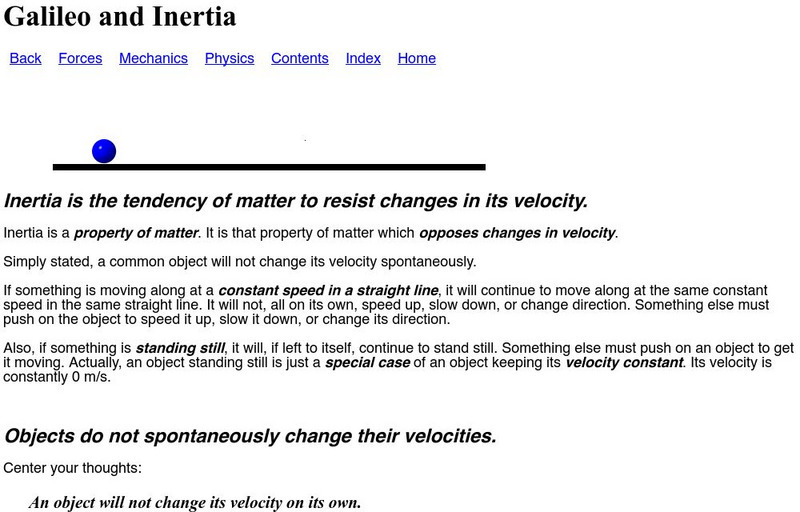
Zona Land: Galileo and Inertia
A tutorial with accompanying animations on classical mechanics. Well-illustrated. Good navigation.
Other
Ask Numbers: Measurement Conversion Calculators and Charts
What kind of unit conversion would you like to do? This site will allow you to do a multitude of conversions. Just click on the specific measurement you are needing to convert. It also provides a history of measurements and a chart of...
Texas Education Agency
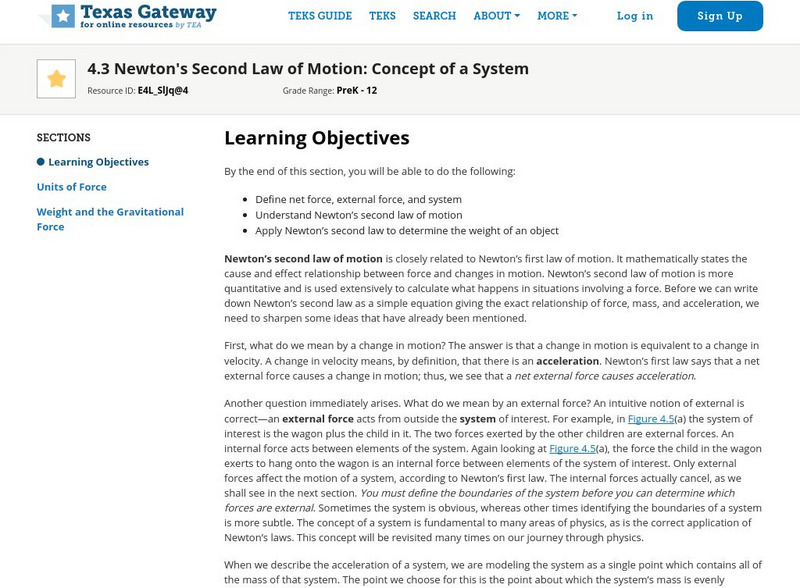
Texas Gateway: 4.3 Newton's Second Law of Motion: Concept of a System
By the end of this section, you will be able to define net force, external force, and system; understand Newton's second law of motion; and apply Newton's second law to determine the weight of an object.
CK-12 Foundation
Ck 12 Exploration Series: Simulations: Physics: Model Rocket
[Free Registration/Login Required] Learn about the relationship between position and velocity for a model rocket during launch and in free-fall. Experiment with rocket mass, rocket thrust, and rocket burn time to understand the...
University of New South Wales (Australia)
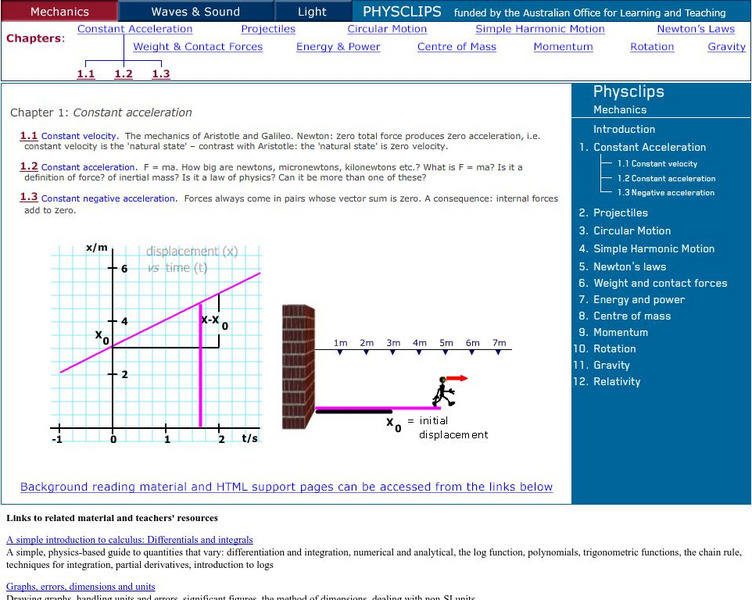
University of New South Wales: School of Physics: Physclips
Physiclips thoroughly presents mechanics concepts with animations and film clips.
TeachEngineering
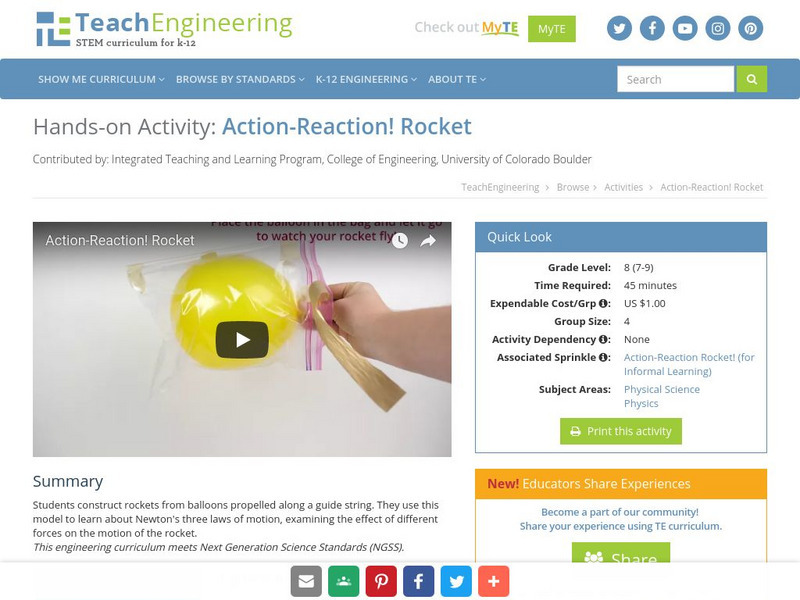
Teach Engineering: Action Reaction! Rocket
Students construct a rocket from a balloon propelled along a guide string. They use this model to learn about Newton's three laws of motion, examining the effect of different forces on the motion of the rocket.
TeachEngineering
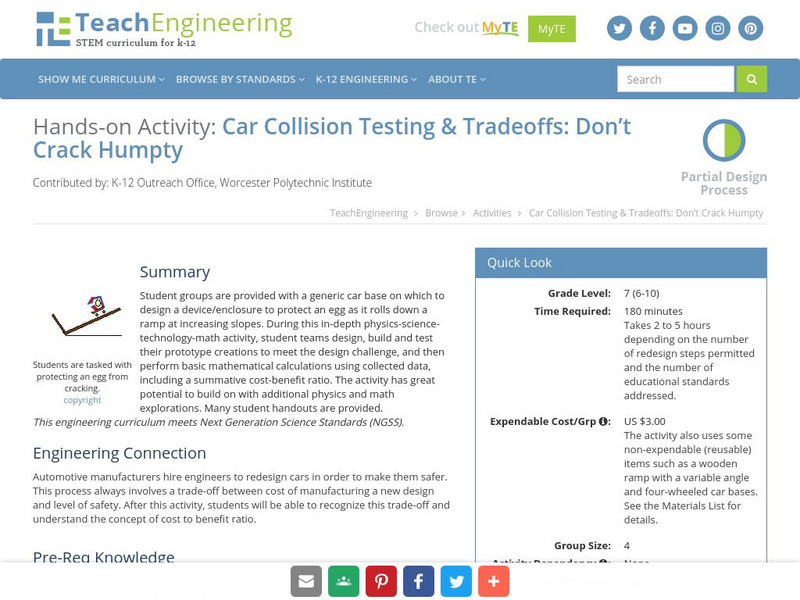
Teach Engineering: Car Collision Testing & Tradeoffs: Don't Crack Humpty
Student groups are provided with a generic car base on which to design a device/enclosure to protect an egg as it rolls down a ramp at increasing slopes. During this activity, student teams design, build and test their prototype...
Sophia Learning
Sophia: Newton's Second Law: Lesson 2
This lesson introduces Newton's Second Law and explains that force is equal to mass times acceleration. It is 2 of 3 in the series titled "Newton's Second Law."
Sophia Learning
Sophia: Newton's Second Law: Lesson 1
This lesson introduces Newton's Second Law and explains that force is equal to mass times acceleration. It is 1 of 3 in the series titled "Newton's Second Law."
Physics Aviary
Physics Aviary: Newton's Law Lab With Photogates
This lab was designed to have students investigate the factors that affect the acceleration of an object on a frictionless horizontal surface. The simulation will give the students data from two photogates which they must use to find the...
Science Education Resource Center at Carleton College
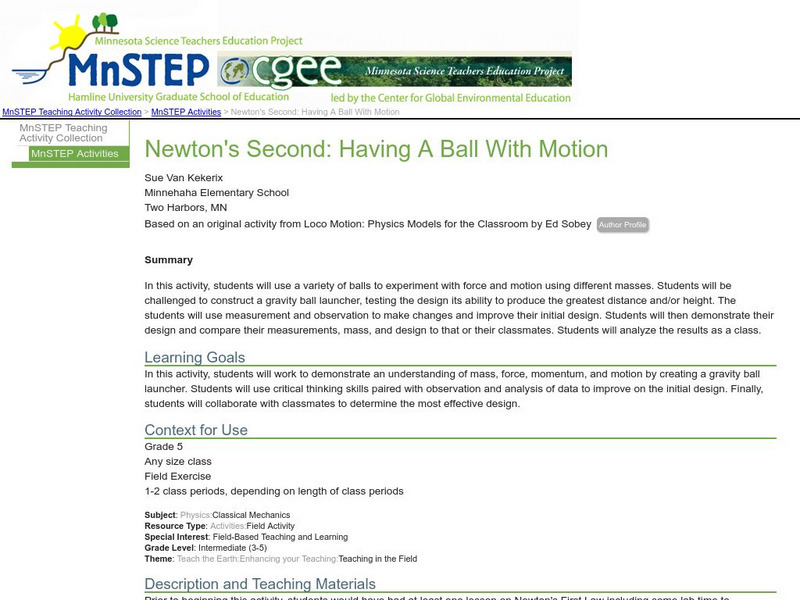
Serc: Newton's Second: Having a Ball With Motion
Students will create a gravity ball launcher to demonstrate their understanding of mass, force, momentum, and motion. The students will use critical thinking, measurement, and observation and analysis of data to make changes and improve...
Texas Instruments
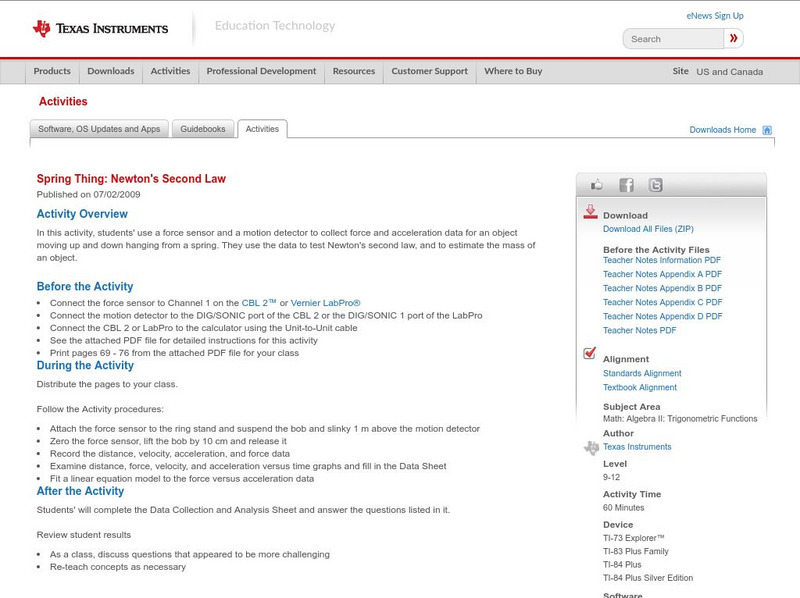
Texas Instruments: Spring Thing
This activity uses the CBL, TI-83 Plus/TI-84 Plus, force probe, and motion detector to investigate the acceleration of a mass on a spring. It also investigates Hooke's Law.
Physics Classroom
The Physics Classroom: Newtons Laws: Rocket Sledder Interactive
Experience the effect of friction, air resistance, and applied force upon a sledder. The speed, acceleration, and force values are displayed as the sled moves. Learners can vary the mass of the sledder and the size of the parachute...
Physics Classroom
The Physics Classroom: Newtons Laws: Atwoods Machine Interactive
Create an Atwood's machine and a modified Atwood's machine in this interactive. Change the amount of mass on either object, introduce friction forces, and measure distance and time in order to calculate the acceleration.
TeachEngineering
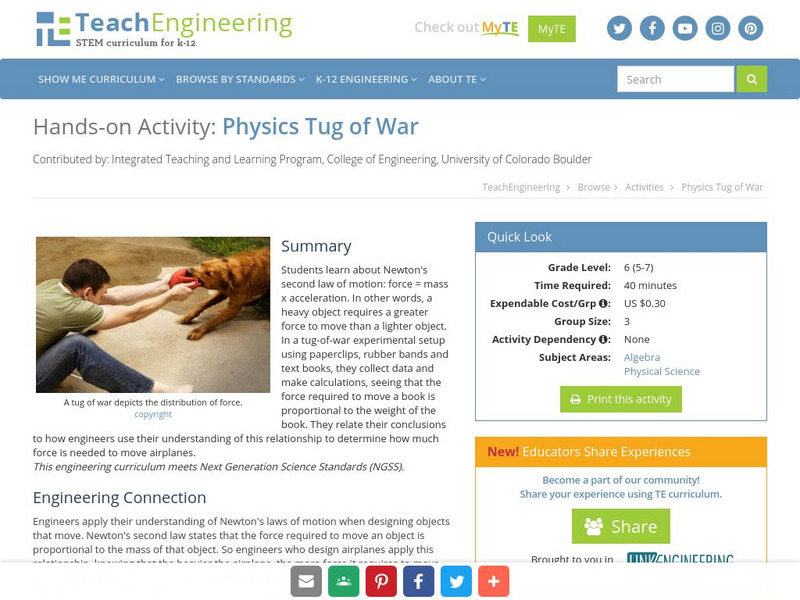
Teach Engineering: Physics Tug of War
In this activity, students will learn about Newton's 2nd Law of Motion. They will learn that the force required to move a book is proportional to the weight of the book. Engineers use this relationship to determine how much force they...

Concord Consortium
The Concord Consortium: Molecular Workbench: A Pendulum
Change the mass of a suspended object to see how its movement and forces are affected by gravity.
TeachEngineering
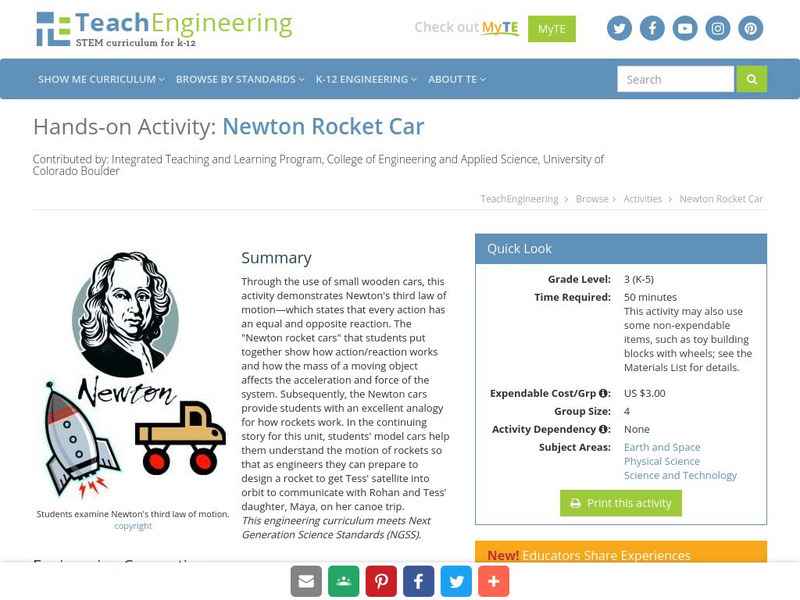
Teach Engineering: Newton Rocket Car
The purpose of this activity is to demonstrate Newton's third law of motion - which states that every action has an equal and opposite reaction - through a small wooden car. The Newton cars show how action/reaction works and how the mass...
Alabama Learning Exchange
Alex: Newton's Laws of Motion
Students use toy cars, a CBR sonic motion detector, and pennies to investigate Newton's Laws of Motion.
San Jose State University
San Jose State University: Buildings in Earthquakes [Ppt]
Explains the physics of building movement during an earthquake through a discussion of force, mass, acceleration, frequency, and period. Then looks at the factors that affect a building's resilience versus the damage it could sustain.
Science and Mathematics Initiative for Learning Enhancement (SMILE)
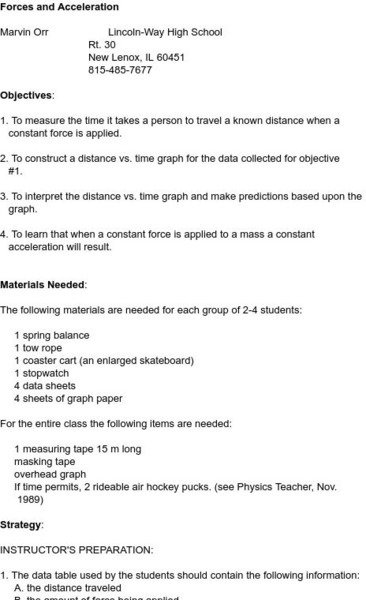
Smile: Lab Work Forces & Acceleration
The Illinois Institute of Technology provides this site. The site contains a graphing activity which illustrates that a constant force exerted upon an object results in constant acceleration. Rolling carts and stopwatches are used to...
Lawrence Berkeley National Laboratory
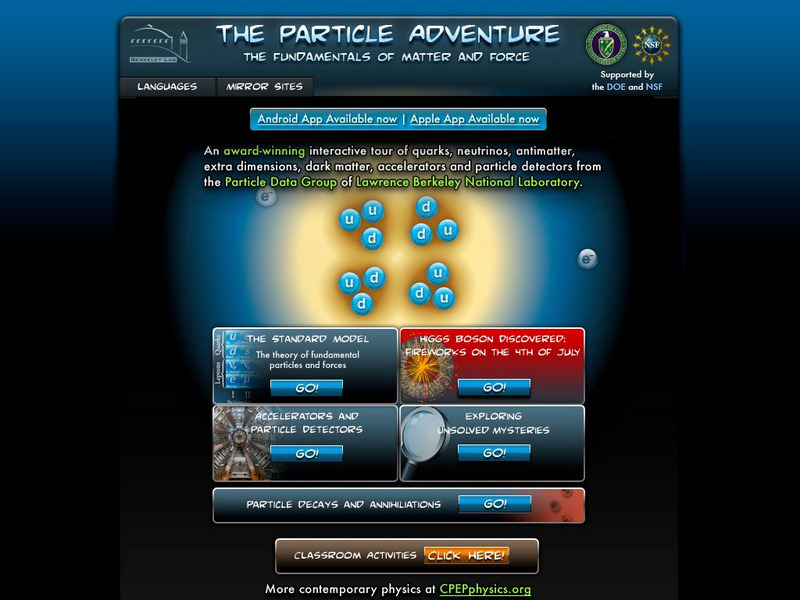
Berkeley Lab: The Particle Adventure
Visit this site for an interactive tour of the atom and all aspects of particle physics. View the animations available with almost every description on this site. A great place for the fundamentals of particles and forces including a...

University of Colorado
University of Colorado: Ph Et Interactive Simulations: My Solar System
An interactive simulation that teaches about motion, acceleration, and velocity by allowing students to build their own solar system and watch the effects of gravitational pull and how that changes with initial position, velocity, and...